
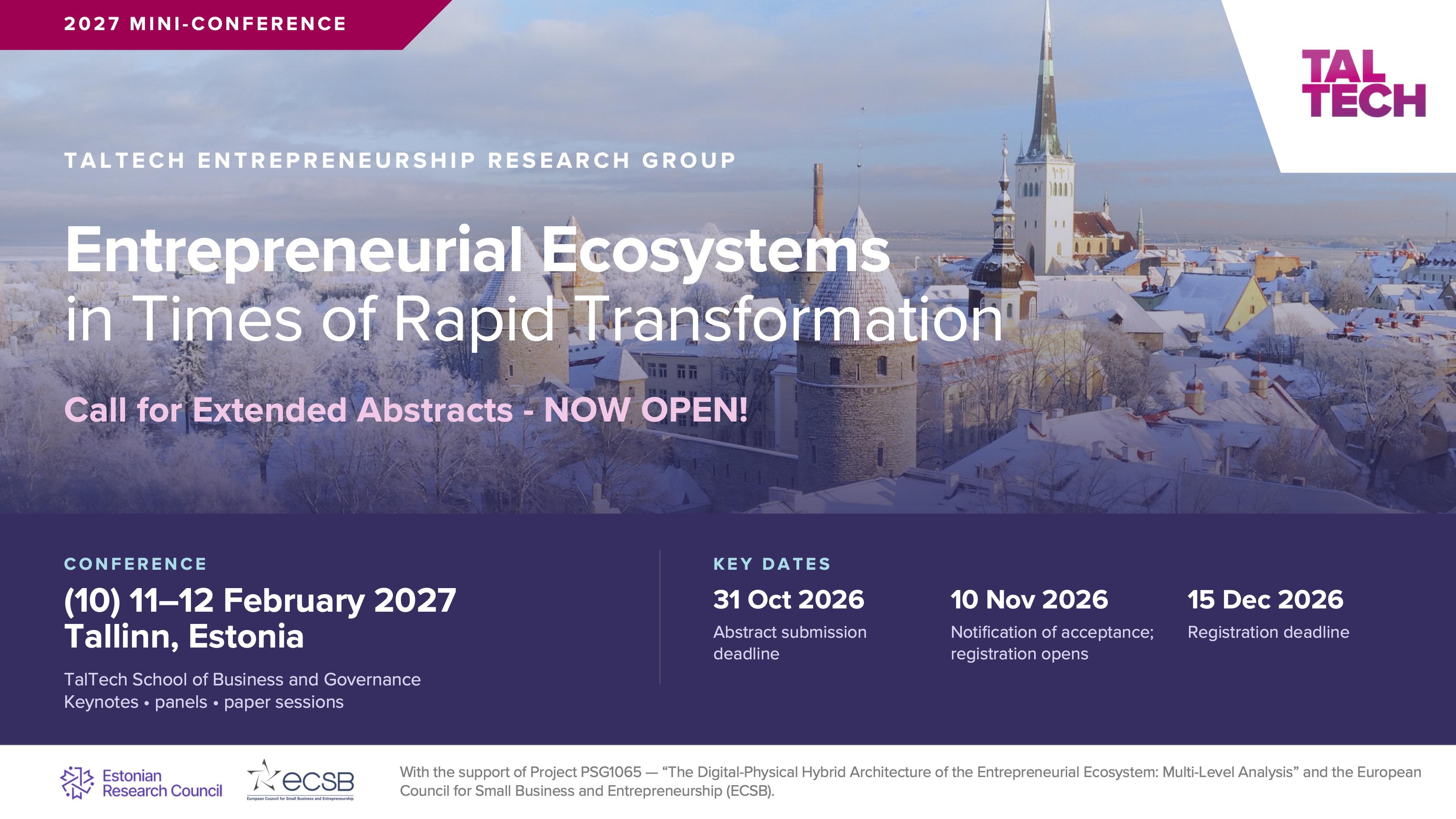
About the Conference
Entrepreneurial ecosystems are being reshaped by rapid technological, environmental, societal and geopolitical change. Digitalization and artificial intelligence are altering how entrepreneurs access resources, engage with ecosystem actors and build ventures, while sustainability pressures set new expectations for entrepreneurship and regional development. Geopolitical uncertainty, societal change and regional inequalities, in turn, raise questions about the resilience, inclusiveness and adaptability of these ecosystems.
How do ecosystem actors coordinate under changing conditions? How are resources mobilized and accessed? Who shapes or leads ecosystem transformation? And how do these processes differ across geographical and institutional contexts?
The 2027 mini-conference, hosted by the TalTech Entrepreneurship Research Group in Tallinn, brings together scholars working on these and related questions. It offers a forum for theoretical, empirical and methodological developments in entrepreneurial ecosystem research and for strengthening exchange within the international research community.
Who should submit? Established scholars and doctoral researchers alike. Work at any stage of development is welcome, provided the abstract clearly communicates the research problem, approach and potential contribution.
- Discuss theoretical, empirical and methodological advances
- Examine digital, green, societal and geopolitical transformation
- Strengthen the international entrepreneurial-ecosystem research community
Themes and Scope
The overarching theme is the transformation of entrepreneurial ecosystems. We particularly welcome research on digital, sustainability, societal and geopolitical transformations and their intersections. Relevant topics include, but are not limited to:
Digital & Hybrid Ecosystems
| Sustainability & Green Transition
| Governance, Actors & Resources
|
Place & Periphery
| Inclusion & Diversity
| Crisis, Conflict & Resilience
|
Theory & Method
|
Contributions need not focus on digitalization, sustainability or crisis. We welcome papers on entrepreneurial ecosystems more broadly, including theoretical, empirical, methodological and policy-oriented; qualitative, quantitative, mixed-method and conceptual across different levels of analysis and geographical contexts.
Submit an Extended Abstract
Authors are invited to submit an extended abstract of 500–1,000 words (references excluded). It should give reviewers enough information to understand the study and its potential contribution.
What to include
- Research problem and question — What phenomenon or problem does the study address, and why does it matter?
- Theoretical background — How is the study positioned in relation to entrepreneurial ecosystem research and relevant adjacent literature?
- Research approach — Empirical papers: research context, data and methodology. Conceptual and methodological papers: the analytical approach.
- Findings or expected insights — Preliminary findings where available, or the main arguments and insights the study is expected to develop.
- Contribution — The theoretical, empirical, methodological and/or policy contribution.
Elements may vary with the type and stage of the research.
Formatting & logistics
| Item | Copy / Status |
|---|---|
| Length | 500–1,000 words; references not counted |
| File format | Text file or Word file (see Submission Form) |
| Template | The title, the list of authors and their affiliations, the corresponding author contact information, the relevance of the research topic, methods, (expected/tentative) findings and theoretical contributions. Max. 1000 words |
| Submission portal | Google Form |
| Deadline | 14 November 2026 (extended from 31 October) |
| Notification | 10 November 2026 |
| Presentation format | Standard PPT presentation |
Timeline & Key Dates
| Milestone | Date | Status |
|---|---|---|
| Call opens | Mon, 31 August 2026 | — |
| Abstract submission deadline | Sat, 14 November 2026 (extended from 31 October) | Open |
| Notification of acceptance | Tue, 10 November 2026 | Upcoming |
| Registration opens | Tue, 10 November 2026 | Upcoming |
| Registration deadline | Tue, 15 December 2026 | Upcoming |
| Pre-conference gathering | Wed, 10 February 2027, evening | Upcoming |
| Conference days | Thu–Fri, 11–12 February 2027 | Upcoming |
Keynote Speakers

Ben Spigel
Professor
Babson College, USA
Prof. Ben Spigel is one of the leading global voices in entrepreneurial ecosystem research. His foundational work has significantly shaped how academics and policymakers understand the relational, structural, and cultural dynamics that drive regional entrepreneurial growth.
As ecosystems face rapid technological, environmental, cultural, and geopolitical shifts, his work gives us a strong starting point for the questions we want to explore together: how resources are mobilized, how actors coordinate, and what ecosystem leadership looks like in times of change.

Miruna Radu-Lefebvre
Professor
Audencia Business School, France
Prof. Miruna Radu-Lefebvre research sits at the intersection of family business, identity, and the socio-cultural embedding of entrepreneurship. Her trajectory is defined by deep, contextualized investigations into how societal expectations, generational transitions, and narrative dynamics shape entrepreneurial action and legacy across diverse environments.
She is also the Editor-in-Chief of the Entrepreneurship & Regional Development, one of the top journals in the field (AJG 3, SCImago Q1). Her work closely aligns with core conference topics, including dynamics in marginalized contexts, how entrepreneurial actors navigate crisis and adaptation, and ecosystem accessibility.
Programme Overview
Detailed schedule coming soon.
| Day | Preliminary Schedule |
|---|---|
| Wed, 10 February 2027 | Informal pre-conference gathering in the evening |
| Thu, 11 February 2027 | Keynote presentations and parallel paper sessions, followed by the conference dinner |
| Fri, 12 February 2027 | Keynote presentations, Special Issue Paper Development Workshop, parallel paper sessions and closing discussions |
Special Issue Paper Development Workshop
The conference program features a dedicated Paper Development Workshop linked to a Special Issue in Entrepreneurship & Regional Development (ERD) on "Entrepreneurial Ecosystem Leadership: Processes, Practices, and Contexts." Authors working toward this special issue will have an opportunity to apply for the workshop, where selected manuscripts will receive tailored developmental feedback. The submission process for the PDW will be explained later to the registered participants.
Fees, Organising Team & Contact
Fees
| Category | Fee |
|---|---|
| Doctoral researchers | €280 |
| Regular participants | €350 |
Registration opens 10 November 2026 and closes 15 December 2026. The participation fee includes an informal social gathering on 10 February with light snacks and drinks, a conference dinner on 11 February, as well as lunches and light snacks (coffee and pastries for breakfast and breaks between sessions) for the two conference days (11-12 February).
Visa and Registration Policy
Participants who need a visa must have an accepted abstract to attend. We are unable to offer listener registration or issue invitation letters to non-presenting participants who require a visa. If you need a visa, please submit an abstract following the submission guidelines. Your invitation letter will be issued once your abstract is accepted and your registration and payment are confirmed.
Committee
| Role | Name | Affiliation |
|---|---|---|
| Organisers | TalTech Entrepreneurship Research Group Aki Harima, Associate Professor of Entrepreneurship and Head of Unit Jaime Joel Rodriguez Santiago, Early Stage Researcher Ekaterina Demiankova, Early Stage Researcher and Lecturer Marianne Kallaste, Lecturer & Programme Director (IBA) Ruzlin Akter, Early Stage Researcher | Department of Business Administration, School of Business and Governance, Tallinn University of Technology |
Contact

Supported by

| 
|
With the support of Project PSG 1065, “The Digital-Physical Hybrid Architecture of the Entrepreneurial Ecosystem: Multi-Level Analysis”, and the European Council for Small Business and Entrepreneurship (ECSB).