
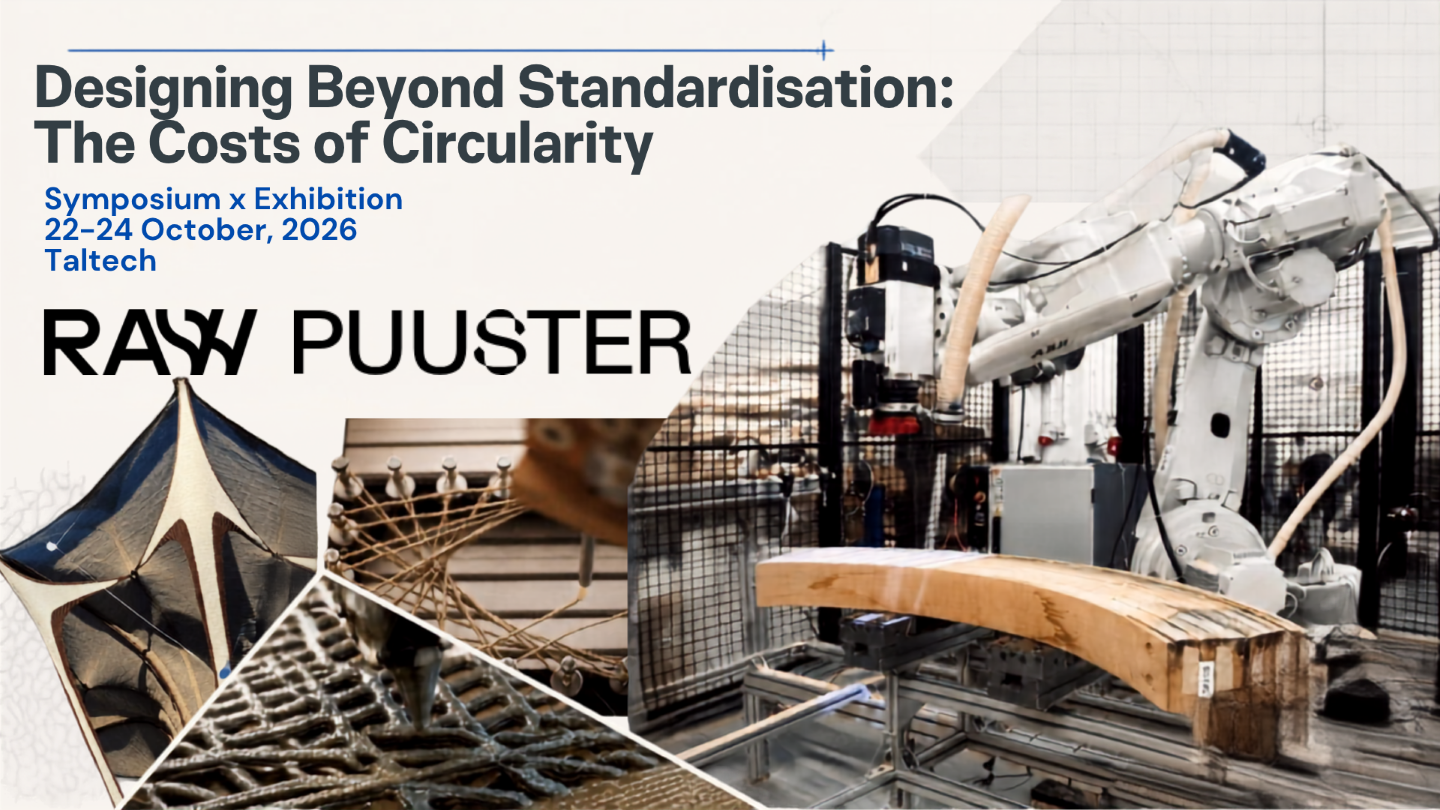
Circularity has become a central ambition in architecture, engineering, and construction. While natural and reclaimed materials are key to this transition, their variability conflicts with an industry calibrated for uniformity. The RAW project treats this difference not as a flaw to correct, but as a design vector, shifting away from grading and sorting regimes that generate waste, toward a material ecology where residue becomes the basis for new tectonic and aesthetic possibilities. Yet circularity carries trade-offs, redistributing costs across labor, expertise, and territorial systems, raising the question of which costs are worth bearing for meaningful change.
Pop-Up Exhibition (22–24 October, Main building lobby)
Prototypes from the RAW research project showing non-destructive assessment, design, and fabrication through novel digital infrastructures—examining Material and Environmental, Labor and Social, and Agricultural and Territorial costs of circularity.
Symposium (22 October, 15:00, Room TBD)
RAW researchers and the Estonian Puuster initiative exchange approaches to sourcing, transforming, and embedding non-standard materials—timber, biogenic residues, computational design—into practice, across three modules: Sourcing & Qualification, Transformation & Performance, and Embedding into Society & Economy.
Organisers: www.rawproject.eu; www.puuster.com
Programme
Welcome
How do we know what we have? Quality, quantity, and provenance.
Topics: characterising reclaimed timber variability, agricultural residues and biopolymers as feedstock; non-destructive testing for bark beetle–damaged timber, engineered wood from non-standard streams.
Discussion: What does "good enough" mean for circular sourcing — and who sets the threshold?
What can we make from imperfect material?
Topics: robotic fabrication with variable inputs, biopolymer processing into architectural components; timber densification and hydrophobic coatings, circular design typologies.
Discussion: How much processing is still "circular"?
What needs to change for this to scale?
Topics: the RAW Semantic Data Model connecting environmental, structural, and economic data across the value chain; certification gaps, business models, and the path from prototype to building regulation.
Discussion: Which costs are we willing to bear, and how is responsibility shared across the value chain?
Drinks & Networking
Interested? Register here for the symposium:
RAW Symposium - Designing Beyond Standardisation: The Cost of Circularity – Fill in form