
Ehitusmaavarad ja mineraalsed jäätmed:
kestliku kaevandamise ning ringse väärindamise võimalused Eestis (TEM-TA143)

About the project (Construction minerals and mineral waste)
Forecasts indicate an increasing need for construction raw materials, but at the same time, there is growing pressure to reduce the environmental and social impacts of mining. Regionally, a shortage of construction raw materials is emerging, and various waste materials are awaiting recycling. The project's objectives are to find new solutions for more sustainable mining of construction minerals, optimise the processing methods, explore various uses for secondary raw materials and contribute to the development of alternative construction materials based on local resources.
The project is based on a cross-sectoral approach and close collaboration with professional associations and companies. The expected outcomes are a more sustainable and resource-efficient mining sector, implementing ESG principles, diminishing construction and demolition waste via circular usage of secondary raw materials, and ensuring academic development in the field.
Project Events
Estonian Mining Industry at a Crossroads: Key Findings from an open survey amongst Estonia’s resource producers
Introduction
Like the rest of the world, Estonia faces a challenging transition in its industry. The traditional oil shale industry faces headwinds from many sides. But also, the extraction of industrial minerals and construction materials is not without challenges. These challenges are related to regulatory issues, environmental impact, social license to operate (SLO), as well as to economic factors like market saturation, product quality, and revenue streams, or technical aspects like aging equipment.
We sought to understand how exactly the situation looks in the eyes of the industry and moreover, what are the adaptations and coping strategies. Therefore, we asked our industry network for its views on the future and academic collaboration to understand how we, as a university, can improve to fit thos needs.
A key point of our survey was the extensive use of open questions. Those are free-text fields with little guidance. This encourages participants to write down what their immediate thoughts are, rather than picking items from a given list. Our aim was to find out what is pressing on the industry's mind.
Please note: Since the survey is an open survey, single answers can be attributed to multiple topics and attitudes. Also, respondents can belong to multiple sectors. As a result, answers do not sum up perfectly — just like in the real world. For example, a respondent can simultaneously mine oil shale, aggregates, and conduct research. They can also address multiple problems at the same time.
Survey participants
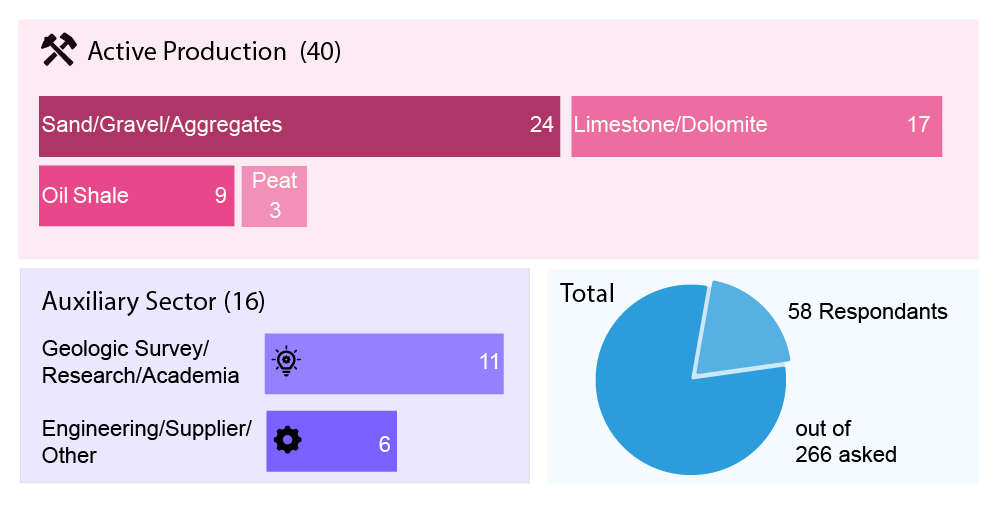
The survey received a total of 58 responses out of approximately 266 invitations, reflecting a notably high response rate (20%)—underscoring the importance of the issue. Respondents come from various subfields within the resource sector. The largest group is the active production segment of the resource industry, including aggregates, limestone and dolomite, oil shale, and peat. Following them is the auxiliary sector, consisting of representatives from the Estonian Geological Survey (EGT), academia and free research, but also engineering firms and suppliers.
A dire outlook within the Estonian mining industry
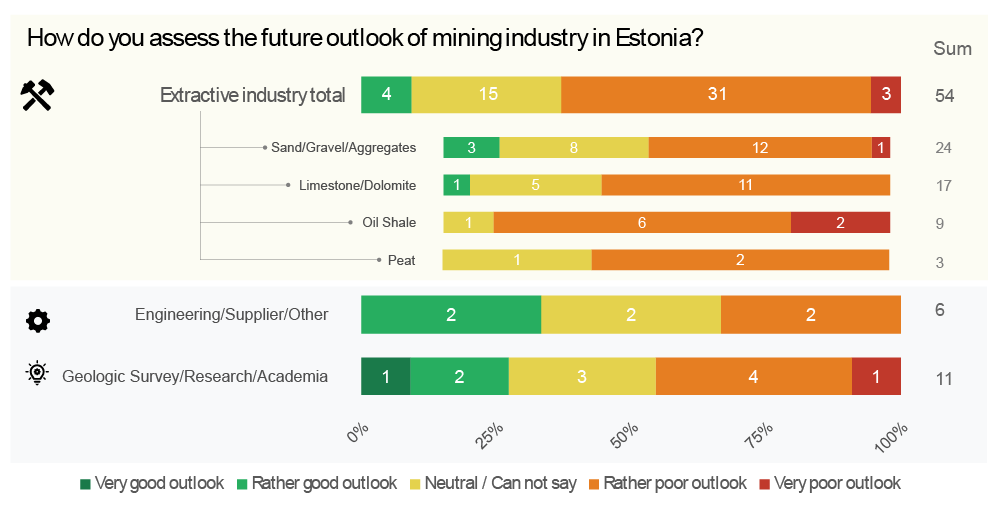
Most respondents consider the future prospects of the Estonian mining industry to be rather poor or worse. Only 4 out of 54 active resource producers state a relatively good outlook for the future. From the oil shale and peat industry, we received no positive answer.
The auxiliary field summarizes engineering firms, suppliers to the active mining industry, but also exploration, geological survey, and research. There, the outlook is rather balanced, with roughly equal proportions of answers leaning towards positive, neutral, and negative views.
Generally, the sentiment structure is rather concerning. The negative views from the peat and oil shale industries are not surprising, but the fact that construction-relevant sectors share only slightly more positive views, however, raises questions. We will shed light on the reasons for this in the following.
The main challenges for the Estonian mining industry
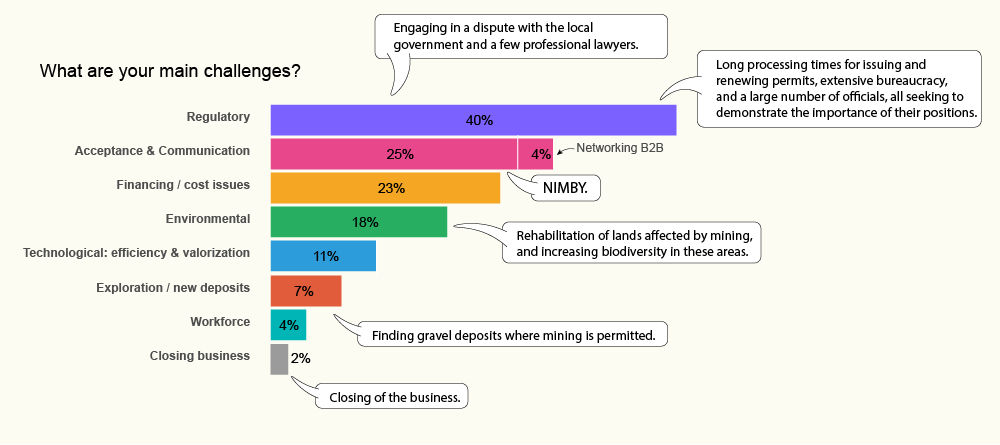
We asked participants what the main challenges they face in their operations are. Regulatory concerns stand as the major challenge, acknowledged by 40% of the respondents. The concerns of respondents are often paired with mentions of very long, delayed, and unclear permitting procedures, increasing environmental requirements, but also with high public opposition. Unsurprisingly, the topic of acceptance and communication follows, with 25% of all participants identifying it as an issue. The main reasons for this are NIMBY (Not In My Backyard) attitudes amongst local stakeholders and a polarised society.
A 23% share mentions financial and cost-related issues. These relate mainly to either limited demand (for construction materials in rural areas) or the ongoing phase-out of oil shale. Another matter is the high production cost.
As such, the reasons for the rather negative evaluation can be attributed to a mixture of high and complicated regulatory hurdles in conjunction with acceptance and environmental issues, along with a stagnant or contracting market and high production costs.
Addressing the challenges
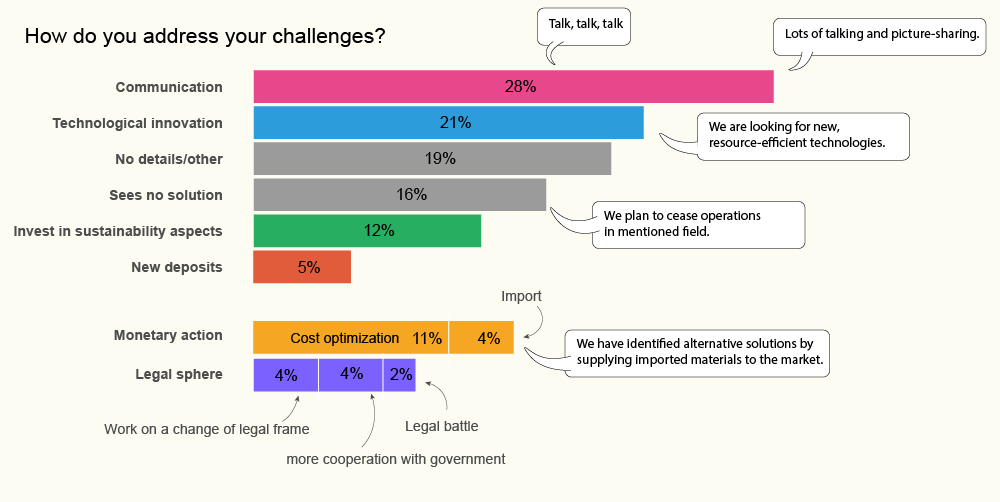
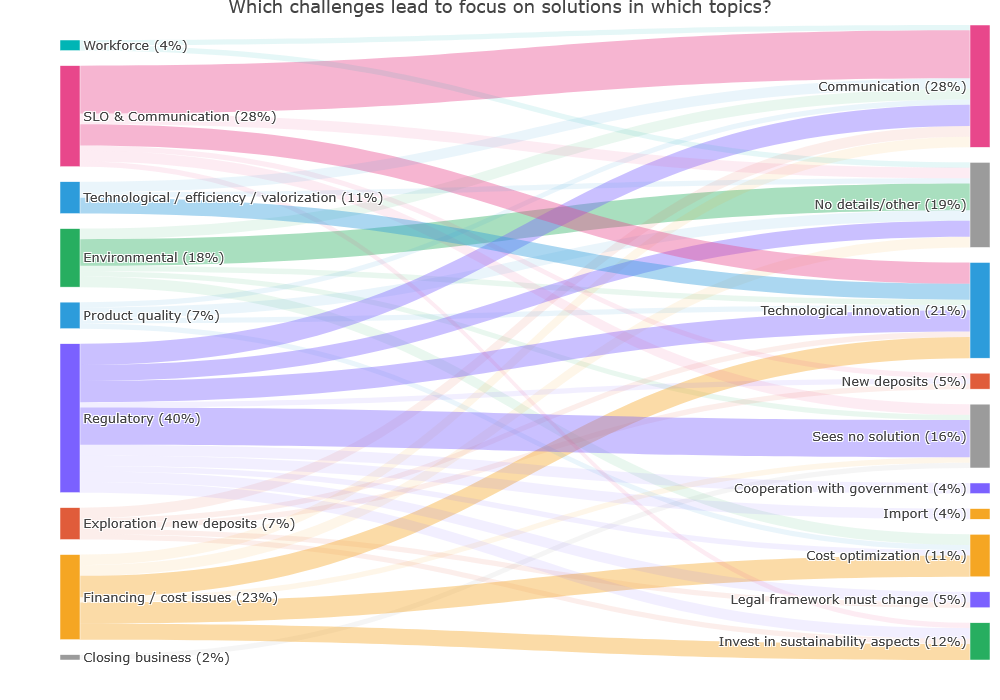
When asked how the representatives are assessing the above-mentioned challenges, most focus on improving communication with stakeholders. This is followed by efforts in technological innovation — mainly to increase efficiency or reduce environmental impact. A considerable number of respondents either did not give concrete details or stated that they see no solution in the current situation. Unsurprisingly, these respondents largely show of a negative view on the future.
Interesting are the details of efforts in the legal sphere aimed at addressing the permitting issues. However, how respondents take action in the legal sphere varies greatly: some respondents seek closer collaboration with regulators, while others argue that the legislative framework must change. At times direct legal confrontation is also an option.
The following diagram shows how the answers between challenges and solution approaches are connected. Only the strongest connections are highlighted. Half of the companies that mention regulatory challenges either do not provide solutions or do not state further details, whereas the other half focuses on communication initiatives and technological innovation. As expected, communication issues lead to efforts in more effective communication. Financing issues prompt technological innovation, cost optimization, and investments in sustainability and environmental solutions.
The concern here stems from the relative passivity of those facing regulatory pressure, highlighting the perceived criticality of the issue.
Future development direction
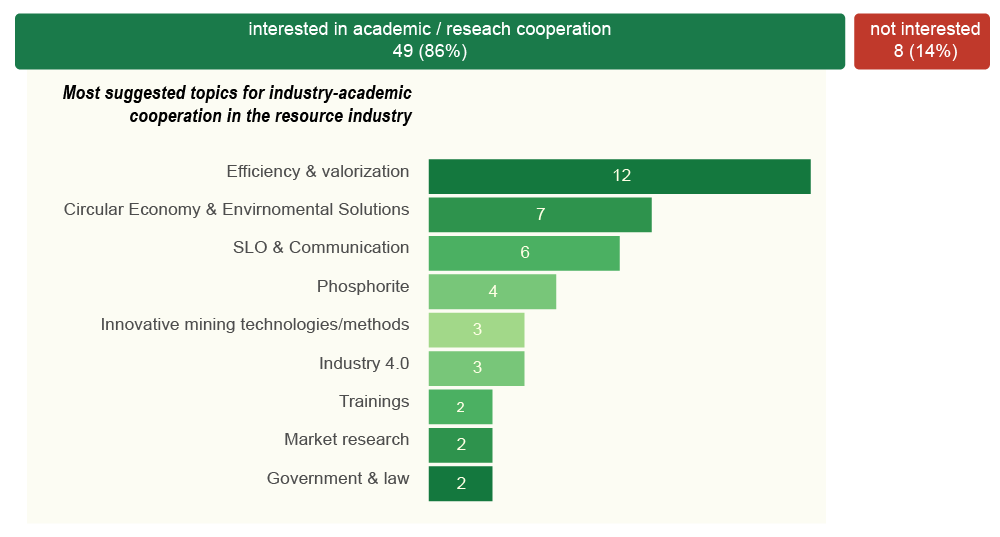
Regarding academic cooperation, over 80% of respondents expressed interest. The subjects understandably follow the problems already stated.
Most respondents suggest research and development in the direction of efficiency and valorisation, followed by environmental solutions or social license to operate & communication. That efficiency and valorisation work is ranked top because such solutions address economic and sustainability challenges, as well as acceptance and permitting issues, simultaneously. Further research, especially on the feasibility of the actual extraction concepts of mining Estonia's phosphorite deposits, is also suggested. Interestingly, these suggestions also come from entities that are not directly related to this subject (e.g., construction material producers). What stands out is that a low number of respondents indicate research in the field of government & law, given that this is one of the main concerns of the industry. It aligns with previous learnings of a perceived helplessness in this subject.
Summary
Estonia’s mining industry is currently at a pivotal moment. This survey, with a focus on the active extractive, paints a picture of a sector grappling with uncertainty and searching for new pathways. Most active resource producers expect poor or worsening prospects, with oil shale and peat operators showing no positive outlook at all.
The survey reveals a clear hierarchy of challenges. Regulatory pressure tops the list—slow, unclear permitting processes and ever stricter environmental requirements have become considerable hurdles. This comes in conjunction with public opposition and communication difficulties, including NIMBY sentiments and polarized societal views on mining. Financial strain, rising production costs, and shrinking markets amplify the pressure.
However, ways out of the crisis are also laid out: many companies highlight strengthening communication and innovating technologically to boost efficiency or reduce impact, and — where necessary — seeking change in the legal landscape.
Estonia's academic sector is positively stated as a possible partner to support mainly technological developments, but also to bring more insights into societal and communication topics. This is precisely what the Division of Mining and Mineral Technology — as Estonia’s only academic institution dedicated to the extractive industry — does.