
Researchers at Tallinn University of Technology and their colleagues in Italy have developed a method for synthesising sugar-based molecules using electric current. Their work makes a reaction used in the synthesis of antibiotics and anticancer drugs faster and more efficient.

Sugars are best known as a source of energy, but their roles in the body are far more diverse. Sugar moieties also form part of many biologically active molecules and can influence their solubility and binding to other molecules. This makes them relevant to drug development: modifying the sugar component can alter the properties of the entire compound.
In chemistry, the term “sugar” covers a wide range of compounds with different structures. Their precise structure matters, as molecules with similar compositions but different three-dimensional arrangements can behave differently in the body. Producing the desired compound therefore requires careful control of the reaction.
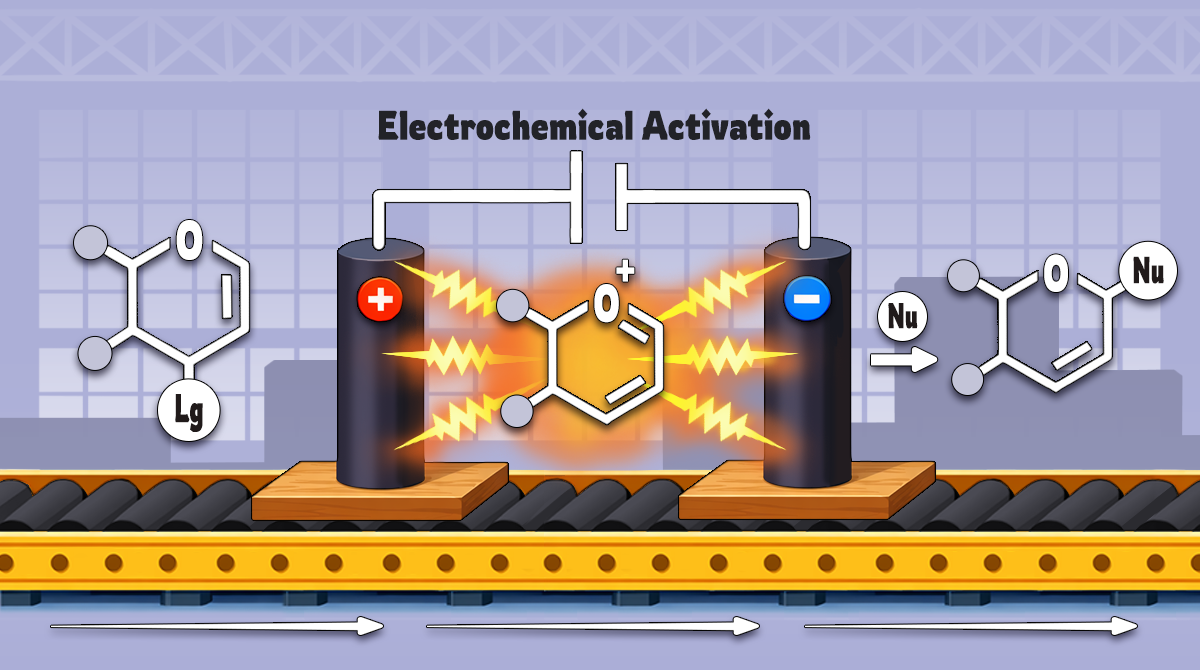
One method used to synthesise sugar-based molecules is the Ferrier rearrangement. This reaction modifies the structure of a sugar-derived molecule and attaches another molecular component to it. The resulting compounds can be used in subsequent synthetic steps. These structural units are important in many bioactive compounds, including antibiotics and anticancer drugs.
Electric current replaces chemical oxidants
The Ferrier rearrangement traditionally uses strong acids or hazardous oxidants. These help activate the starting material for the reaction but generate environmentally harmful waste.
Researchers from the Synthetic Flow Chemistry Research Group at the Department of Chemistry and Biotechnology, together with colleagues from the University of Rome Tor Vergata proposed an innovative approach combining electric current with a flow reactor. In flow operation, reagents pass continuously through the reactor, where the electrochemical reaction takes place.
Compared with the conventional batch method, in which a single batch is processed in a reaction vessel, this approach enables better control of the reaction, reduces energy consumption and significantly speeds up the process. Using electric current eliminates the need for chemical oxidants and the waste associated with them. A comparison with earlier electrochemical Ferrier methods also showed that less material was needed to produce the same amount of product.
According to Professor Maksim Ošeka, head of the research group, the team’s work brings the method closer to industrial application.
“Earlier methods developed by other research groups were important scientific breakthroughs, but their industrial application was limited by complex equipment, low productivity or the use of hazardous reagents. Our aim was to make the reaction practical, and we developed a simple and efficient solution to achieve this,” he said.
A reaction in under 20 seconds
One of the new method’s most striking features is its speed: the reaction can take place in less than 20 seconds. This also enables exceptionally high productivity: the system can produce compounds on a gram scale in continuous flow at a rate of more than 10 mmol per hour. This demonstrates considerable potential for industrial application, where cost-effectiveness and scalability are crucial. The method is also cost-effective because it uses a simple reactor design and inexpensive graphite electrodes.
Beyond its practical advantages, the work provides new insights into the reaction mechanism. The results suggest a radical-chain mechanism in which the reaction is initiated by electrochemical oxidation and then propagates through a chain process. Understanding this mechanism can help guide further optimisation of such reactions.
The study was published in Communications Chemistry, a Nature Portfolio journal.