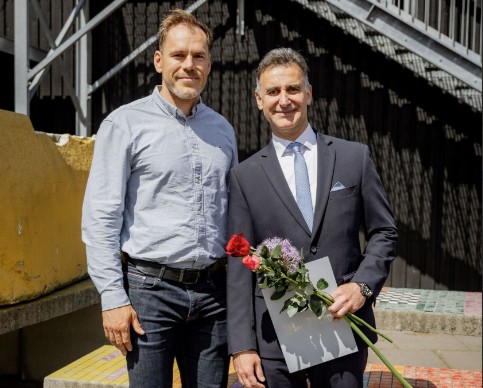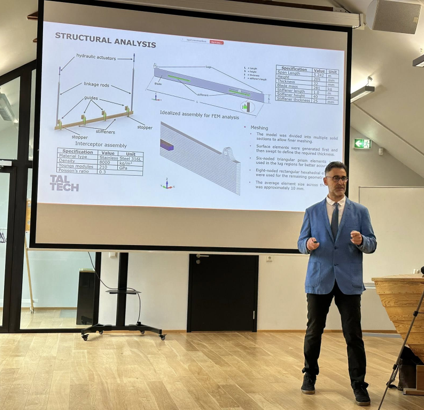
Murat defending his master study at Kuressaare college
When it comes to maritime affairs, the world is changing faster today than ever before. Ships are becoming smarter, systems more automated, and the maritime industry is searching for solutions that are at once efficient, sustainable, and technologically advanced. This means one thing the maritime sector needs people who can combine practical experience with modern engineering knowledge. The MSc in Marine Engineering at TalTech Kuressaare College was created precisely for those who want to take their knowledge to the next level. A great example of this is Murat Kilic – a cum laude graduate of the very first Marine Engineering master’s programme cohort, who began his studies in 2023 and graduated in 2025. Today, Murat continues his academic journey as a doctoral researcher at Tallinn University of Technology, focusing on intelligent control systems for autonomous ships. However, his path to research began not in academia, but in the practical world of the maritime industry.
Please introduce yourself: what programme did you complete and when did you earn your master's degree at Kuressaare College?
My name is Murat Kilic. I was born in Istanbul, Turkey, and have been living in Estonia since 1997. I completed the MSc in Marine Engineering at Kuressaare College, Tallinn University of Technology, graduating in 2025. My thesis focused on vibration analysis and design improvement of the interceptor blade of a high-speed craft, a topic directly drawn from my hands-on experience in fleet operations.
What motivated you to pursue master's studies?
With over 30 years in the maritime industry, progressing from seafarer to Chief Operating Officer, I reached a point where practical experience alone was no longer enough. Technology in the maritime sector advances rapidly, and I strongly believe that knowledge and experience must grow in parallel with those developments. I had always been passionate about the engineering side of ship’s design, construction, machinery, and the MSc in Marine Engineering was the natural next step to formalise that passion academically. It also prepared me for the future maritime careers that are on the horizon and ultimately led me to the doctoral research I am now pursuing.
Why did you choose Kuressaare College for your studies?
Having lived in Estonia since 1997, I have deep roots here, my wife is Estonian and we have raised our family here. Choosing a programme within Tallinn University of Technology felt both natural and meaningful. Kuressaare College offered an MSc in Marine Engineering that was perfectly aligned with my background as a mariner and fleet manager, and its focus on practical, applied learning suited someone like me who brings extensive industrial experience to the classroom. The quality of the programme and its strong connection to the maritime industry made it the right choice.
What was your learning experience like at Kuressaare College?
It was genuinely transformative. I came with decades of field experience but with gaps in the formal engineering theory that underpins what I had been doing in practice for years. The programme filled those gaps in a structured and rigorous way. Studying whilst working part time was demanding, but the experience was highly rewarding. The environment was focused and professional, and I felt that the college took its students seriously regardless of their stage in life or career.
Which courses or topics were the most interesting or influential for you?
The most interesting and influential topics for me were marine structures, hydrodynamics, and mechatronics and smart systems. What made these subjects particularly compelling was how naturally they connected with my existing academic background, I hold a BSc in Mechanical Engineering and an MSc in International Maritime Management, so these modules brought together the engineering principles and maritime knowledge I had built over the years and deepened them at a much higher academic level. Rather than starting from scratch, I was able to engage with the material with real context and appreciation, which made the learning experience all the richer. Murat Kilic May 13th, 2026
How would you describe the support from lecturers and supervisors?
The support was thorough and genuinely engaged. Lecturers were invested in the quality of the teaching and consistently challenged me to think rigorously. For someone coming from a largely operational background, having academics who were willing to bridge the gap between theory and practice was extremely valuable. I never felt like just a name on a register, there was a real sense of academic mentorship throughout.
In what ways did the learning environment at Kuressaare College differ from your previous experiences?
I have studied across several institutions, in Germany, the UK, and Estonia and each has had its own character. Kuressaare College felt notably intimate and applied. The maritime focus runs through the institution, which meant the environment was highly relevant to my field rather than generic. Compared to larger universities, there was a closer relationship between students and faculty, which I found conducive to deeper learning.
Was there a particularly challenging moment during your studies and how did you overcome it?
Balancing the demands of a MSc Programme alongside my professional responsibilities was undoubtedly the most challenging aspect. There were periods of considerable pressure. I managed by maintaining strict discipline around my time, setting clear priorities, and drawing on the resilience I had developed over decades of working in high-pressure maritime environments. Keeping sight of the long-term goal helped enormously.
What was the topic of your master's thesis and why did you choose it?
My thesis examined the vibration analysis and design improvement of the interceptor blade of a high-speed craft. I chose this topic because it sat at the intersection of my hands-on operational experience with high-speed crafts and the engineering theory I was developing through the programme. During my career I had encountered the practical consequences of such design challenges first-hand, and the thesis gave me the opportunity to investigate them with academic rigour and propose genuine improvements.
How did you manage to balance work, studies, and personal life?
Discipline and planning were essential. I have a long history of studying whilst working, I completed my BSc in Mechanical Engineering entirely during working hours, studying in the evenings and at weekends. My family has always been tremendously supportive, and that support made a real difference. I approached my studies the same way I approach complex projects at work: by breaking them down, setting milestones, and remaining consistent even when the workload was heavy.
What advice would you give to current or future master's students?
Be clear about what you want to do and why you want to do. A master's degree is a significant commitment, and that sense of purpose will carry you through the difficult periods. Do not be discouraged by the gap between your current knowledge and where you want to be, that gap is precisely why you are there. Engage fully with your lecturers, supervisors and fellow students, and try to connect what you are learning to real problems in your field. The richer that connection, the more you will get out of the programme. Murat Kilic May 13th, 2026
To whom would you recommend master's studies at Kuressaare College?
I would particularly recommend it to maritime professionals who have substantial practical experience and are looking to deepen their technical and academic foundations. If you are someone who has spent years working in the industry and wants to understand the engineering principles behind what you do, or to move into research, design, or more senior technical roles, this programme is an excellent fit. I would also recommend it to anyone who values a focused, industry-relevant environment over a large, impersonal institution.
How have your master's studies contributed to where you are today and what you are currently doing?
The MSc in Marine Engineering was a direct stepping stone to where I am now. I am currently pursuing a PhD at Tallinn University of Technology, researching intelligent motion control systems for Maritime Autonomous Surface Ships (MASS). Without the academic grounding provided by the programme at Kuressaare College, that transition would not have been possible. It also gave me the confidence and the credentials to pursue research at the highest level, and it has sharpened my ability to contribute meaningfully to the future of the maritime industry.
Is there anything else you would like to share that could encourage future students to apply for this programme?
I would simply say this: it is never too late, and experience is never wasted. I began this MSc with over 30 years in the maritime industry behind me, and rather than being a disadvantage, that background enriched my studies enormously. The programme respected and built upon what I already knew whilst pushing me significantly further. If you have the drive and the genuine curiosity, Kuressaare College will give you the tools to reach the next level, whatever that looks like for you.