
Gert Jervan, Dean of the School of Information Technologies at Tallinn University of Technology, was reappointed at the end of last year for a new term at a time when the technology sector is undergoing rapid and profound change. According to him, the decision to run again did not come lightly, but was the result of careful consideration of both developments in the field and his own role within them.
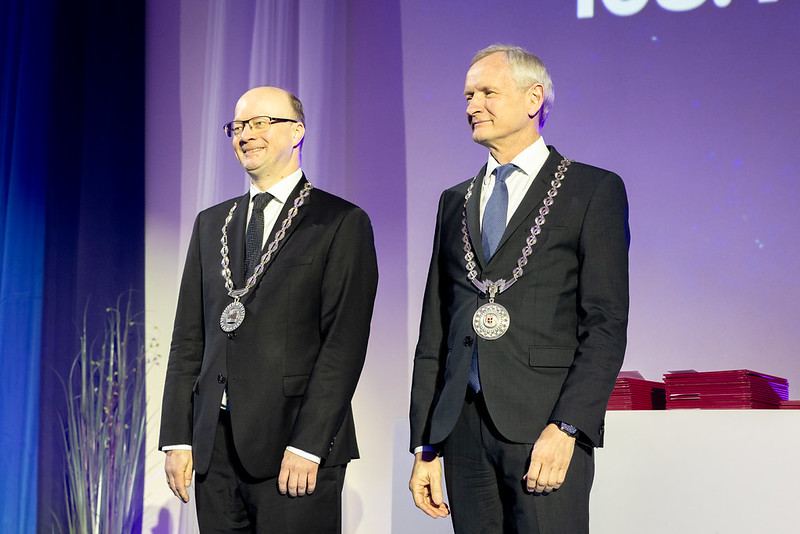
“IT has been at the center of rapid development for years, but the rise of artificial intelligence has brought about a truly transformative shift,” says Jervan. In his view, the present moment is both exceptionally exciting and highly responsible — an opportunity to lead the school during a period when technological change is having an increasingly broad impact on society.
For the new term, Jervan identifies adapting teaching and curricula to the needs of the AI era as a central goal. This entails a thorough rethinking of what is taught, how it is taught, and to whom. He also sees a growing role for reskilling and continuing education, providing opportunities for those who wish to update or expand their competencies. “Education must keep pace with global developments and support learners throughout their careers,” he emphasizes.
Changes in the field of education
In the first months, the dean plans to focus primarily on understanding the impact of artificial intelligence and engaging in discussions with national initiatives such as TI-Hüpe, Eesti.AI, and others. Additional input will come from his participation in the Ministry of Education and Research’s AI advisory council. It is essential to understand what skills — and how many specialists — society will need. These discussions cover both academic higher education and professional higher education, as well as the development of potential new curricula. This will form the basis for setting strategic goals to ensure IT education meets future needs.
According to Jervan, several initiatives must certainly continue. For example, the teaching assistant system, widely implemented at the school, has proven its value. He also considers it important to maintain the school’s strong reputation among top applicants, while at the same time expanding access to new target groups. Admission under special conditions and collaboration with various organizations help bring in motivated learners from diverse backgrounds.
This is closely linked, in Jervan’s view, to the growing importance of interdisciplinarity. IT is no longer a standalone field with applications limited to the technology sector. On the contrary, digital methods, data-driven decision-making, and AI-based solutions are shaping medicine, industry, public administration, the humanities, and creative fields. “Our graduates should be able to apply their knowledge across different sectors, not only in IT,” he notes. This reflects a broader understanding of the university’s mission: to prepare individuals who not only build systems but also understand the contexts in which they are used.
In developing research and research collaboration, the dean sees cooperation with other fields of science and international partners as crucial. In his view, the role of IT is to support other disciplines by helping them apply technology meaningfully.
International research networks provide a strong foundation for this work. They not only offer access to collaborative projects or external funding, but also enable engagement with globally relevant questions: how to build trustworthy artificial intelligence, how to ensure the sustainable development of digital infrastructure, and how to educate the next generation of engineers in a world where technological change itself has become a constant.
Jervan also sees the school playing an important role in societal debates. In his view, the university’s role is not merely to respond to external expectations, but to help shape public understanding of upcoming technological changes and the choices they entail. Through its international connections, the school can bring a broader perspective and longer time horizon into these discussions — essential for understanding not only next year’s trends but also deeper structural developments.
The importance of open dialogue and autonomy
Work culture is also a key priority for Jervan. He emphasizes that people must feel welcomed and valued, and that cooperation between institutes and research groups should be smooth. “I want to maintain an environment where employees can focus on their work, their contributions are noticed, and achievements are recognized,” he says.
In terms of staff well-being, he highlights the importance of flexibility, as well as maintaining a balance between work and private life. Academic work, he notes, does not fit within the framework of a standard workday: research, teaching, supervision, and international collaboration are intertwined in ways that require strong self-management. For this reason, leaders must recognize when dedication turns into overload and create conditions where high expectations do not lead to burnout.
When it comes to strengthening the role of students, Jervan considers open dialogue essential. Feedback on teaching, participation in councils, and involvement in student organizations all provide opportunities to contribute to better decision-making and to shape a learning environment that meets students’ needs. He encourages students to express their ideas, criticism, and proposals openly.
His message to students is straightforward: the world is changing rapidly, and intellectual flexibility has become indispensable. Curiosity, a willingness to learn continuously, and the courage to move beyond the boundaries of one’s initial field are no longer added value, but a basic necessity. Jervan recommends taking advantage of opportunities to study at other universities, experience different academic cultures, and keep both eyes and mind open.
Reflecting on his experience as dean so far, Jervan highlights the importance of autonomy as the most important lesson. “The role of a leader is to create a framework, but give people the freedom to decide and act. When responsibility and decision-making authority are balanced, strong results follow,” he says.
He draws energy and inspiration primarily from people and positive outcomes — moments when the results of work make people’s eyes light up. And if the new term were to be summed up in a single phrase, his answer is concise and telling: “The AI revolution.”