
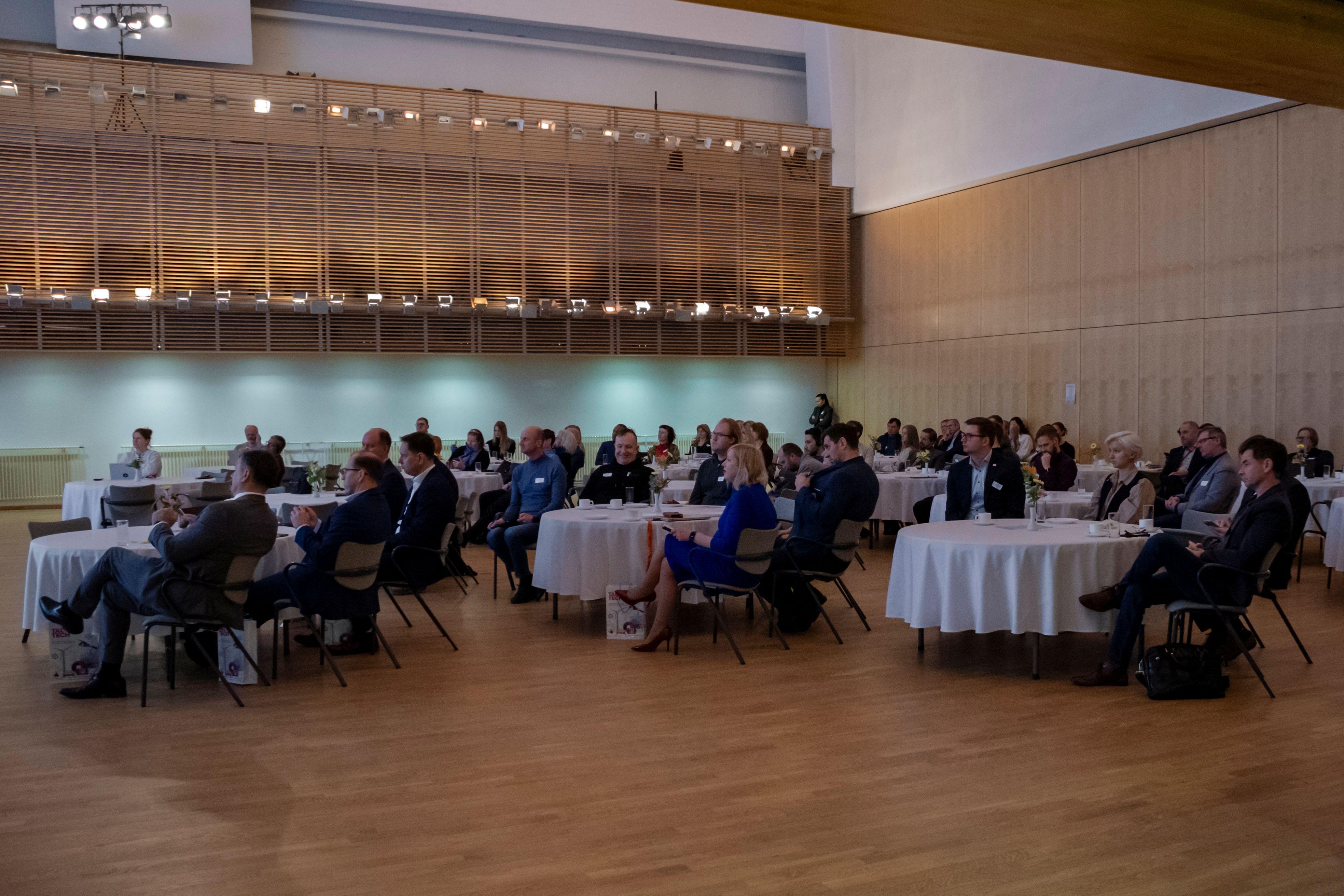
On February 11 a seminar held at TalTech focused on the role of doctoral degrees in the development of Estonia's economy and society. The central question of the seminar “Engineering + PhD = Stronger Economic Impact” was how Estonia can become a more research-intensive and prosperous society, and what role doctoral degree holders play in the process. Approximately 100 people participated in the discussion, including doctoral students, entrepreneurs and business representatives, research and development advisors, and policymakers.
Doctoral degree as part of economic growth
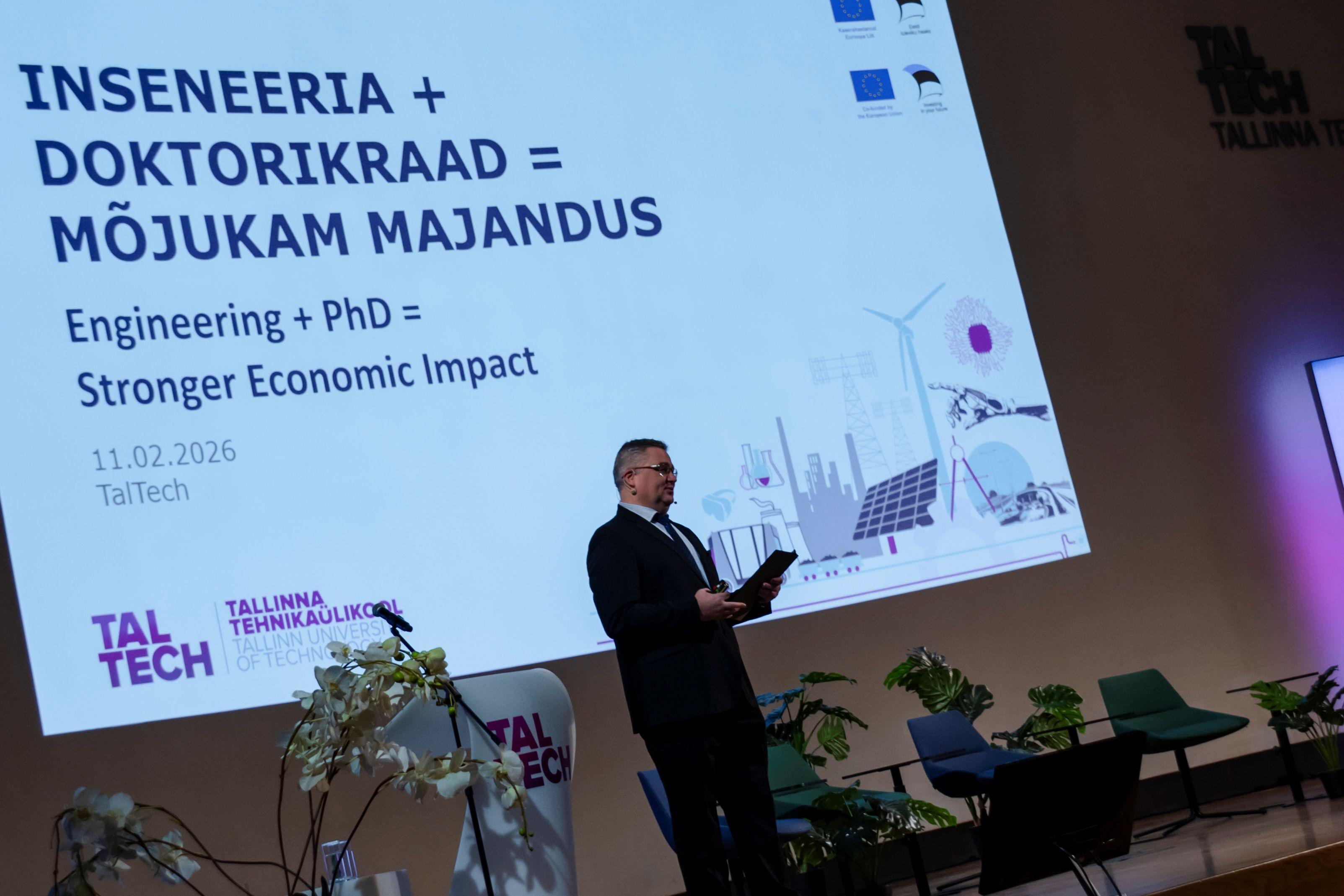
The seminar was opened by Jarek Kurnitski, Vice Rector for Research at Tallinn University of Technology, with a presentation entitled "Doctoral degrees as prerequisite for economic growth." He emphasized that a doctoral degree is not merely an academic achievement, but a strategic resource for the development for the state.
Currently, about 1% of the adult population in Estonia has a doctoral degree. The goal is to increase this figure to 1.5% by 2035. If too few doctors are trained, their impact on the economy will remain modest. At the same time, in addition to academic succession, the country also needs specialists with doctoral degree working in private companies and the public sector for successful development.
Kurnitski emphasized that the days when a doctoral thesis was a life's work are over. It is a high-level academic achievement that is increasingly practical and has a direct link to solving real-life problems.
Experience speaks for itself
At the seminar, managers and experts with doctoral degrees shared their career stories and practical experiences. Nadezda Dementjeva, CEO of Stoneridge Electronics Estonia, said that doctoral studies are primarily a journey of taking responsibility. In their daily work, managers have to make quick and often very costly decisions in situations where they do not have all the necessary information. A doctoral degree provides the tools for this – systematic thinking, the ability to break problems down into pieces, the courage to say "I don't know, but let's find out," and the discipline to analyze and reach a decision.
Marko Paavel from Tech Group AS emphasized the impact of a doctoral degree on adaptability to adjust and the creation of added value. Companies and employers are not so much interested in the degree itself, but rather in the value that a person creates for the company. At the same time, he added that a doctoral degree increases the likelihood that this value will be greater and more strategic. He encouraged future doctoral students already at the point of choosing their doctoral topic to think what benefits their work will bring to the Estonian and to a specific company's economy.
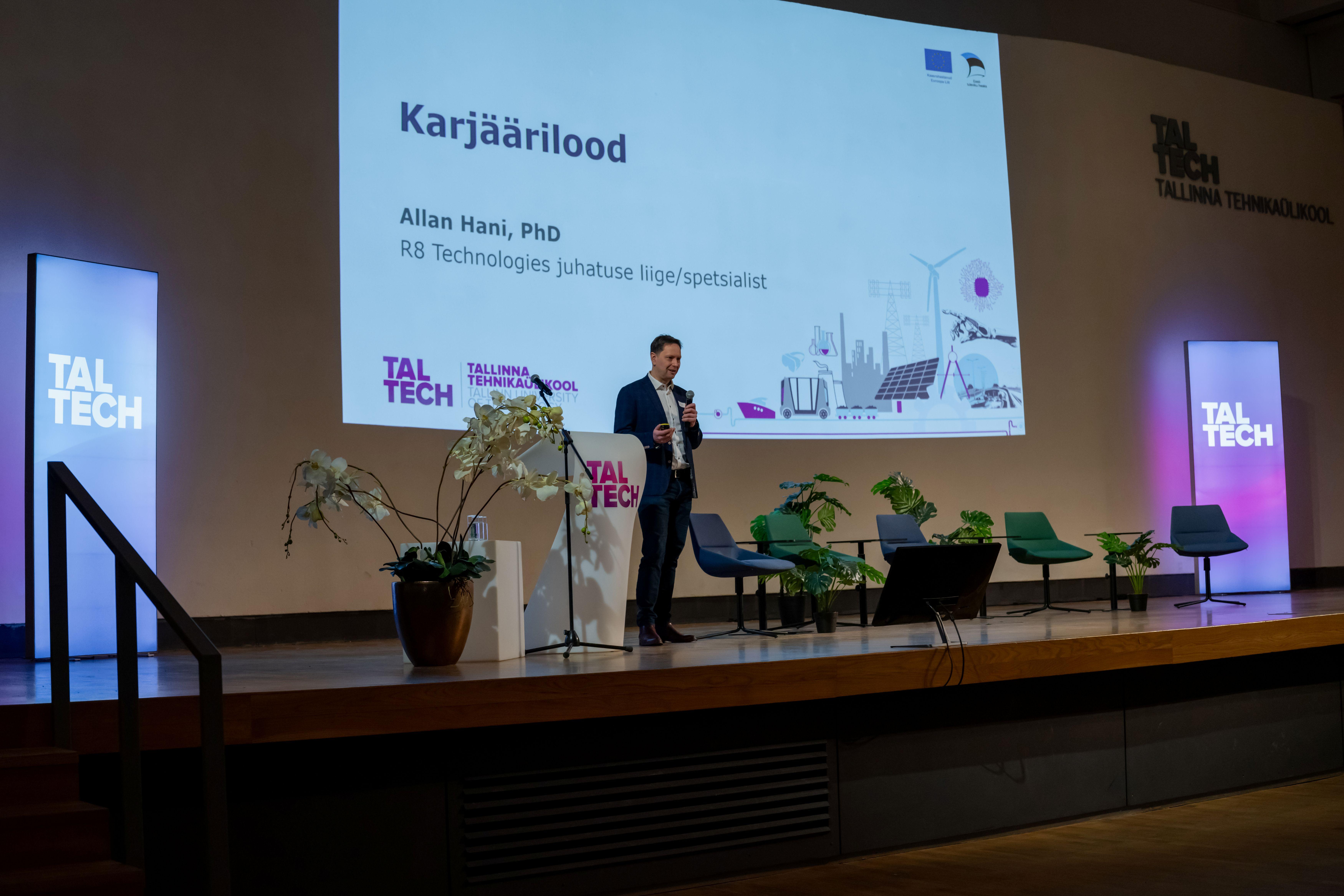
Allan Hani, from the management team of R8 Technologies, highlighted the critical thinking and depth that are developed during doctoral studies. According to him, a doctoral degree gives you the ability to analyze problems on a whole new level. This is a skill that can be successfully applied in private business.
Discussion: how to achieve a more knowledge-intensive society?
The seminar culminated in a panel discussion entitled "How Can Estonia Become a More Knowledge-Intensive and Wealthier Society?", moderated by Kirke Maar, Director of the AIRE Center.
Sigrid Rajalo, Head of the Innovation and Technology Department at the Ministry of Economic Affairs and Communications; Ragle Raudsepp, Development Manager at Eesti Energia; Mario Kadastik, Associate Professor at Tallinn University of Technology; and Argo Rosin, Vice Dean for Research at the Faculty of Engineering attended the panel.
The panel discussion concluded with a shared understanding that a doctoral degree in itself does not create wealth or innovation – value is created by the knowledge, skills, and mindset that are developed during doctoral studies and applied for the benefit of the society. It was a joint acknowledgement that a higher proportion of specialists with doctoral degrees in companies and the public sector is a prerequisite for research-based decisions, higher value-added products and services, and stronger international competitiveness.
Why is this strategically important?
A knowledge-based economy does not arise on its own. It requires people who are able to analyze complex problems, combine science and practice, and think ahead long-term. A doctoral degree develops precisely these competencies.
Economic growth does not happen by itself; it requires the interaction of various components. The university not only trains academic researchers, but also creates knowledge and skills that are transferred to businesses, industry, and the public sector. Specialists with doctoral degrees help shape innovation policy, lead technological developments, and strengthen the resilience and defense capabilities of the Estonian economy.
The seminar showed that a doctoral degree is not a separate academic stage, but an investment in Estonia's future. The question is not only how many PhDs we have, but how their knowledge and skills can be used to create value for the society in a larger scale.
The project "University Cooperation in Promoting Doctoral Studies" (2021-2027.4.04.24-0003) is co-financed by the European Union.