TalTech helps researchers grow ideas from their scientific work that can make their way into the real world - becoming products, services and collaboration projects with companies. The third activity of the ASTRA+ project focuses precisely on ensuring that research results do not remain on the shelf but find practical application.
“Until now, scientific projects have mostly assessed the technology readiness level, but in reality other aspects also need to be evaluated and developed: whether there is a customer, a team, a business model, funding and an intellectual property strategy,” explained René Jõeleht, Head of the TalTech Technology Transfer Centre. “The ASTRA+ project helps researchers think through these components, develop them further and take their results to the next level.”
Science-based entrepreneurship is becoming increasingly important for Estonia’s economic growth and competitiveness. “To grow the economy, we need companies with higher added value. One way to achieve this is by transferring research results into business,” Jõeleht added.
Science needs a team to come to life - not just a good idea
Moving from research to entrepreneurship requires far more than strong scientific results. “Researchers are experts in their field, but successful implementation requires a diverse team — for example entrepreneurs, business developers and marketers. Our role is to help bring these worlds together,” said Jõeleht.
In practice, this often means involving partners outside the university and progressing through sequential steps: first validating the customer problem and market need, followed by testing the business model and developing an intellectual property strategy. Only then can the process move on to prototyping and testing in a way that aligns with real market demand. “These activities help determine whether the technology solves a real problem that people are willing to pay for,” Jõeleht emphasised.
ASTRA+ Activity 3 supports the development of research teams
The third activity of ASTRA+ is designed to help research teams assess and increase the market readiness of their research results. Through the project, activities are funded that support both technological and business maturity - such as customer validation, prototyping, business model testing or intellectual property protection.
“If a researcher has developed a new technology within another project, the ASTRA+ development grant helps take it to the next stage and assess whether the technology has a real market and how it can be best applied,” explained Jõeleht.
These activities are closely linked to the daily work of the Technology Transfer Centre. “The closer a research result is to the market, the faster it can grow into a new spin-off company or reach a licensing agreement. Increasing innovation maturity is the key link that connects science with entrepreneurship,” he added.
First results already visible
The first round of ASTRA+ development grants has taken place, and the outcomes are promising: a total of 30 projects were submitted, 18 of which received funding. The Technology Transfer team consulted on 28 of the submissions. According to Jõeleht, this reflects growing awareness and interest among researchers in applying their results. “More and more researchers want to understand how their work could impact society and industry. This is a very positive trend.”
Spin-off creation has gained new momentum
Between 2010 and 2020, only a handful of spin-offs and licences were created at TalTech. Now, in 2025, more have been established in a single year than in the entire previous decade. The launch of ASTRA+ Activity 3 projects significantly increases the number of research initiatives ready to transition into entrepreneurship — resulting in new companies and technology licensing agreements.
One of the most notable recent examples is the creation of the spin-off C2Grid. “In autumn 2024, Professor Vladimir Kuts contacted the Technology Transfer Centre with the idea of forming a spin-off. Rector Tiit Land signed the agreement three weeks later, and by the summer of this year, the company had secured an investment from a German venture capital fund,” Jõeleht added.
International framework and systematic assessment
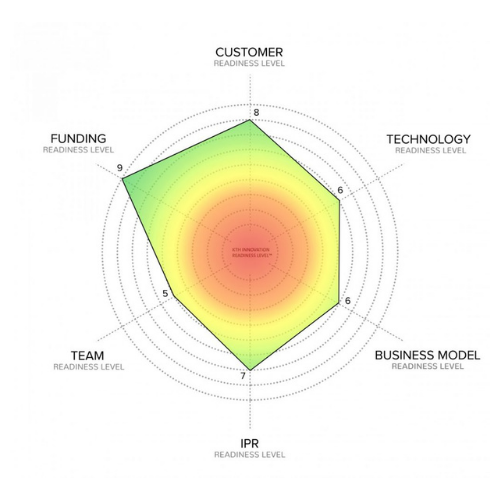
To assess innovation maturity, TalTech uses the model developed by KTH Royal Institute of Technology in Sweden.
“There are six domains, each with nine levels. For example, in the case of intellectual property, the process starts at a point where the researcher has no overview of rights, and ends at level eight, where the technology is patented, protected and functioning,” Jõeleht explained.
This framework provides research teams with a clear understanding of where they stand in their development and what is needed to take the next step. It creates structure and helps researchers view their work as a holistic innovation process rather than just a scientific project.
Everyone benefits - researchers, companies and society
The aim of ASTRA+ Activity 3 is to create an environment where researchers understand the value of their work beyond the laboratory and find opportunities to collaborate with companies.
“We hope that these activities will broaden researchers’ perspectives and increase their motivation to seek collaboration opportunities. When scientific work helps solve real-life problems, everyone benefits - companies, the university and society,” said Jõeleht.
According to him, this systematic approach also helps strengthen Estonia’s innovation capacity. “When more high value-added companies emerge, the state will also have more resources to invest in research and development. ASTRA provides a strong foundation for this.”
ASTRA+ Project Activity 3: Developing the Innovation Maturity of Research Results
Objective: To support TalTech research teams in assessing and increasing the readiness of their research results for application in business and society.
Lead institution: TalTech Technology Transfer Centre
Focus: Developing the maturity of technology, teams, market understanding, customer needs, business models, funding and intellectual property.
Outcome: Research gives rise to applications, companies and collaboration projects that create value for society.