
Good urban environments emerge from collaboration between experts across disciplines and local communities. According to Ioannis Lykouras, head of TalTech’s Academy of Architecture and Urban Studies, meaningful engagement can make planning more complex and time-consuming, but it can also lead to better spatial solutions. On World Town Planning Day, 8 November, he invites us to consider why architects and communities should be involved from the very start of the planning process.
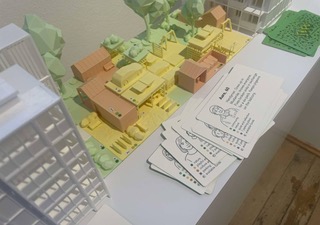
Urban planning shapes our everyday lives more than we may realise. It influences how we travel, work and spend our leisure time; how easily we can reach schools, workplaces, shops and parks; and how safe and comfortable urban spaces feel to people of different ages and needs.
In Estonia, there has been considerable discussion in recent years about making planning processes faster and more flexible. Amendments to the Planning Act that came into force this year aim to reduce lengthy procedures and enable local authorities to respond more quickly to development proposals. Yet streamlining procedures raises an important question: how can we ensure that faster decisions also create better urban environments?
For Lykouras, who took over the leadership of the academy in early November, good urban environments begin with how problems are defined and who is involved in solving them.
“Involving architects at the planning stage, rather than only later in the design process, can open up fundamentally different possibilities for public spaces. Architects are trained to frame problems and develop visions, which enables them to help other stakeholders imagine and discuss different potential solutions,” says Lykouras.
Are we simply renovating buildings, or improving places to live?
Early engagement matters just as much in the renovation of apartment buildings as it does in new developments. Renovation projects often focus on energy savings, costs and affordability, and the technical condition of buildings.
But is a building that is technically sound and energy-efficient necessarily a good place to live? According to Lill Sarv, who leads TalTech’s caring urban environments research group, the success of renovation needs to be assessed more broadly than through technical and economic indicators alone.
“A renovated building may be in good technical condition, but if its spatial quality does not meet residents’ actual needs, this can diminish its appeal, usefulness and long-term viability,” Sarv explains.
Architects have an important role in renovation, she says. Their task goes beyond designing a building’s exterior: it is about creating a coherent, high-quality living environment. Thoughtful layouts, accessibility, comfortable shared spaces and connections to the surrounding urban environment all shape how people experience their homes and neighbourhoods. In practice, however, meaningful involvement of architects is often constrained by tight project budgets, differing stakeholder expectations and the priority given to architectural quality.
Sarv stresses that renovation should be seen as more than a technical upgrade. It is an opportunity to improve people’s everyday surroundings and make existing buildings more accessible, comfortable and responsive to the needs of different residents.
Involving architects and residents from the outset helps identify solutions that support both a building’s technical performance and its long-term use. Ultimately, successful renovation is measured not only by the energy saved or the number of buildings upgraded, but also by whether those buildings offer a good living environment and remain desirable places to live.
Engagement should lead to better decisions, not more meetings
For Lykouras, meaningful engagement is less about collecting as many opinions as possible and more about creating a space where different perspectives can be discussed together and inform the resulting designs.
“The aim of a good engagement process is not to gather as many opinions as possible, but to create an environment where stakeholders can discuss their perspectives together and use them as a starting point for developing spatial solutions,” he adds.
This approach helps clarify different stakeholders’ needs and expectations and allows alternative solutions to be considered during planning. Although more thorough engagement can make the process more complex and time-consuming, it can also produce more carefully considered outcomes that better accommodate different needs.
Even a good plan can encounter unexpected obstacles
Recent research by TalTech’s caring urban environments research group shows why collaboration between stakeholders remains essential when plans are put into practice.
As part of the EU-funded URBREATH research project, doctoral candidates Mariliis Niinemägi, Lill Sarv and Germo Ausin examined the experiences of four European cities — Tallinn, Leuven, Madrid and Cluj-Napoca — in implementing nature-based solutions in urban environments.
Their research showed that even carefully planned solutions can encounter unexpected obstacles. In Leuven, Belgium, residents’ opposition prompted further discussions about traffic arrangements. In Madrid, finding an organisation willing to take responsibility for the long-term maintenance of an innovative urban cooling solution proved difficult. In Tallinn, challenges arose in reconciling technical requirements with public procurement rules.
The research also highlights the important role of municipal staff in balancing different interests, technical requirements and administrative processes. One of its central findings is that a good plan alone is not enough: clear responsibilities and collaboration throughout the project are equally important.
The discussion continues in Tartu
How to create fairer, more sustainable urban environments that better meet people’s needs will also be discussed at the 11th Tartu Planning Conference on 19–20 November, under the theme “Culture in Planning and Planning Culture”.
On 20 November, TalTech researcher Lill Sarv will chair a session entitled “Why Invest in Caring Urban Environments?” Researchers, developers and local government representatives will explore how urban planning can bring together spatial justice, environmental considerations and people’s experience of using urban spaces.
Creating good urban environments is a shared responsibility
This year’s World Town Planning Day message, “Great communities are built on planning”, emphasises that creating high-quality places to live requires both expert planning and collaboration with communities.
Good urban environments are not the product of a single person or profession. They draw on the knowledge and experience of architects, engineers, urban planners, decision-makers and residents.
The purpose of urban planning is to create places that are accessible, sustainable and comfortable for as many people as possible — today and in the future.
World Town Planning Day is celebrated each year on 8 November to highlight the role of planning in creating high-quality places that put people first.
Further reading
The research article “Beyond Structural Barriers: Storytelling, Affect and Municipal Responsibility in Urban NBS Implementation”, by TalTech doctoral candidates Mariliis Niinemägi, Lill Sarv and Germo Ausin, was published in the international journal Land in October 2026.