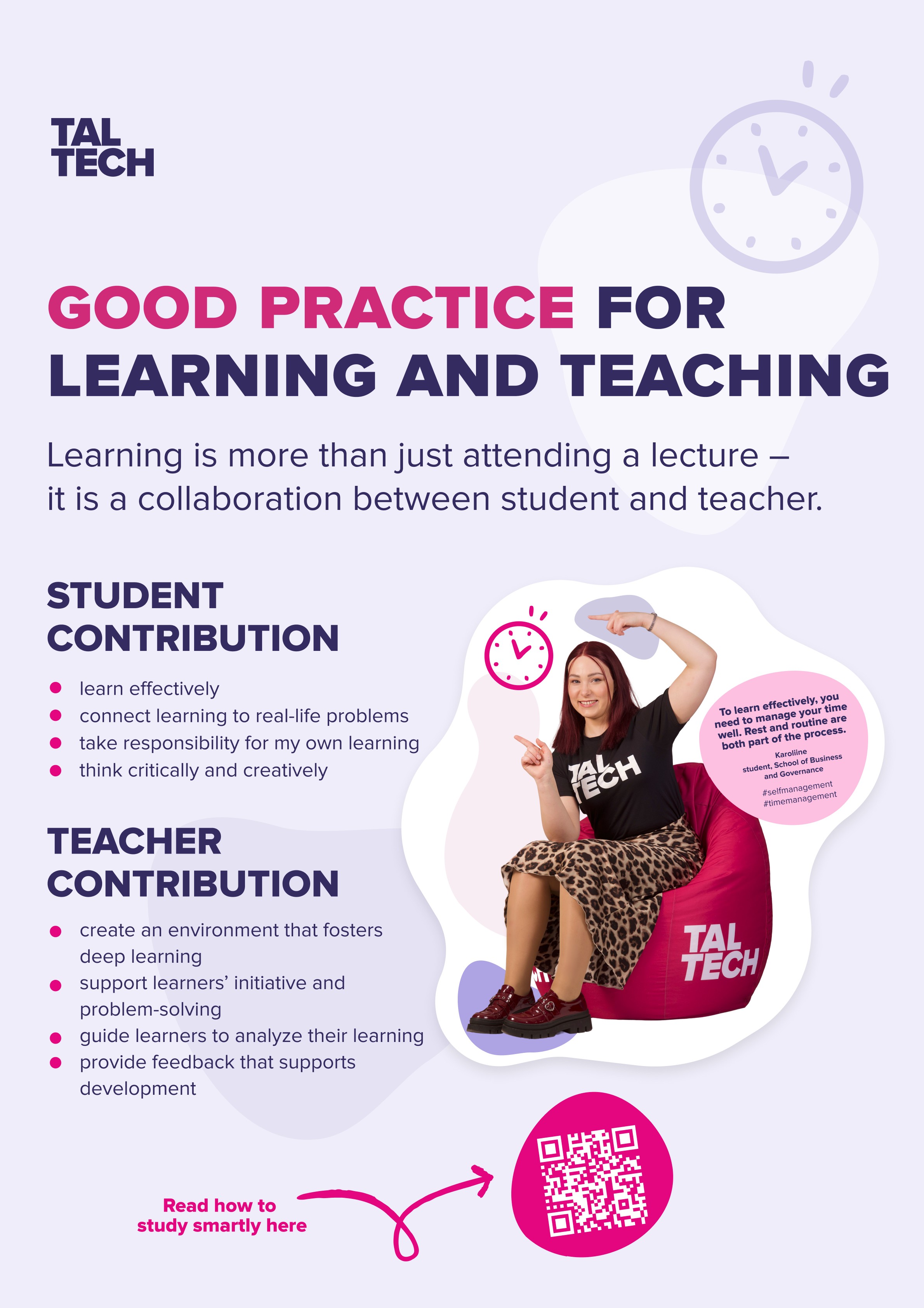
Karoliine Orav is a third-year student at TalTech’s School of Business and Governance, studying Public Administration and Governance, and is now in the final year of her bachelor’s degree. Her daily life, however, extends well beyond the lecture halls: Karoliine is a member of the TalTech Student Union Board responsible for education, where she works from the students’ perspective on how learning and teaching actually take place at the university.
Karoliine points out that people and previous experiences played a major role in her choice of university. A very specific role model tipped the balance in TalTech’s favour. “Someone I knew studied at TalTech, and I saw her representing the university at an event. I thought it was so cool—I remember thinking, wow. Later, I had the chance to talk to her myself, and she gave off such great energy. That’s when it became clear to me that this was the university I wanted to attend,” she recalls. That personal connection and example made her feel that TalTech could be the right place for her too.
When it came to choosing her field of study, her previous interests and experience proved decisive. Participating in a youth council gave her a positive and meaningful introduction to the public sector. “I had a really good experience there, and it helped me realise that this was a field I was interested in,” she says. This made the Public Administration and Governance programme a natural choice.
Learning is an investment in yourself
For Karoliine, learning is first and foremost about personal development and investing in herself. She describes herself as a persistent, open-minded and eager learner, adding that her active involvement in the Student Union is a natural part of learning for her.
She sees teaching as a form of guidance. A lecturer is not simply someone who “passes on knowledge”, but someone who sparks interest and encourages students to explore a subject in greater depth. Karoliine emphasises that successful learning requires both sides: the lecturer creates the right conditions and provides support, while the student is responsible for whether and how they actually learn—whether they attend lectures, complete their assignments and manage their time effectively.
What Karoliine values most in teaching is variety and active engagement. She does not enjoy lectures where students remain passive listeners. “If a lecture includes a discussion or group work and you get to contribute yourself, you remember it much better,” she says. Discussing your own ideas and listening to other people’s perspectives helps you understand the subject more deeply and makes learning more meaningful.
When thinking about teaching methods, group work is one of the first things that comes to Karoliine’s mind. She says that many courses include at least one group assignment, and its value depends greatly on how the group is formed. Sometimes students can choose people they already know and work well with; at other times, groups are assigned randomly. It is the latter that really pushes students out of their comfort zones and helps them develop genuine collaboration and communication skills.
Collaboration, communication and critical thinking—especially in the age of AI
When Karoliine thinks about the competencies that help young people succeed in the labour market and in life more broadly, she starts with collaboration. “You can go far alone, but together you can go even further,” she says, immediately connecting this with communication: having the courage to speak up, make connections and build a network. She feels that university develops these skills at a new level—the same competency returns almost like a spiral, but each time in a more mature and complex context.
Critical thinking is equally important to her, especially in today’s information environment. She says it starts with a simple question: where am I getting my information from? “You don’t take material for your work from some random website. You have to think about whether it is a reliable source,” she explains. This skill is essential not only in academic work, but in everyday life as well.
She considers critical thinking particularly important in the age of artificial intelligence. “We can use AI, but it doesn’t always give you answers that are 100% correct. It wants to please you and may tell you what you want to hear,” she says. This is why learners need to know how to check, compare and evaluate information rather than treating the first answer they receive as the final truth.
“You might say that you already know how to work in a group or communicate with people. But at university, you develop these skills at a new level—in a more adult way than you did in secondary school,” Karoliine notes. It is this greater depth and increased responsibility that make the experience different.
The ideal student does not burn out; the ideal lecturer is open-minded
If Karoliine had to describe the ideal TalTech student, she would say they are balanced and determined. According to her, studies should still be the first priority—attending lectures, completing assignments and genuinely learning. At the same time, university life is about more than sitting in lecture halls.
In her view, participating in organisations or projects is also an important part of student life. “That’s also a place where you learn,” she says. Student activities develop collaboration, communication and leadership skills and provide experiences that lectures alone cannot offer.
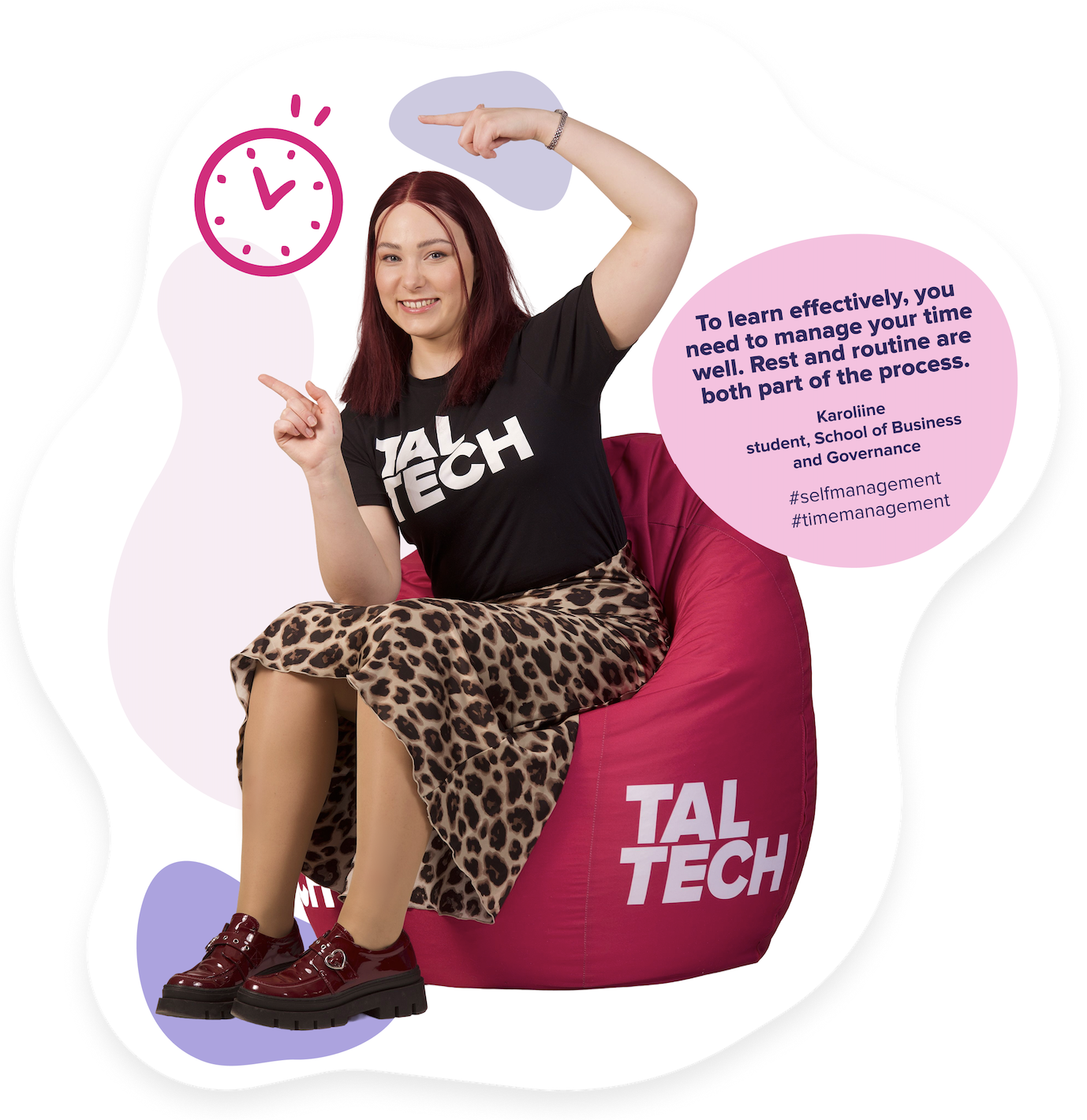
She considers balance equally important. “The ideal student doesn’t burn themselves out but knows how to manage their time. They don’t go to bed at three in the morning,” Karoliine laughs, pointing out that rest and routine are part of effective learning. Studies should remain a priority, and consistent effort is important.
According to Karoliine, the ideal lecturer should above all be open-minded. She believes teaching is not a one-way process, because every new group of students brings new perspectives and ways of thinking, and lecturers can also learn from their students. “Every generation is a little different. Lecturers should be open to their ideas and perspectives,” she says. “That doesn’t mean following every trend, but being willing to listen, take students’ views into account and adapt when necessary.”
For her, openness also means asking for feedback and involving students. What kind of learning format works best for them? What helps them understand the material better? When lecturers take students’ views into account instead of relying solely on their usual way of teaching, genuine dialogue can emerge.
What Karoliine values most in teaching is variety and active engagement. She does not enjoy lectures where students remain passive listeners. “If a lecture includes a discussion or group work and you get to contribute yourself, you remember it much better,” she says. Discussing your own ideas and listening to other people’s perspectives helps you understand the subject more deeply and makes learning more meaningful.
A dream of more interdisciplinary learning
When Karoliine is asked to dream a little further and imagine her ideal TalTech, her thoughts quickly turn to the TalTech of the future. For her, it is important that the university remains inclusive and continues to take student feedback into account. “The student voice should have a genuine impact on the university’s development,” she says. She would like development to be deliberate and future-oriented—not merely reactive, but innovative as well.
One concept that particularly resonates with her is interdisciplinarity. Karoliine admits that although she studies public administration, she is still interested in engineering as well. Her dream is to see even more opportunities for different fields to intersect.
Karoliine believes students should be introduced earlier and more actively to the idea of deliberately venturing beyond their own field of study. “I regret a little that I didn’t do that at the beginning, or perhaps didn’t have the courage to,” she admits. Now, as a tutor, she recommends the same to others: if something interests you, take courses from other schools or even choose a minor, because the experience can be extremely valuable.
Karoliine’s story highlights one clear idea: university is not a place where you simply memorise information. It is an environment where responsibility, collaboration and critical thinking develop, and where you grow and evolve as a person more than you might expect. And when students have the courage to speak up, ask questions and take charge of their own development, education truly opens doors.
TalTech’s Good Practice for Learning and Teaching is a university-wide agreement aimed at supporting high-quality learning and teaching and fostering a shared academic culture. At its heart is the idea that learning is not merely about acquiring knowledge, but a collaborative process of development in which both the learner and the lecturer have an important role.