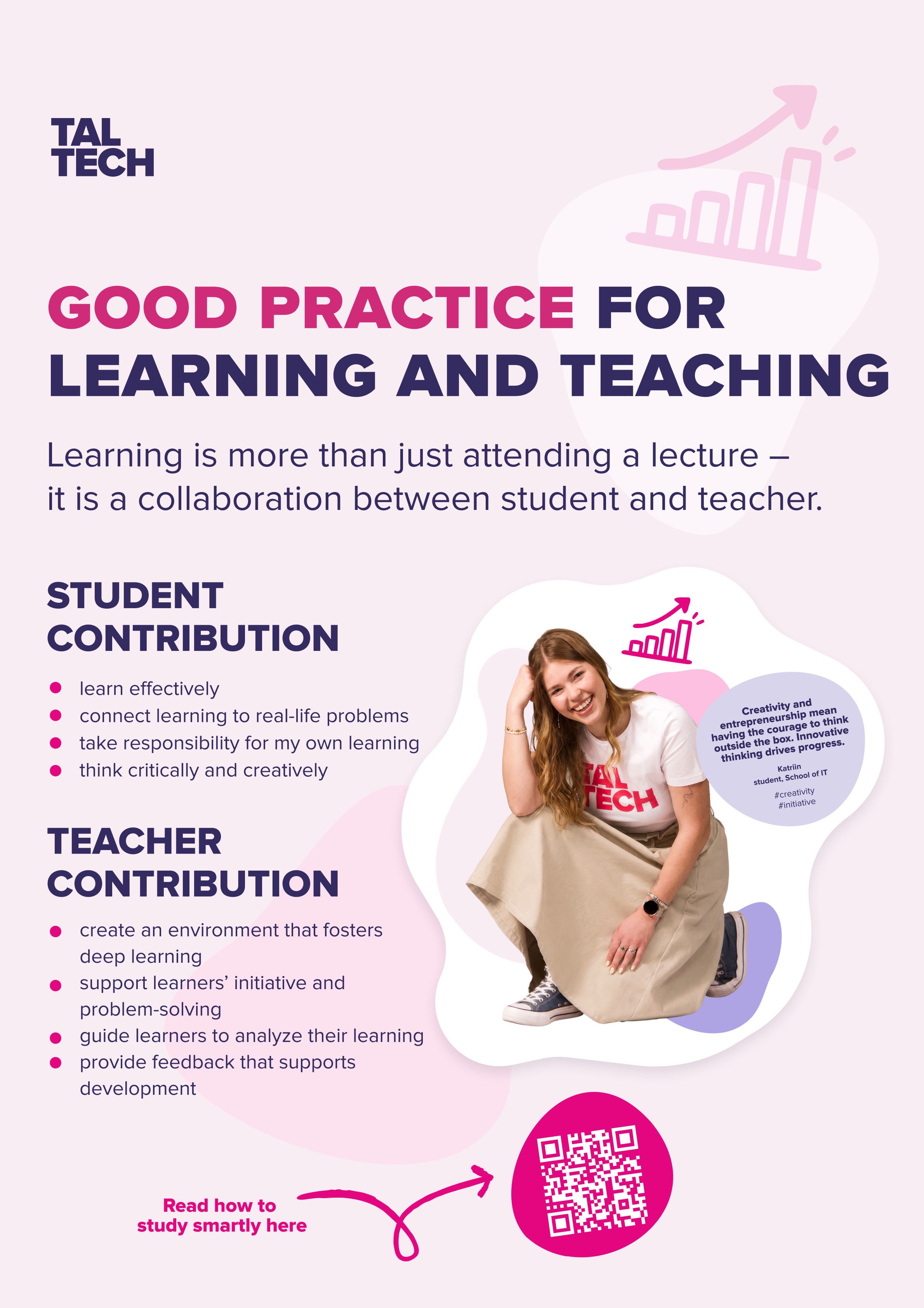
TalTech third-year Business Information Technology student Katriin Saarep believes that learning is a mindset, driven by curiosity and a willingness to continuously develop.
Katriin’s educational journey has been shaped by deliberate choices. After graduating from the mathematics and physics track at Pärnu Koidula Gymnasium and spending a year in Australia, she considered two options: the more creative field of web design or the more technical Business Information Technology programme. In the end, she chose the STEM-oriented path, which, she says, keeps more doors open for the future.
Her time in Australia, however, taught her a different and perhaps even more important lesson. “Estonians often only realise after living abroad how valuable Estonia’s education and healthcare systems – and the country as a whole – really are,” she says. The experience reinforced her desire to learn and grow in an environment rich in opportunities.
Learning as curiosity, teaching as creating the right environment
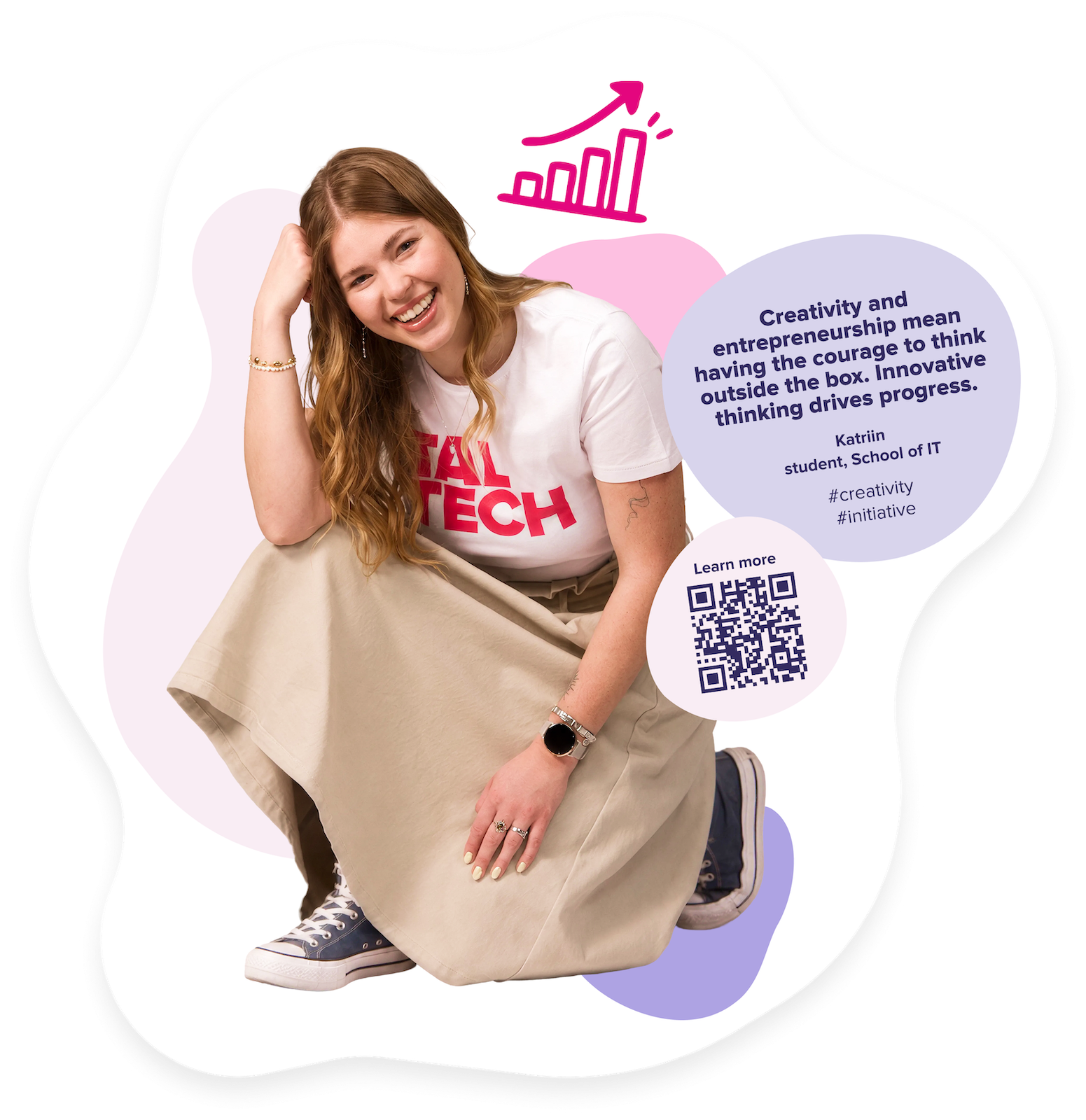
For Katriin, learning begins with genuine interest. “Learning happens when you are truly interested and want to understand more about a subject yourself,” she says. In her view, learning never ends, even when you think you have become an expert in a particular field. The world changes, knowledge and technology evolve, and continuous learning and reskilling are a natural part of life. For her, the essence of learning is curiosity and self-development – an inner drive to keep moving forward and improving.
Studying Business Information Technology has strengthened this mindset even further. Katriin’s motto is simple: try, experiment, fail and try again. “I learn best when I can do something myself and connect it to real life,” she says. Theory alone is not enough; what matters is understanding how what you have learned actually works in practice. When discussing cybersecurity, for example, she immediately thinks about how it applies to her own computer or everyday life. Making these connections helps her consolidate what she has learned.
For Katriin, learning also requires the courage to ask for help. “If you are afraid to ask for help, you waste time or end up struggling on your own.” She emphasises that there are many people at university to learn from – fellow students, students from more senior years and lecturers. Asking for help is not a weakness but part of learning, and collaboration is a natural way to deepen knowledge.
She also highlights self-fulfilment as an important source of motivation. Once she has committed to something, she does not leave it unfinished. Even challenging mathematics courses are part of the journey towards becoming a stronger professional in her field. “Learning always adds something; it never takes anything away,” she says.
Katriin sees teaching as something broader than simply passing on knowledge. The best teaching is not about merely delivering content, but about creating an environment that makes students want to learn for themselves. “A lecturer does not have to tell you everything – they guide you and create the conditions in which students want to ask questions and explore further.” In her view, the highest form of teaching is creating an environment where learning is not an obligation but an intrinsic need.
Learning habits begin at home
Katriin’s attitude towards learning did not emerge overnight. She believes it is something that has been with her since childhood. “That’s how I was brought up,” she says. “At home, we read newspapers, discussed current affairs, and learning was naturally woven into everyday life.”
She recalls playfully exploring different topics with her brother – sometimes they practised multiplication tables together, while at other times they discussed whatever happened to interest them. “Learning was somehow made enjoyable. You didn’t even realise you were actually learning – it just felt like a game,” she says. This playful and curious approach has stayed with her at university.
Her grandfather also played an important role through a saying that has stayed with her to this day: “For someone who has worked hard and made a consistent effort throughout the year, the exam becomes a pleasant conversation with the lecturer.” For Katriin, this captures an attitude in which consistent work transforms stressful situations into confident dialogue rather than intimidating challenges.
General competences – the invisible foundation
When discussing general competences, Katriin names communication skills first. Although communication comes naturally to her – she considers herself a people person – she sees that this skill can no longer be taken for granted.
“Phones are reducing our communication skills,” she says. In her view, it is important to be able to share a room with someone without turning to a screen, and to express your thoughts in a way that the other person understands without feeling attacked. Critical thinking is equally important, particularly in the age of artificial intelligence. “AI can suggest ideas, but you cannot blindly trust everything it gives you. You need to know how to ask the right questions, add your own perspective and think critically yourself.”
Collaboration, she says, goes hand in hand with communication. At TalTech, many courses are project-based, making group work part of everyday studies. “No project is completely free of conflict,” she says. “Differences of opinion and time pressure are a natural part of the process, but resolving them develops communication, collaboration and problem-solving skills – often without you even noticing.”
Katriin believes that project-based learning can be particularly valuable for more reserved students, as it creates a safe environment in which to open up. “Sometimes all it takes is being placed in a group where the others encourage you.”
She also considers conscious self-reflection important, whether after giving an interview or putting her thoughts into words for an article. “Afterwards, I always think about what I said and how I could do it better next time.”
For Katriin, general competences are not something separate from professional expertise; they are its foundation. A good specialist is not simply someone who knows their field, but someone who can communicate their knowledge clearly, apply it within a team and assess it critically. These are the skills that give theory practical meaning.
The essence of good learning and teaching: initiative and responsibility
Of the principles set out in TalTech’s Good Practice for Learning and Teaching, Katriin identifies most strongly with the section emphasising creativity, initiative and ethics. For her, this means above all having the courage to think outside the box. “It’s okay not to do things only the way you have been told. On the contrary – innovative thinking is encouraged and supported,” Katriin says.
In everyday university life, she sees the principles of good practice reflected primarily in collaboration and responsibility. Interaction with both lecturers and fellow students is a natural part of studying, but ultimately, responsibility for learning always lies with the student. “Lecturers create the environment, but the desire to develop myself has to come from me,” she emphasises. In her view, university is not a place where someone else turns you into a finished product; it is a place where students use the opportunities available to shape themselves.
She also highlights the importance of continuous and immediate feedback, particularly in IT courses. Regular feedback helps students understand what they already know and what they still need to develop. “You immediately understand what you could do differently and what else you need to learn. This kind of continuous reflection supports development and gives learning greater depth,” she says.
A vision for the future: more collaboration across schools
Asked what she would say to a friend considering studying at TalTech, Katriin does not hesitate: practicality and initiative are valued here. Her experience shows that students who are prepared to explore subjects in depth and ask questions will discover more opportunities than they might initially expect. Learning is not confined to the lecture hall; what matters is the ability to apply acquired knowledge in real life.
“There is a difference between theoretically knowing how to write code and actually being able to do it,” she says, using an example from her own field. In her view, one of TalTech’s strengths is that learning does not remain abstract but develops into practical skills. She also values student life as a space where people build connections, develop collaboration skills and create a sense of community. It is the combination of practicality, initiative and active student life that creates a well-rounded learning environment.
When imagining her ideal TalTech, however, interdisciplinarity is the first thing that comes to mind. Katriin sees great potential in collaboration across the university’s schools. “Doing projects with your coursemates is one thing, but working together with students from another school would be a completely different experience,” she says. In her view, project-based learning could offer more opportunities to genuinely bring together knowledge from different fields.
She gives a simple example: IT students could contribute technical expertise, while business students could add a commercial and strategic perspective. Together, they could produce a more comprehensive result. This kind of integration of knowledge would create a more realistic learning environment – one that more closely resembles the working world students will encounter after graduation.
Ultimately, Katriin believes that good learning is about more than acquiring facts. It is about curiosity, consistency, responsibility, collaboration and the courage to think outside the box.
TalTech’s Good Practice for Learning and Teaching is a university-wide agreement designed to support high-quality learning and teaching and foster a shared academic culture. At its heart is the idea that learning is not merely the acquisition of knowledge, but a collaborative process of development in which both students and teaching staff play an important role.