For third-year Electrical Power Engineering and Mechatronics student Renee Maripuu, an interest in engineering began at a very early age – standing beside his grandmother, when making a light bulb come on seemed almost like magic. Today, he studies at Tallinn University of Technology in a field whose importance he already recognised when he was young, while also playing an active role in student life alongside his studies.
His story is a good example of how studying at TalTech is not just about acquiring knowledge, but also about mindset, responsibility and continuous self-development. Renee also knows that, ultimately, he is studying for himself.
Learning and teaching as a conscious process
For Renee, learning is first and foremost about acquiring new knowledge, retaining it and later putting it into practice. “I rely heavily on the principle that true understanding only comes when I can explain a topic in simple terms to someone who doesn’t understand it. If I struggle to explain something, it means there’s a gap somewhere and I need to go back to the topic. Explaining something is a very honest test of whether you truly understand it or not,” Renee says.
According to Renee, teaching is naturally intertwined with learning – it is a way of making knowledge truly your own. “To me, teaching means that someone has developed a very strong understanding of a particular field and reinforces that knowledge by passing it on to others. One of my lecturers once put it very aptly: the first time I explain something, nobody understands; the second time, I start to understand; and the third time, I understand, but nobody else does anymore,” Renee says.
This captures the dialogical nature of teaching well – learning and teaching happen together through a shared process of making sense of things.
A student who goes beyond what is required
Asked to describe himself as a student, one defining characteristic stands out: he does more than is required. “I started my first semester with 42 ECTS credits, and the workload hasn’t really decreased much since then.”
Alongside his major, he is pursuing a minor in public administration and political science and is actively involved in student activities. Jokingly, he calls himself a “joker” – someone who will be able to fit into a variety of fields in the future and keep more options open when it comes to master’s studies.
How does he manage it? Renee says his greatest source of motivation is his fellow students. “We have this great group of six people who are basically a support system for one another. When you’re studying with them late at night for an exam or a test, the suffering doesn’t feel quite so painful anymore,” Renee jokes.
“Of course, it’s also motivating when a lecturer can explain topics in a way that is clear and engaging. When it’s not just someone reading dense text off old slide decks, but genuine teaching – where students feel that they understand and want to think along.”
Competencies that provide confidence in an uncertain world
For Renee, university is about more than subject-specific knowledge. Technical skills are essential, but success is often determined just as much by the skills that help people navigate different situations.
“I think that in today’s rapidly changing society, the ability to learn and adapt is incredibly important. Knowledge becomes outdated quickly, and people need to be able to retrain when necessary. That gives you a certain sense of security in an uncertain world,” Renee notes.
“Self-management is also extremely important – I’d even say it’s the foundation. Without it, you can’t achieve anything. Life is about choices: do you get up in the morning ready to take on the day, or do you spend half the day lying in bed lost in thought?”
In his view, creativity, problem-solving and critical thinking are skills that the future world of work will increasingly demand – and TalTech deliberately helps students develop them.
“It’s often difficult to keep up with new trends. People’s ability to concentrate is increasingly being put to the test – we constantly need new stimuli. That’s why creative ideas and the ability to solve problems will be especially important in the future,” he reflects.
Renee believes these competencies are developed at TalTech primarily through independent work and practical assignments. He tries to do as much additional work as possible beyond compulsory group projects, searching for materials independently and comparing different sources. This helps him make better sense of a topic and structure his thinking – even when his initial understanding is incomplete.
Renee has had to work particularly consciously on self-management and time management because he has so many commitments: studies, projects, student activities and other responsibilities. “I’ve learned to break tasks down into smaller parts and monitor my pace to avoid excessive stress. My calendar is pretty colorful on a daily basis,” he admits.
According to Renee, project-based learning has taught him that there are not always ready-made answers and that failure is a natural part of learning.
When a lecturer explains things like a human being
Renee vividly describes the kind of teaching that genuinely supports his learning. He recalls an electrical systems course where lecturer Henri Manninen explained complex topics in an accessible way. “Electrical Systems was one of the first courses where I felt that I actually understood what was going on. The lecturer explained things like a human being – like someone who had once been a student himself. He brought diagrams, discussion and plain language into the lecture instead of robotic text.”
Students were also given the opportunity to present topics themselves in front of the class – an experience that helped develop both their confidence and a deeper understanding.
Renee also gives a good example of developing collaboration skills from his experience in his minor. According to him, group work is an everyday part of studying there, forcing students to communicate and adapt constantly. “In the School of Business and Governance courses, collaborative learning is very effective at developing teamwork skills,” he says. “There are lots of different group assignments – I’d even say that almost every week there’s something you have to work on outside lecture hours as well.”
What makes the experience particularly valuable for him is that the groups are never quite the same. “It’s not some fixed group of people. You always end up in a completely new group, with students from different programmes and different years,” Renee explains. “That means you’re constantly practicing how to communicate and collaborate with people who may think completely differently from you. That’s exactly what teaches you how to work towards a common goal with different kinds of people.”
TalTech as a “gym for the brain”
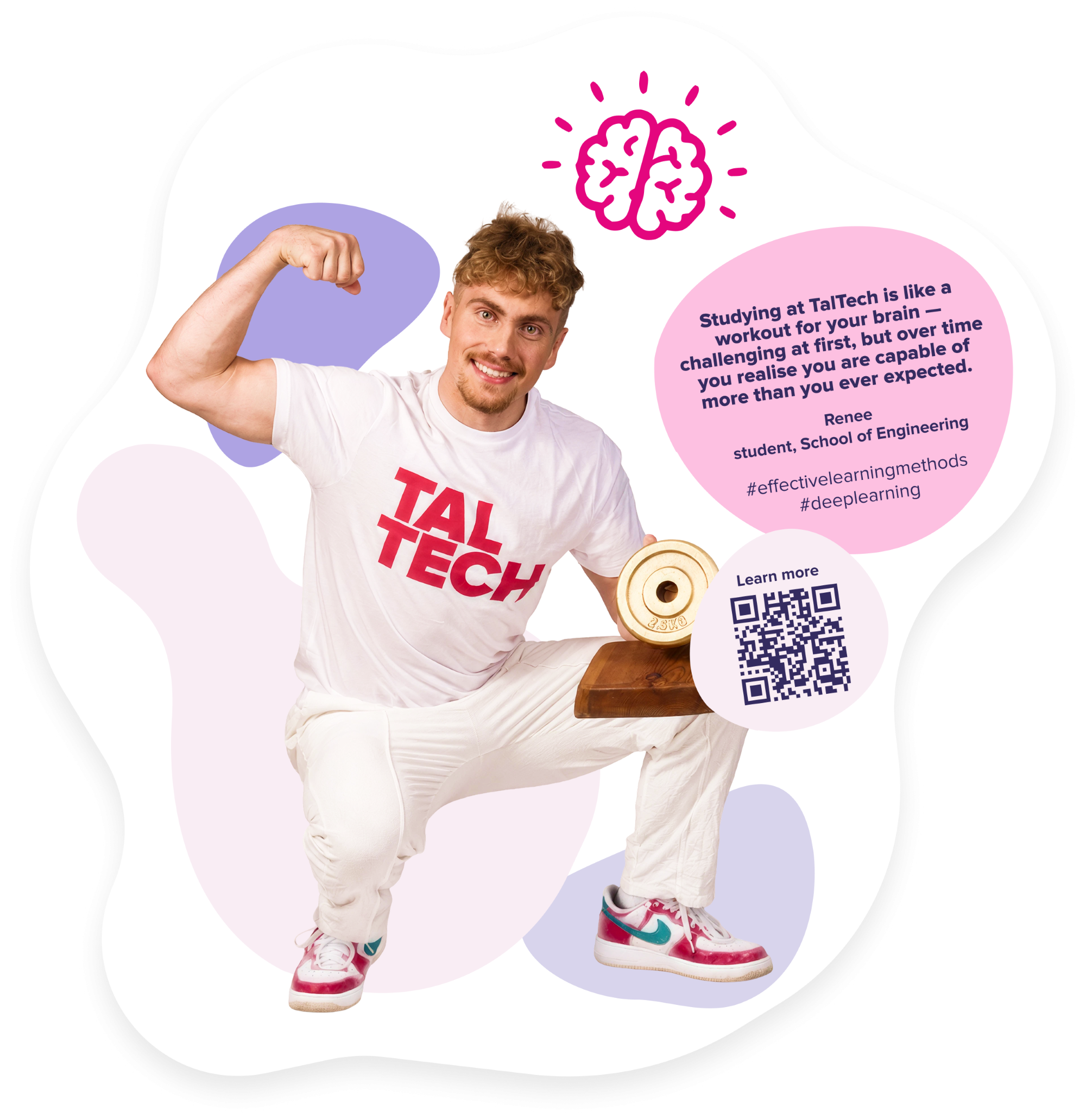
Asked what studying at TalTech is really like, Renee offers an apt metaphor: “Studying at TalTech is a bit like going to the gym for your brain – it’s uncomfortable at first, and sometimes you feel like giving up, but at some point you realize that you’re capable of more than you thought.”
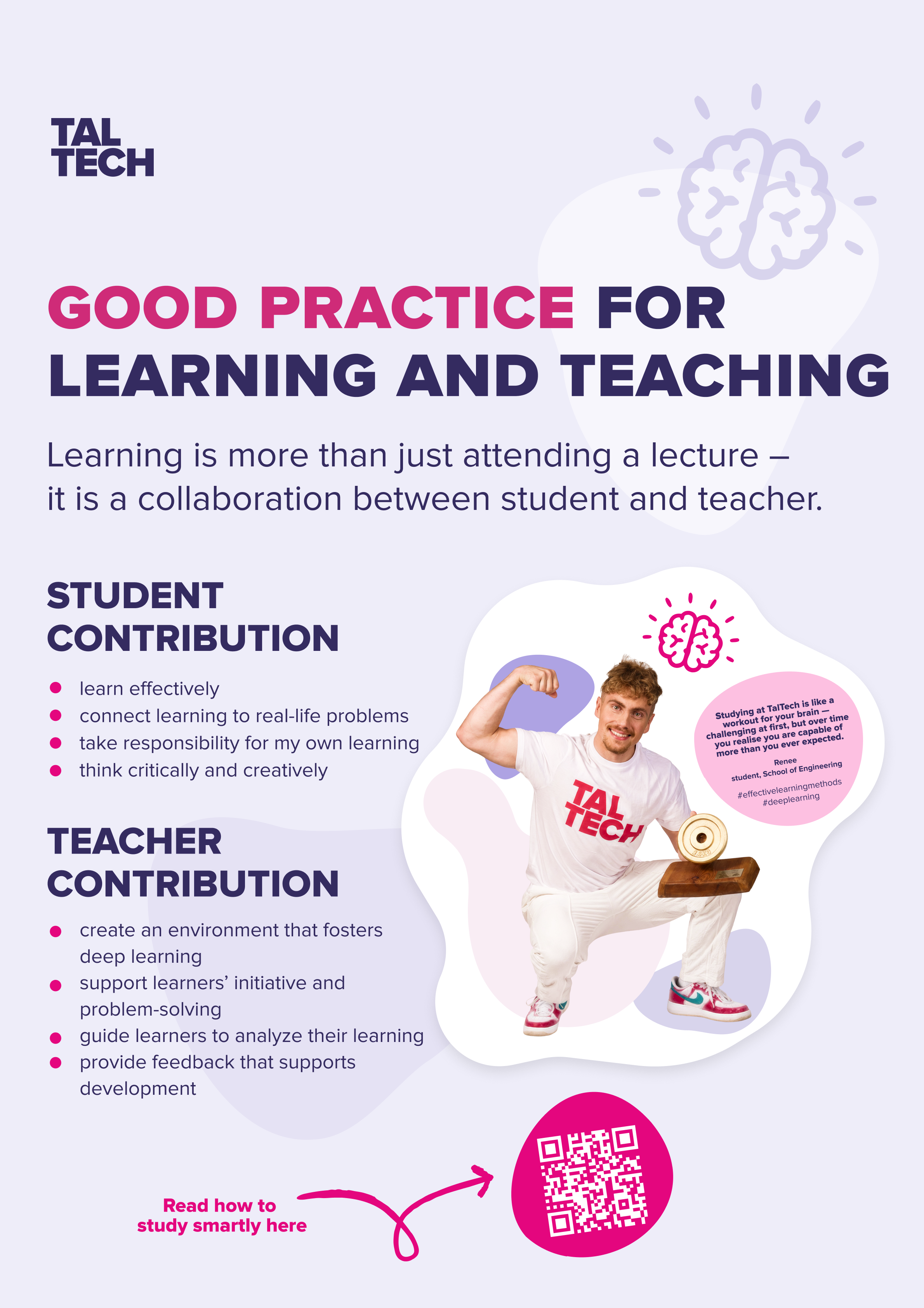
According to him, students are not always handed ready-made answers. Instead, they are “thrown in at the deep end” so that they learn to search, ask questions, debate and take responsibility for themselves. This directly reflects the principles of good learning and teaching practice, where lecturers create an environment conducive to learning and students take responsibility for their own learning.
For Renee, good practice in learning and teaching is not simply a document, but the sense that learning is a shared and purposeful activity. “Good practice has a genuine purpose and motivation behind it. It provides a framework that ensures learning isn’t just about getting things done, but about doing something together, consciously and with purpose.”
His three keywords for ideal teaching are purposeful, human-centred and personal. “Mutual understanding is extremely important. Both sides – learners and teachers – should understand that the people facing them are human beings. That sense of humanity is something we should make a greater effort to preserve,” Renee says.
TalTech’s Good Practice for Learning and Teaching is a university-wide agreement designed to support high-quality learning and teaching and foster a shared academic culture. At its core is the idea that learning is not merely about acquiring knowledge, but a collaborative process of development in which both students and teaching staff play an important role.