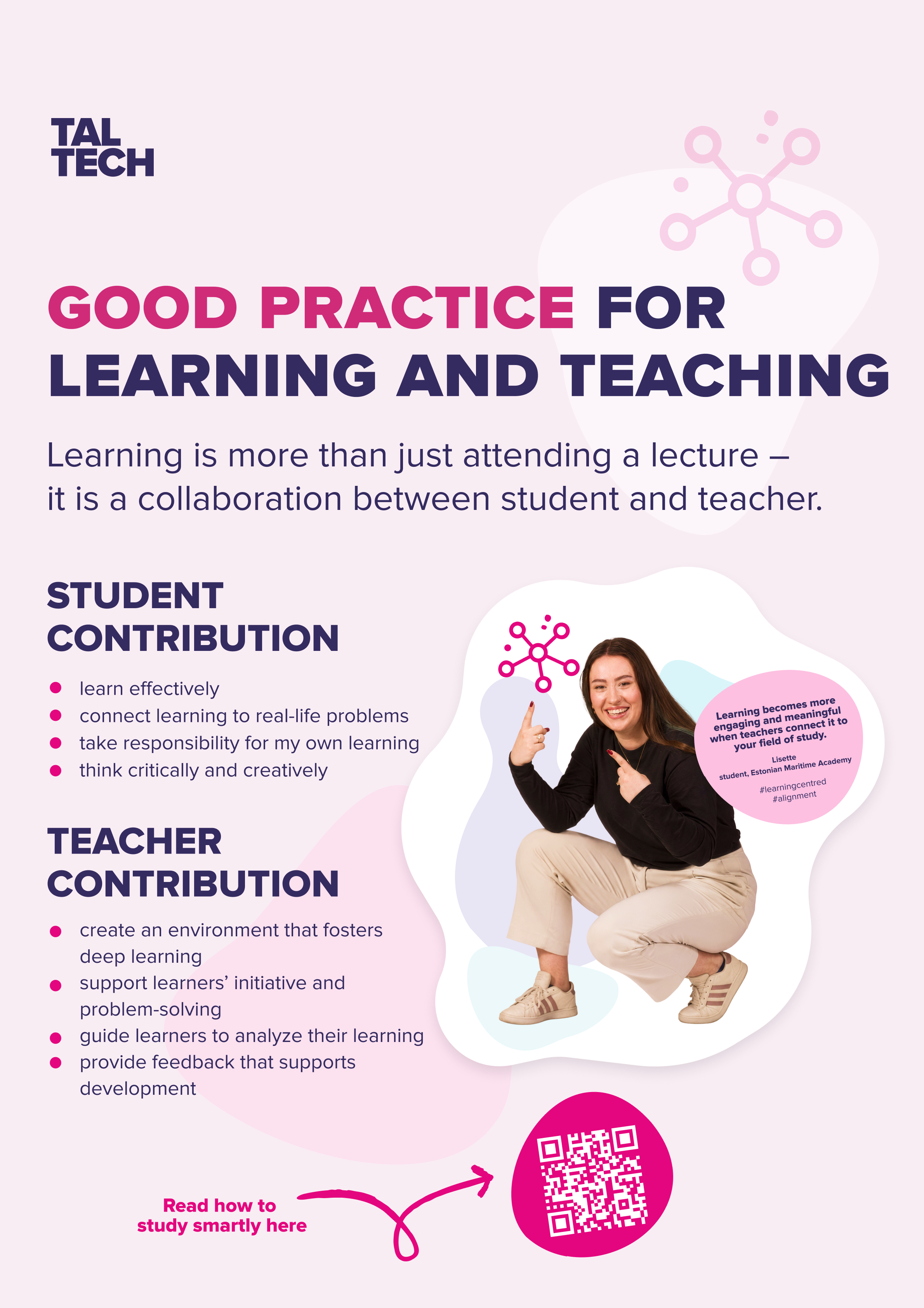
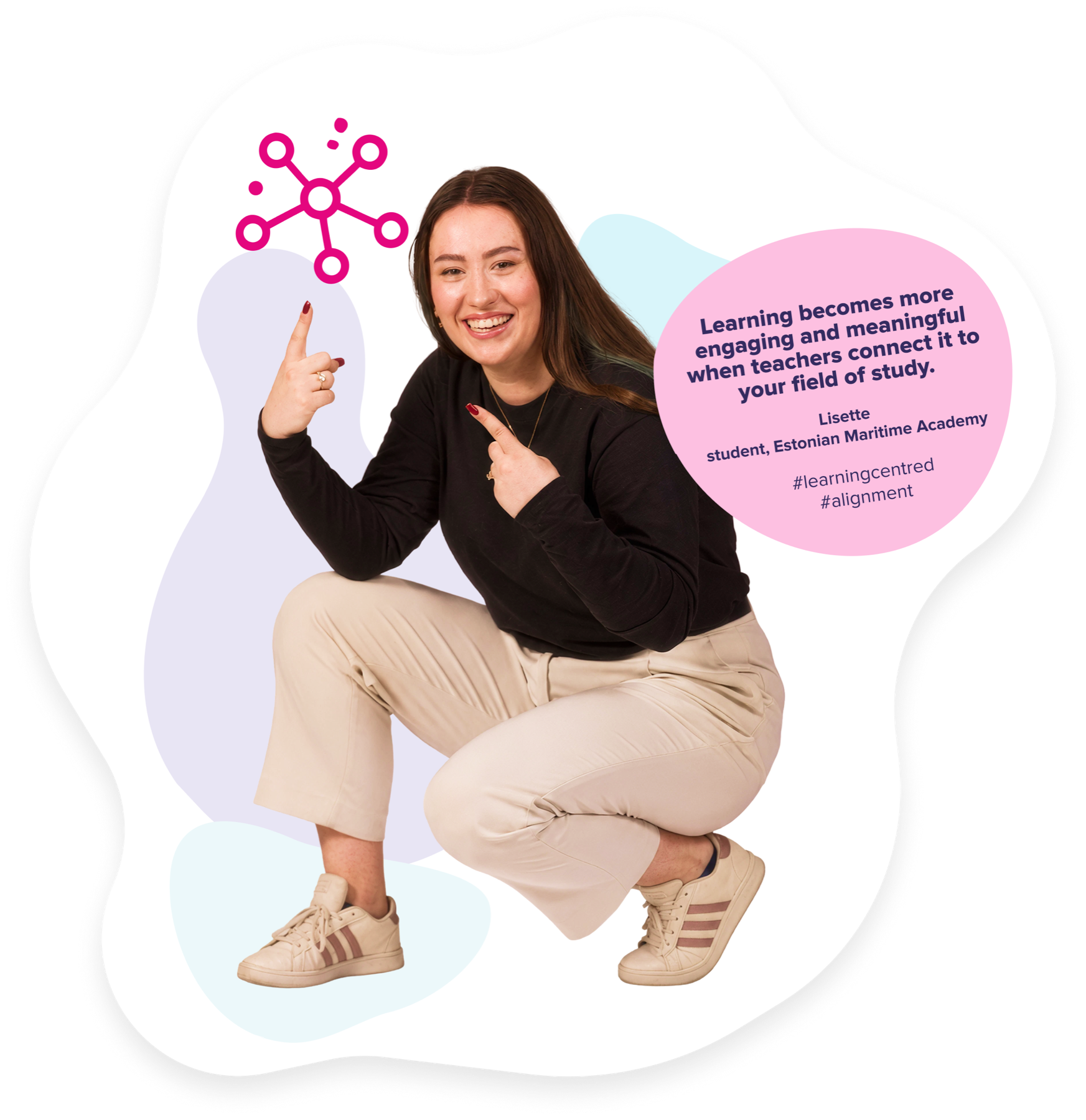
When Lisette Johanson talks about learning, she does not talk about grades or exams. She talks about discovery, challenging herself and how, in the end, learning helps a person get to know themselves better.
Lisette is in her third year at the Estonian Maritime Academy, studying waterway management and safety management. Her path there was far from straightforward. “At secondary school, we were constantly told that we had to find the right direction to commit our lives to,” she recalls. “I visited several universities, shadowed students and eventually felt that nothing interested me.”
She then took a break. Moving to another city and taking time to think helped her gain a new perspective. When she began looking at study options again, she deliberately chose something different. “I wanted to study something exciting that no one in my circle was doing. Something useful and important.”
That is how the young woman from southern Estonia found her way into the maritime field, where safe maritime traffic is central and which also plays an important role in national security. Today, she smiles and says she is very happy with her choice.
Learning as discovery and a journey
When Lisette thinks about what learning really means to her, she goes beyond the conventional definition. To her, learning is much more than acquiring new knowledge. “It can mean gaining a new skill or knowledge, but also stepping outside your comfort zone, developing and discovering yourself.” She also values the ability to see connections and understand how different knowledge and experiences fit together and help us make sense of the world.
Lisette sees teaching as guidance rather than telling someone what to do. In her view, a teacher cannot simply carry someone along with knowledge. Instead, the teacher helps the learner discover and understand for themselves. “I like to think of teaching as lighting the way,” she says. “The teacher helps you see the direction, but you have to go forward yourself.”
Lisette’s principle is simple and clear: study for yourself. She consciously reminds herself that the goal is not just grades. In her view, studying solely for grades can mean that knowledge is quickly forgotten and the time spent learning is wasted. It is much more important to study thoughtfully, understand connections and take that knowledge into life. This principle also helps her avoid comparing herself with others. “I try to focus on how I am developing,” she says.
According to Lisette, an important part of university study is having the courage to make mistakes and try again. In her experience, failure at university is not the end, but an opportunity to learn and move forward. “If something does not work the first time, it is not the end of the world – there is always a chance to try again.”
Asked how she would describe studying at TalTech to someone considering university, she answers simply: it is a place where learning is truly motivating. She says practical application of knowledge, learner independence and responsibility, and cooperation between students and lecturers are valued here. “Learning is not just sitting in lectures or studying for exams. The goal is for students to really understand and be able to use what they have learned.”
For her, university helps people grow not only as specialists, but also as independent and responsible individuals.
What motivates her to learn?
Lisette says her greatest motivation is knowing that her studies are helping her towards a future where she can do work that is both stable and interesting. Working in a field that genuinely appeals to her matters: good results and job satisfaction follow.
“I am motivated by the thought that in the future I can work in a field I really like,” she says. At the same time, learning continually gives her new knowledge and skills, building her confidence and broadening her horizons.
Lisette sees university as more than a place to acquire professional knowledge. Studies also teach many skills needed in life: time management, consideration for others, communication and resilience under pressure.
She acknowledges that challenging herself also plays an important role in her motivation. Maritime studies require knowledge of physics, for example – a subject in which she did not feel especially strong at school. This gives her extra motivation. “It is also a way of proving to myself that I am capable of more than I sometimes think.”
General competences: the skills that hold everything together
Lisette believes the general competences valued at university are not just an extra topic alongside a speciality, but among the most important things to take away from learning. The skills are so closely connected, she says, that weakness in one inevitably affects the others.
“If, for example, communication or cooperation skills are lacking, learning becomes much harder too,” she says. Cooperation and communication affect not only relationships with fellow students, but also learning with lecturers and later working life. Even someone who expects to work mostly independently cannot avoid communication and cooperation, she emphasises.
She also considers self-management important: the ability to plan time, maintain motivation and direct one’s learning consciously. Alongside this, she values critical thinking, analytical skills, problem-solving and the ability to argue a case.
These skills have an impact far beyond studies, Lisette says. “When you feel confident in your field and can communicate and cooperate with people, you feel better and life runs more smoothly.” For her, general competences provide a foundation for both professional skills and personal development.
She has developed these competences in practical ways during her studies. She plans exam preparation early and breaks her work into smaller parts. She develops cooperation skills by working with classmates and participating in student organisations. She is also a group representative, which involves daily communication with fellow students, lecturers and the study centre.
Communication occurs almost every day at university, she says, whether in discussions, joint projects or debates about ideas. These situations also develop critical thinking: ideas need to be analysed, opinions justified and, when necessary, disagreement expressed politely.
She believes there is always room to develop general competences further. She would like to become more decisive. “I sometimes spend a long time weighing things up and discussing them with everyone. I would like to learn to make decisions a little faster and more confidently,” she admits.
Good Practice for Learning and Teaching: a culture of cooperation and respect
For Lisette, the key word in the Good Practice for Learning and Teaching is cooperation. Good learning, she believes, arises not simply from conveying knowledge in a lecture but from the relationship between lecturer and student. “What stands out most to me is cooperation and mutual respect,” she says. “When a student feels they have a good connection with the lecturer and communication works, motivation to learn is much greater. Otherwise, learning can become considerably harder and less effective.”
The classroom atmosphere is also crucial. Small groups may seem ideal for discussion and questions, but much depends on whether the lecturer creates an open and safe environment. Some lectures generate lively discussions; in others, answers seem to have to be coaxed out. She believes the lecturer’s confidence in the subject also matters. “When a lecturer knows their subject and can connect the course content to the students’ field of study, learning becomes much more interesting and meaningful,” she says.
Lisette finds learning most supportive when lecturers are practitioners in their field. “When someone talks about something they actually do and love, that has an effect on students too,” she says.
She particularly values lectures connected to real life: visits to workplaces, real equipment and examples brought into the classroom, or practical assignments. These create a clear link between learning and future work. “Then I understand what I am learning and why,” she says.
She also likes regular short exercises to check understanding. A brief check that does not affect the grade before moving to a new topic helps consolidate previous material and connect it to the new.
More cooperation across schools and borders
Lisette believes university studies could offer even more opportunities to cooperate with students from other schools and with international partners. She sees particularly great potential for international cooperation in her field.
“If I become a hydrographer, it would be really exciting to do larger projects with hydrography students from other universities,” she says. The maritime sector is international, and countries often have slightly different approaches and solutions. Cooperation would allow students to compare them and learn from one another. “It is a very large sector, and it would certainly be interesting to see how the same things are done in other countries,” she says.
She also sees opportunities within the university. Although there are already some shared courses with students from other schools, she would like to see more. For example, she thinks students from the main campus could visit the Maritime Academy more often and take electives offered there. “It really is not that far – the buses go from door to door,” she says with a smile.
TalTech’s Good Practice for Learning and Teaching is a university-wide agreement aimed at supporting high-quality learning and teaching and developing a shared academic culture. At its heart is the idea that learning is not merely about acquiring knowledge, but a collaborative process of development in which both the learner and the lecturer have an important role to play.