
The year 2026 has begun turbulently, with rapid and transformative change as the main keyword. We asked Professor Erkki Karo how, in such a world, a small country can make good decisions, keeping both the short and the long perspectives in mind. We also discussed the importance of bringing young decision-makers into the circle, the work done by the Council for Efficiency and Economic Growth under the Government Office, and the competitiveness of Estonia and Europe.
Interviewer: Anne-May Nagel
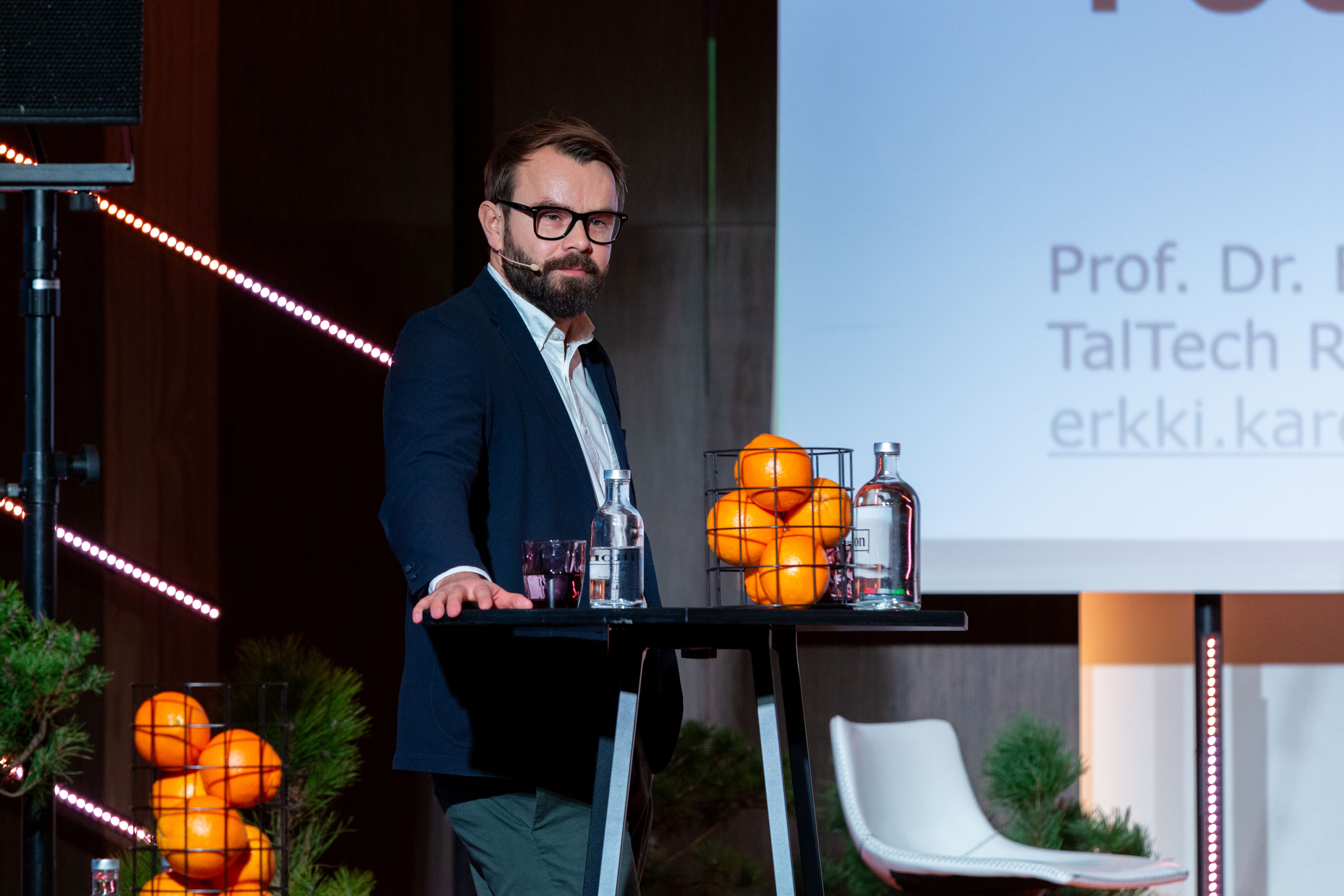
At the Natural History Museum, a new exhibition titled “Future Exhibition” is being prepared. You are contributing to its creation as an expert. The exhibition opens in 2027 and invites people to think about future scenarios for our economy, society, and nature, and about each person’s role in shaping those futures. The exhibition speaks of futures in the plural—so what is our role in making sense of futures?
We somehow need to get used to living with several possible futures at the same time. It’s not like there is one clear path for which we plan and then calmly implement it. We do need merely a shared direction and vision, but we also need a flexible approach in moving toward it: if things go this way, we do this; if they go that way, we do that. In other words, we need to constantly have—and in some sense also implement—multiple plans. This is hard because it’s unfamiliar, requires more work, and requires admitting that there is no longer just one clear track.
Another important aspect is the temporal perspective. If we get stuck in the short term and worry only about tomorrow all the time, it eats away at our ability to hold a long-term view. We must find ways to keep multiple plans and multiple perspectives at the same time, looking for a point of balance.
When you say “multiple plans at the same time”—what would that look like in practice?
Instead of thinking in the style of “we have one plan that must succeed,” we think through different possible scenarios and futures, both in the long and short view, and consider whether our planned actions keep us successful across different possible futures. What do we do if the economy goes one way; what do we do if security developments go another; what do we do if technology makes a leap, and so on. This also requires honesty about the fact that different futures are possible, you can’t guarantee that it will definitely go one way or another. Planning is writing in a way that allows clear thoughts; implementing plans is continuously adjusting those thoughts to reality.
This is much more complicated than in the previous, rule-centered world, where there was a more or less stable framework for how things worked. Right now, that framework is wobbling: geopolitical developments are unclear and dubious, technology is advancing at a new speed and within a new paradigm, and environmental and climate changes are more complex than previously thought. Multiple plans and multiple perspectives take more time and are more tedious, but the alternative is that we make just one plan and then wonder why “Plan A” didn’t work again.
It seems like the old rules are no longer there, and the new ones are being created from a position of power. How can small states operate in such a world?
If the old rules are breaking down and others want to write new rules in a way that ignores smaller states, then it becomes harder. Previously, the logic was that you find your niche within the framework of old stable rules and operate as successfully as possible inside it. What makes writing new rules more frightening is that we have many short-term, existential challenges.
That puts everyone in a defensive posture, worrying about tomorrow, which is a logical reaction in the short term. The only problem is that in uncertain times, short-term stories and reactions tend to be negative. We make today’s systems more secure against tomorrow: we build up the military, dig wider ditches against flooding, raise higher firewalls against digital fraud. And at the same time, if you are unable to tell a longer story – for what we are doing all of this and see more positive futures and development opportunities in the long run – then you get the feeling that control is slipping away and we are dealing only with worries and problems. In that sense, small countries like Estonia need to maintain pragmatic positivity with a long-term view.
Pragmatic positivity is probably also very necessary for young people who have anxieties because of the future. They are the ones who must live in that future, so they should have a say. How can we bring young people more into shaping future perspectives?
This question is often framed as “young” vs “old” and as a generational confrontation, but perhaps it is more useful to look at it as “young” vs “experts.” Do today’s experts – people who have reached decision-making and leadership levels – consider young people to be important partners? Experts tend to optimize current systems, whether it is the energy system, the food system, or the pension system. Those systems may no longer work for the next generation in the same way. Here again, thinking about the difference between short and long perspectives is relevant.
The younger generation looks at possible futures from a different perspective because their “time ahead” is longer. If the goal is to create real sustainability, or to find solutions to any other systemic problem, then different perspectives must be brought in. Otherwise, we will build solutions that look optimally beautiful on paper and in spreadsheets today but will not work in reality.
Give one example where the difference between the “long view” and the “short view” becomes apparent.
A very practical topic is, for example, what happens in the long run to working life and the social system. Today’s experts and decision-makers will retire rather in the mid-60s and optimize systems – and above all pension pillars – within that mindset. But for the younger generation the picture is completely different: the retirement age may be 70+, and a very different learning and working life lies ahead, with more career changes and retraining than before. We need to think through career patterns and life courses that involve working at a much older age than today, but that is not only a question of individual choices; it is also a system-design challenge that a short perspective does not grasp.
And then a question arises that young people sometimes ask quite directly: “Okay, why should I contribute to the system if I do not see that anything is being given to my generation and maybe I will not even be able to retire?” It is an uncomfortable question, but it cannot be ignored, because solving big problems requires the perspectives of different generations.
Which trends are shaping science and innovation the most right now?
One interesting trend that repeats history – and is important to me – is that very large technology and industrial giants have emerged, with their own hypotheses and their own models. They themselves define which technologies to develop and in what direction society moves through these technologies. Looking globally, in some places the public sector and universities are rather “lagging behind”, trying to understand how to be part of the process in the first place and what to do.
At the same time, we see states attempting to rein in major technology companies.
Indeed! And it is interesting that, for example, not a long time ago in the U.S. there was a debate about whether and how to break them up or restrict them. Sometimes the discussion reaches very concrete ideas, e.g., like whether Google should sell Chrome. At the same time Europe is trying to have control over these same giants through regulation and fines. That shows how big the tension is. On the one hand you want innovation and speed. On the other, you understand that if a few big players control the infrastructure and the rules, society loses the ability to steer development itself. Policymaking constantly faces a dilemma: how to regulate without stifling development, but also without giving away all decision-making power.
In Estonia, the Council for Efficiency and Economic Growth has been established under the Government Office, which should help put the state and the economy on a new track and add speed. Why do we need something like this in the first place?
A more cynical view would say it is the fashion of the times that it gives political points to politicians.
At the same time, since many of the topics raised in the council have come directly from the public sector itself rather than being brought forward by the private sector, I would first view it positively as an attempt to lift those “stuck issues” above the tangle of day-to-day work and bring closer to the government and the prime minister where quick decisions can be made. In that sense it can be useful: not to produce yet another report, but to bring concrete issues to the table that otherwise just keep dragging on between ministries and agencies.
But something like this works more as a temporary solution. You do not clean out a drawer every day, but from time to time you need to open it up, sort things out, and make decisions how could it be better. If, however, such councils become permanent structures, they will likely themselves become part of the system. Then people start managing the process rather than solving the problems.
As a temporary solution, such councils and networks work sometimes quite well, but they need a very clear mandate so that under the term “efficiency” one cannot simply deregulate and reduce accountability. In that regard, society must keep this honorable council under scrutiny and accountability.
The European Union is often criticized for being too slow – decisions drag on, there are too many compromises. In your view, is this “slowness” a problem or part of the solution?
It depends on the point of comparison and the time horizon. Europe is often slow because it is built on compromise and rules. And when the world around you is moving quickly and from a position of power, that feels especially frustrating.
But the other side of the coin is that this slowness is also a protective mechanism: if you must negotiate, you cannot turn 180 degrees every week. When a direction is finally agreed, it is more stable and predictable within the European Union, and it also enforces decisions. For a small state, that is generally better than a world where rules change overnight and the stronger party dictates how things are.
Therefore, the right question is not “Is Europe slow?” but “Where can we be fast without breaking our rules-based functioning?”. In other words: what do we need to do faster, and what is actually wise to do more slowly – because that is what builds trust and keeps the playing field open in the first place.
Finally: in Estonia people talk about efficiency, in Europe about competitiveness, and at the same time there is a temptation to say that the “green transition” is less important right now. What is your recommendation to decision-makers in this area?
Big real issues like the climate crisis are not going away anyways. If you push them out of the debate, they will come back, just not as a calm and preventive discussion, but as a crisis, for example through price pressure, disruptions in supply chains, or other unpleasant side effects.
It is also worth considering that, in the context of green issues, if you try to pursue a more down-to-earth approach, Estonia’s small size and the logic of export-driven economy will quickly push back. If you are small and dependent on exports, then your main markets and partners set the rules of the game. So even if at home people say, “competitiveness is more important right now and green issues are less important,” in practice those sustainability and resilience requirements do not disappear as on markets and in financing, those conditions are still there. Decisions must be made so that a short-term win does not build a new long-term minus and new crises for us.
One typical mistake is that we want to choose one big, comfortable focus and put everything else on pause. But in turbulent times, when crisis is constantly in the air, that does not work. Worries do not come one by one, but all at once. Rather, we must keep multiple perspectives: do what is essential today, and at the same time not let go of what will determine tomorrow’s playing field. We also need the previously mentioned pragmatic positivity and the ability to see several possible futures.