
To highlight TalTech’s Good Practice of Learning and Teaching, we are introducing 12 inspiring lecturers whose teaching has been highly valued by students. One of them is Loreida Timberg from the Estonian Maritime Academy of TalTech.
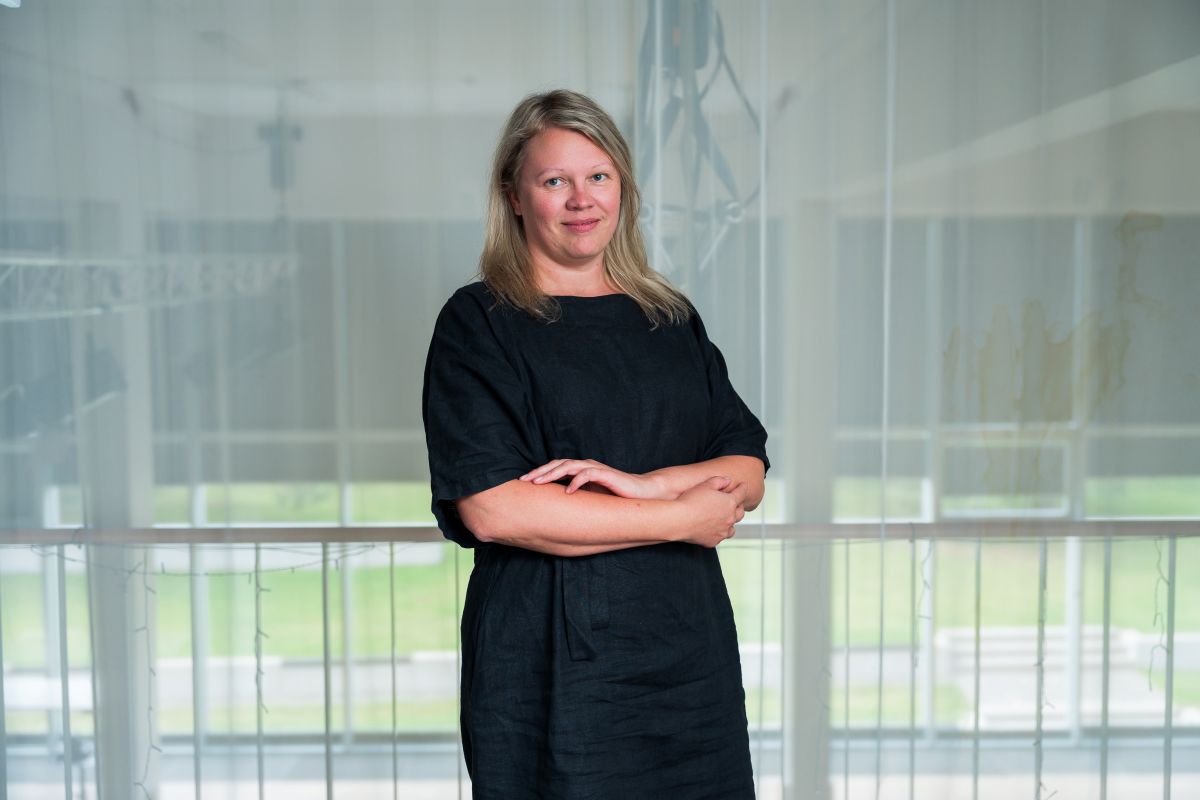
Loreida Timberg, Director of Research and Development and Senior Researcher at the Estonian Maritime Academy, has been teaching at TalTech for more than ten years. Her subjects range from sensory analysis in food technology to refrigeration technologies and quality management in maritime transport – areas that may seem very different at first glance, yet share a common thread: collaborative learning.
Learning as partnership
At the beginning of each course, Timberg reminds students that they are not just learners but her “young colleagues”. “Learning means acquiring the skills and working methods that enable you to operate in your field for real. I create the environment and point the way, but the learning must still be done by the learner,” she explains. She sees learning as continuous improvement – a drive to find ways of doing things faster and better.
As a teacher, Timberg describes herself with three words: “why?”, because both the student and the teacher must understand the purpose behind every activity; collaboration, because learning does not happen alone; and knowledge-based, because discussions and solutions must rely on facts, not assumptions.
For her, the greatest value in teaching lies in students’ critical thinking. “They don’t blindly believe everything I say. They ask questions, analyse and test ideas. That pushes me to keep developing too,” she says. She finds particular inspiration in students’ readiness to experiment with new methods and technologies – an openness she considers invaluable.
General competencies: self-management, collaboration and ethics
Timberg names several TalTech colleagues as significant influences on her own teaching – Birgy Lorenz, Tiia Rüütmann and Marianne Kallaste, whose work on learner-centred approaches and entrepreneurial competences has been especially inspiring. From her own student years, she recalls Professor Toomas Tamm of inorganic chemistry, whose perspective shaped by his experience at an American university made a lasting impression.
According to Timberg, all general competencies taught at university begin with the student’s own motivation. “If the motivation isn’t there, no teacher can get you to graduation. It has to come from within,” she emphasises. She also considers collaboration and communication skills essential – the ability to influence colleagues and work effectively in teams – as well as ethics. “Young people may find it difficult to grasp that every small decision in their professional work will have future consequences for the economy, the environment and society,” she notes. Creativity, in her view, is not about artistic talent but about the ability to find different solutions to problems.
Timberg sees TalTech’s Good Practice of Learning and Teaching document as useful, but believes it could be more practical, with examples and methods. She especially values the emphasis on creativity: “Even in the most technical subjects, creativity is unavoidable – it lies in how we interpret data and solve problems.”
The winding path of learning and a growth mindset
Timberg does not hide from students the fact that learning is hard. She often uses visual models, such as the learning curve, to show how knowledge comes quickly at first, but a more difficult phase inevitably follows. “That’s normal – difficulty means you are developing,” she reassures. She also talks to students about the growth mindset: the ability to see oneself as a continuously developing learner, rather than clinging to labels such as “smart” or “average”.
If Timberg could shape the future of teaching at TalTech, it would be guided by three principles: creative, motivating and purposeful. Creative, so that students dare to seek new solutions; motivating, so that each class is valuable and dialogue-driven; and purposeful, so that curricula offer flexibility and coherence rather than rigid compartments.
Learn more about good learning and teaching: taltech.ee/en/learning