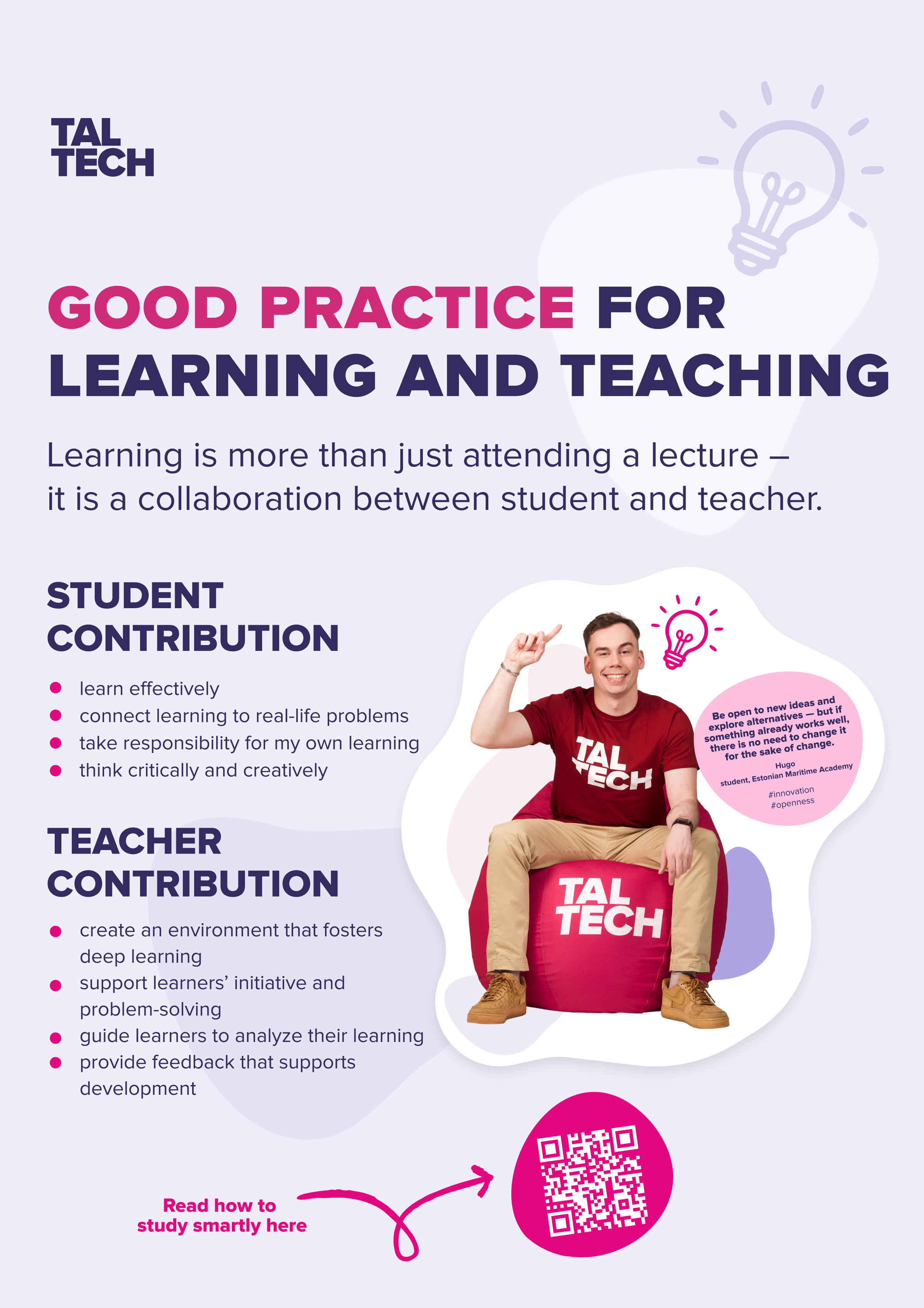
Hugo Kallaste, a third-year student in the Marine Electrical Engineering programme at the Estonian Maritime Academy, chose his field of study with his future career prospects in mind: the qualification opens up opportunities to work both at sea and on land. His family also played a role in his decision, as Hugo’s father studied exactly the same field. However, the path to making his final choice was far from straightforward.
“It was quite a long process. When I first enrolled, I wasn't entirely sure about my choice of degree programme,” he admits. “I studied for a couple of months and then took academic leave because I had other ideas. I wanted to explore my options before making a final decision.”
During his academic leave, he studied other subjects and took time to figure out what genuinely interested him. Eventually, he came full circle and returned to the same degree programme. “And I've never looked back since,” says Hugo.
Learning is a process, and a good teacher teaches you how to learn
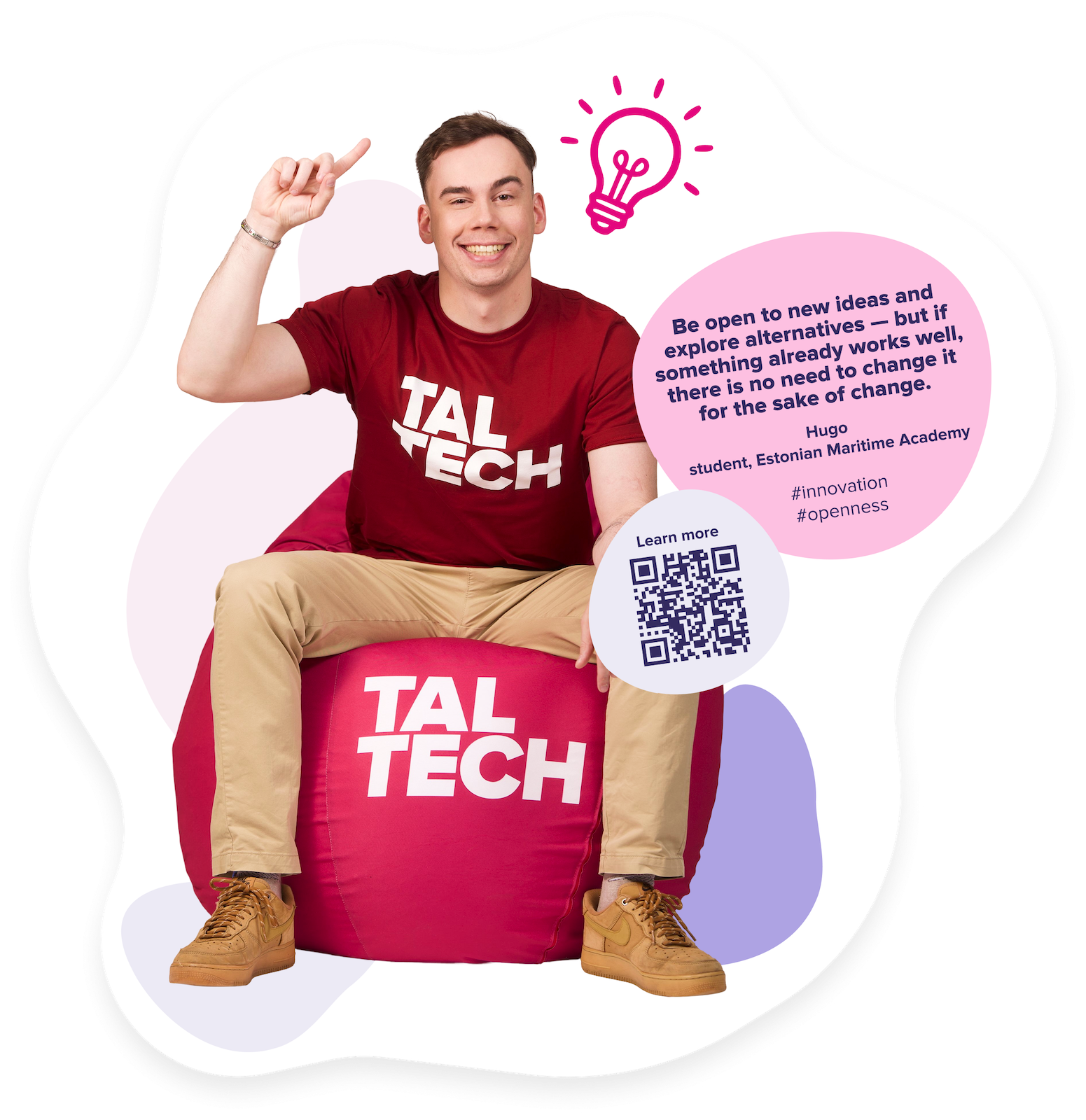
For Hugo, learning isn't something that begins when you walk through the university doors and ends with an exam. Instead, he sees it as a natural, continuous part of life.
“Learning is an everyday process for me. Some people associate learning only with school, but I see it as something natural – we learn throughout our lives,” he explains.
He also emphasises an idea he considers particularly important: making mistakes is normal and even necessary, because he believes mistakes are often our greatest teachers.
Hugo describes teaching as a pillar of support for learning: teachers create the right environment and help students stay on track, but they cannot do the work for them.
“Teaching is there to support learning. A good teacher creates a comfortable, positive environment, listens, takes individual needs into account and supports students in every possible way as they work to realise their potential,” Hugo explains.
One particular thought shared by a teacher at his basic school has stayed with him – although it took him years to truly understand its meaning.
“A teacher doesn't simply teach us; a teacher teaches us how to learn,” says Hugo. “It's only now that I really understand what that means. Nobody else can make you learn. Ultimately, you have to take that step yourself.”
That's why he also values teachers' enthusiasm and choice of teaching methods. The same subject can be taught in very different ways, with dramatically different effects on students.
“When a teacher is enthusiastic, I feel motivated to study independently and learn with genuine interest. But if teaching is just about reading bullet points and letters off slides, it doesn't really spark much interest.”
Two mottos that keep him going, even when his energy runs low
Hugo says his approach to studying is guided by two principles that have developed through personal experience rather than from self-help books.
“Consistency is what gets you to your goal,” he says. “And when you're tired and don't have the energy to do much, do at least a little – but do it well. Do it really well.”
He points out that everyone gets tired and nobody can give 100% every single day. What matters is maintaining momentum and doing whatever you do to the best of your ability.
“I might do the bare minimum, but at least I'll do it well. The next day I'll do a little more, and then a little more again – and eventually I'll take a break. If I tried to do too much, I'd burn out.”
According to Hugo, these two simple ideas have been the foundation of his learning journey: it's not about always pushing yourself to the limit, but about steady progress and purposeful effort.
Engagement, consistency and punctuality
Asked to describe himself as a student, Hugo chooses three words: engagement, punctuality and consistency. For him, these aren't simply personality traits, but a conscious approach to making the most of his university years.
For Hugo, being engaged means much more than simply attending lectures. It means taking full advantage of the environment and the wide range of opportunities a university offers. He believes every student would benefit from being a little more present and involved – not only in their studies, but in university life more broadly.
“I don't want doors to be closed to me in the future because I didn't make the most of my time at university,” he explains. “Everything I gain from this experience will stay with me for the rest of my life.”
For Hugo, punctuality is closely linked to precision and organisation. He finds learning more effective when there is a clear system and study materials are logically structured.
“I like to have everything organised when I study,” he explains. “When my notes are accurate and easy to understand, I create a logical system for myself that I can easily return to later.”
The third quality he considers essential is consistency – the ability to maintain a steady rhythm even when motivation fluctuates.
“If I weren't consistent in what I do, I'd be the one who suffered most,” says Hugo. “It would be much harder to catch up afterwards. That's why I've been studying very consistently for the past three years.”
According to Hugo, consistency is what builds discipline, and discipline is what keeps you going when motivation is lacking.
General competencies are tools that never become outdated
Hugo was already familiar with the concept of general competencies, and the two he considers most important are self-management and critical thinking.
“Critical thinking is a tool that helps you navigate information overload. Self-management, meanwhile, helps you plan your time and focus on one task at a time,” Hugo explains.
He points out that while specialist knowledge may become outdated over time, general competencies are different – these are tools that remain useful throughout life.
As examples, he mentions independent study and reading technical books, which require considerable self-management, as well as group assignments and project presentations, which develop communication, collaboration and critical thinking.
He adds that he previously hadn't been particularly conscious of these connections, but during the past semester he has started paying more deliberate attention to the competencies he develops alongside his academic knowledge.
“Before, it just happened naturally. But now I look at a project and realise that I'm developing my general competencies as well as my technical knowledge.”
One specific experience that made the importance of general competencies especially clear was last autumn's Marine Hack event, where Hugo was placed in a team with people he had never met before.
“When you put people together in a group for five to seven hours to discuss a problem on a national scale, that's when general competencies really come into play,” he explains. “Expressing yourself, listening to others, understanding different perspectives and solving problems in ways you wouldn't necessarily have thought of yourself.”
According to Hugo, situations like these reveal just how important it is to consider others when working in a team – rather than always trying to take the lead.
TalTech's unwritten rule: every learner is valued
According to Hugo, one of the most important unwritten rules of TalTech's learning culture is that every learner is valued. In his view, students aren't treated as identical parts of a machine; instead, their individual differences are recognised and respected.
“We're all different people. We have different strengths and weaknesses, and that doesn't automatically make anyone better or worse than anyone else,” he says. “TalTech provides a really good environment where everyone is valued equally and everyone can find support.”
Hugo would also describe TalTech students using two adjectives: curious and ambitious. He believes that people who choose to study at TalTech have an inner desire to understand the world and their chosen field.
“I think every student who comes to TalTech is naturally curious – whether it's curiosity about the world or about their own area of study,” he says.
He also believes that every student has ambition: the desire to develop, improve and achieve their goals, whether that means finding a good job or fulfilling their professional potential.
That's why Hugo sees a typical TalTech student as someone who is both curious and determined to build their future.
Learning is our own responsibility
Of all the principles outlined in TalTech's Good Practice of Learning and Teaching, the one that resonates most strongly with Hugo is responsibility.
“Learning is our own responsibility. We came here for ourselves – to become better and to develop. We're not studying because our mum told us to or because our dad would otherwise stop giving us pocket money,” says Hugo.
He also identifies with the principles of creativity, initiative and ethical behaviour – particularly the idea that every learner needs to find the learning methods that work best for them and have the courage to initiate change when necessary.
“I admire people who take matters into their own hands and try to do something about it when they see that something isn't right,” he says.
Hugo emphasises the importance of cooperation between students and teachers: he believes that mutual respect also strengthens students' commitment to learning.
Looking towards the future, Hugo says that his ideal learning experience would be practical. At the same time, he values balance: innovation is important, but change shouldn't happen simply for the sake of change.
“We need to be open to new ideas while also remaining somewhat conservative about practices that already work,” he says. “If something works, there's no point in changing it just for the sake of it. But we should always keep looking for alternatives.”
TalTech's Good Practice of Learning and Teaching is a shared agreement within the university designed to support high-quality learning and teaching and foster a common academic culture. At its heart is the understanding that learning is not merely about acquiring knowledge, but is a collaborative process of development in which both students and teachers play an essential role.