
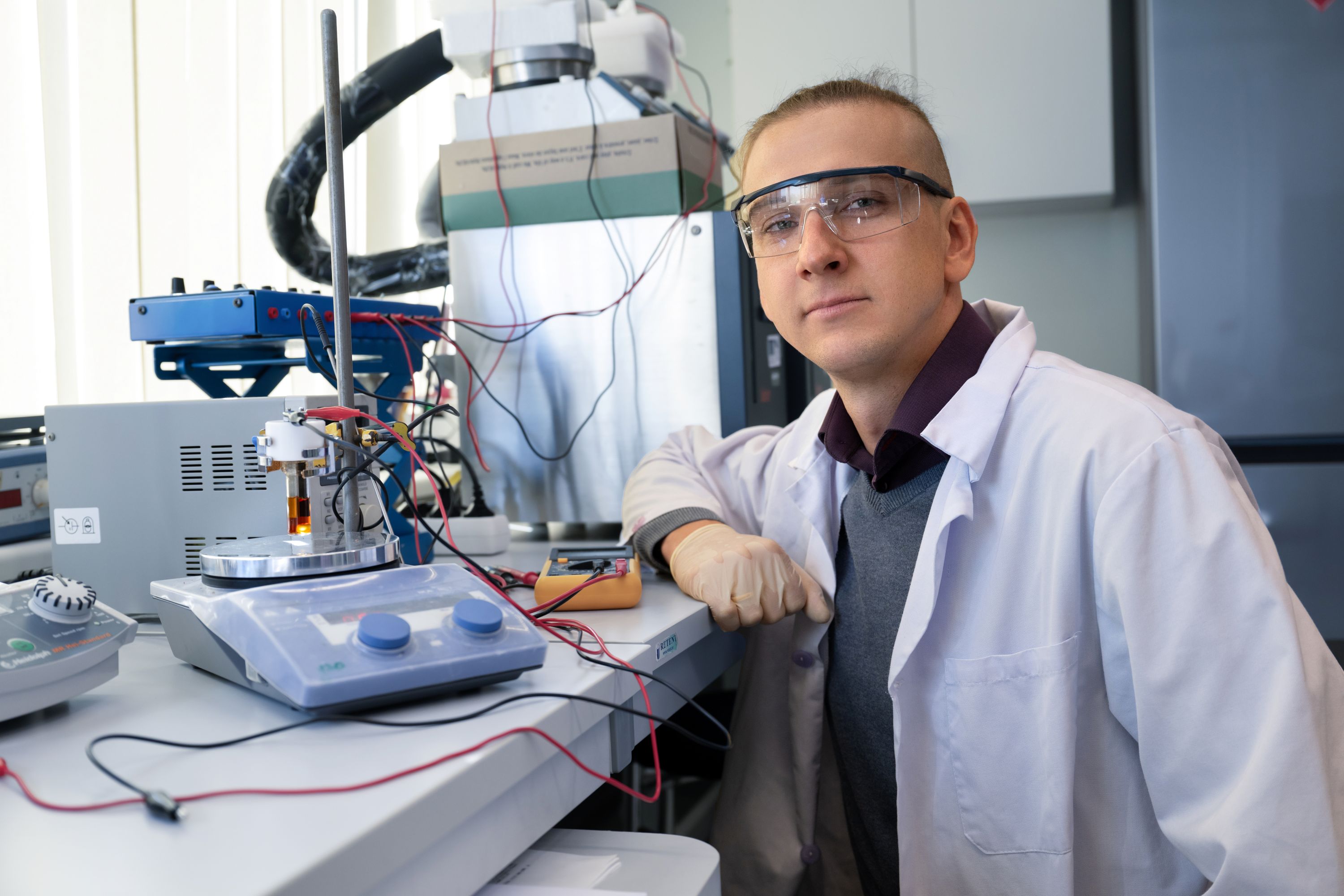
In the “Tunne teadlast/Meet the Scientist” series by Delfi Forte and Estonian universities, Maksim Ošeka, Tenured Associate Professor of Synthetic Technologies at the Department of Chemistry and Biotechnology, introduces himself and his research.
Where are you from, and how long have you been involved in research?
I am from Tallinn and have been doing research since 2009. I earned all my academic degrees – my bachelor’s, master’s and doctorate – at Tallinn University of Technology. At the same time, I have always sought opportunities to gain experience abroad. During my master’s studies, I spent a semester at the University of Oslo through the Erasmus programme. During my doctoral studies, I worked in Spain for six months, and after completing my doctorate, I spent two years as a postdoctoral researcher in the Netherlands. While abroad, I have tried to learn new methods and techniques that were not yet being used in Estonia, and to bring that knowledge and those skills back home.
How did you get into research, and what appeals to you about it?
My interest in chemistry began at school. I started taking part in chemistry olympiads in Grade 8 and did quite well. I continued competing in upper secondary school and particularly enjoyed the practical component, where we could carry out experiments in the laboratory. That interest led me to study applied chemistry at Tallinn University of Technology. In the second year of my bachelor’s studies, I joined Professor Tõnis Kanger’s research group – my first step into research.
What appeals to me about research is that every day brings something new. We investigate new things, face new challenges and keep learning. Above all, though, I enjoy working with people. I am surrounded by people who are passionate about chemistry and research. Their interest and dedication motivate me to keep going too.
What research problem are you currently working on, and why is it important?
My Synthetic Flow Chemistry Research Group develops new methods of synthesis. Modern methods allow us to synthesise molecules with highly complex structures, including molecules that can be used as medicines. The question, however, is how efficient the process is: how many steps it requires, how much the synthesis costs and how much waste it generates. Our aim is to make the preparation of molecules as efficient and environmentally friendly as possible.
One of our tools is electrochemistry, in which we use electricity to drive reactions. In certain reactions, this allows us to avoid hazardous or toxic reagents and carry out chemical transformations under milder conditions. We also work on asymmetric organocatalysis, using small organic molecules as catalysts. These enable us to preferentially produce one of a molecule’s two mirror-image forms. This is particularly important in medicines, because the two mirror-image forms of a molecule can have different effects in the body.
In our research, we try to combine these approaches to find even more efficient solutions. We want to develop methods that could, for example, be used in pharmaceutical manufacturing in the future, making synthesis simpler, greener and less expensive.
Which discoveries in your field have had the greatest impact on society so far?
The impact of organic synthesis on society is well illustrated by six Nobel Prizes in Chemistry, awarded in 2001, 2005, 2010, 2021, 2022 and 2026. The practical applications of scientific discoveries can sometimes lie far in the future, but the impact of the discoveries recognised by these prizes is already clear. They have become cornerstones of modern drug discovery and the pharmaceutical industry: chemists use this knowledge and these methods in their everyday work.
There has been enormous progress in the development of new medicines over the past twenty to thirty years. Today, we can treat or manage diseases for which the options were once very limited. Advances in organic synthesis have played an important part in this: to develop a new medicine, we must be able to make the desired molecule and find a way to produce it in sufficient quantities at a reasonable cost.
From the perspective of your field, what is the most pressing problem in Estonia or the world today?
In my view, one of the biggest problems, both in my field and in fundamental research more broadly, is insufficient and unstable funding. Over the past 10–15 years, the focus has shifted between different priorities: first the rapid growth of the IT sector, then the green transition, and now artificial intelligence and national defence. All of these are important areas that need attention. Often, however, the main expectation is for rapid practical results, with the emphasis on applied research and engineering.
The value of fundamental research may not be immediately apparent. A discovery may find a practical application only ten, twenty or thirty years later, sometimes even a century later. This does not mean that the discovery has been useless in the meantime – we simply cannot yet foresee all the possibilities that new knowledge opens up. We must remember that major breakthroughs in applied science cannot happen without fundamental research. As the name suggests, it provides the foundation on which new solutions can later be built.
Research funding is currently largely project-based. Researchers have to apply for grants from Estonian and international funding programmes, including European programmes, where competition is intense. Writing applications takes a great deal of time, yet even a good research idea and a strong application may not secure funding.
That is why we need sufficient and stable baseline funding alongside competitive grants. This would allow researchers to focus on research, keep their groups together and plan studies over a longer period. It would also give them the opportunity to explore bolder ideas whose outcomes cannot be guaranteed but which may lead to major breakthroughs. Researchers should not have to worry constantly about whether they will be able to continue their work when their next project ends.
Which research achievement are you particularly proud of?
My research group is among the first in the world to have successfully combined organocatalysis with synthetic electrochemistry. This is a novel approach that offers several advantages over previous methods and opens up new possibilities for molecular synthesis.
This achievement also has personal significance for me. During my doctoral studies, I worked on organocatalysis, and during my postdoctoral research, I worked on electrochemistry. When I established my own research group, I wanted to bring that experience and knowledge together. Our collaboration with Italian colleagues has now resulted in a paper that will soon appear in a highly prestigious scientific journal. (Publication is expected in late 2026 or early 2027.)
What else would you like to achieve in your research?
I would like to apply the methods and expertise our group has developed in flow chemistry, electrochemistry and photochemistry to drug development and manufacturing. The aim is for these methods to be used in the pharmaceutical industry and help create medicines that reach the market and patients.