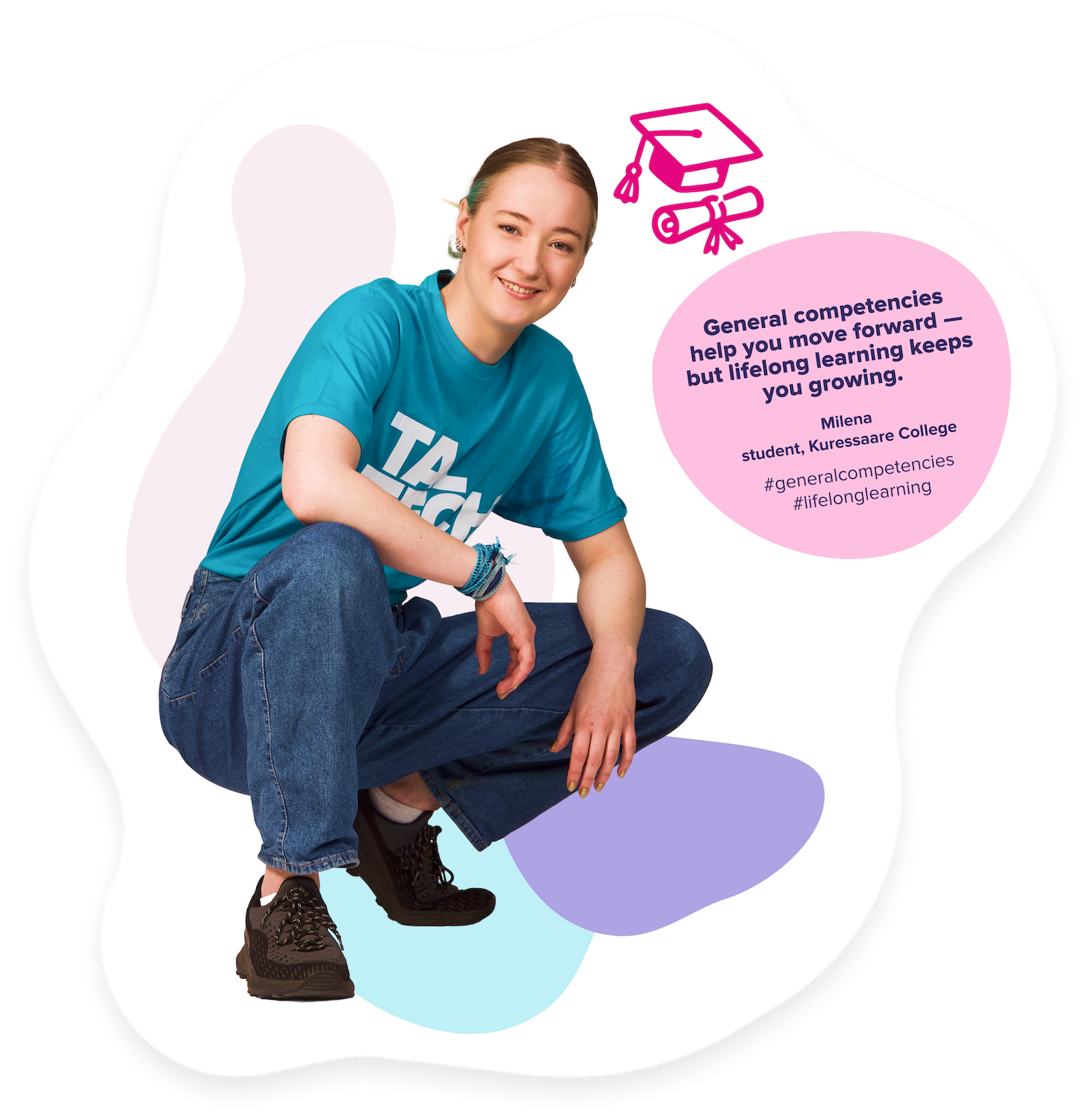
Milena Vaakmann, a third-year student at TalTech’s Kuressaare College, is studying marine engineering and shipbuilding. The sea and ships had fascinated her before she enrolled, so the programme felt like a natural choice.
The study programme was the deciding factor for her; location and other considerations played a smaller part. “The programme was the most important thing. Once it felt right, moving to Saaremaa was no problem for me,” she says.
Learning works best when you can do things yourself
Milena describes learning simply but meaningfully. For her, it is about truly acquiring something, rather than ticking a box or completing a task. “For me, learning means gaining a new skill or knowledge. It is more than having a record somewhere saying I have done something.” She particularly values knowledge she can use again, whether in everyday life or by sharing it with others.
Milena says learning becomes most meaningful when theory is connected with practical activity. One of her most memorable experiences was a course in which students had to design their own ship as a group: produce drawings, do calculations and think through the entire structure. “It was a really good group assignment. We had to truly understand what we were doing and discuss it together,” she recalls. Such tasks make students engage deeply with the subject and develop their collaboration skills.
For her, this distinction makes it clear when real learning takes place and when students are simply getting through a course. “If a lecturer just tells you to complete something and use artificial intelligence to do it, it can easily become a matter of simply passing the course. But when you have to think for yourself and find solutions, you learn much more.”
She believes it is very important for lecturers to encourage questions and be available when needed. She recalls a lecturer explicitly telling students to write if anything remained unclear. This reassures students that help is available. At the same time, she emphasises that the ultimate responsibility still rests with the learner.
Done today, worry-free tomorrow
Milena’s approach to learning is closely linked to self-management. She likes to get things done as early as possible, instead of leaving them until the last minute.
“My principle is quite simple: done today, worry-free tomorrow,” she says. In session-based studies, this often means doing homework straight after a lecture, while the subject is still fresh in her mind. This leaves more time for other activities later and frees her from constantly thinking about unfinished assignments.
Milena believes an important principle in learning is to take time to think before acting. Rather than starting an assignment immediately, she first reads the instructions carefully and works through what needs to be done, step by step. This helps her identify the materials or guidance she may need and where to find them.
She describes herself as a learner in three words: conscientious, thorough and organised. Being conscientious means she cannot relax properly until the necessary tasks are done. Being thorough means exploring a subject deeply enough to be able to do the same thing again after the course has ended. “If there are further questions or something can be explored in more detail, I try to do that. Then I feel I have truly understood.”
Motivation comes from a sense of accomplishment
Milena finds it difficult to explain her motivation to study in terms of a single reason. She admits she cannot say exactly where it comes from, but knows what helps sustain it. Completing assignments while the subject is still fresh in her mind plays a major role.
This does not mean her motivation never fluctuates. The most difficult situations arise when several large assignments need to be completed at once and their deadlines fall around the same time. At such moments, concentration can slip and stress can build.
Taking a deliberate break helps. “When my motivation drops, I do something completely different for a couple of hours,” she says. Sometimes this means going for a walk outdoors; sometimes it means a quiet activity such as solving sudoku puzzles. Once her mind has had a rest and her stress has eased, she finds it much easier to return to studying.
Managing time and working efficiently
For Milena, general competences are not abstract or theoretical concepts, but practical skills needed both during studies and later in working life. In her view, everything starts with time management and the ability to set priorities. “People need time in their lives for rest and simply enjoying themselves,” she says. “If you focus only on work or studying, you risk quickly burning out and becoming unhappy.”
She also values the ability to optimise what you do: to do as much as necessary, but no more. With many different responsibilities in life, people need to find a balance that allows them to attend to everything that matters. Milena also believes the ability to concentrate is becoming increasingly important. “In today’s world, being able to say ‘I am studying now and will not get distracted by other things’ is a skill in itself.”
Milena also highlights the critical evaluation of sources. Even when materials are provided by a lecturer, students should not simply accept them blindly. “You still need to check where the figures or data come from,” she says. Knowing how to ask for help is equally important. “You cannot push through everything on your own. Sometimes you need others to help,” she says, adding that studying and discussing things together often makes difficult topics much easier.
General competences help you move forward in life
These competences do not develop overnight, Milena says, but gradually over the course of studies. “Session-based studies are a good test in this respect: when there is a longer break between lectures, it can feel as though you have plenty of time. At first you think you will do the homework later, but then you discover how much time the work actually takes,” she explains. Such experiences teach time management and responsibility.
Milena believes lecturers can support general competences primarily through guidance. For projects, for example, students are told about the experiences of previous cohorts and advised to start early. Separate courses also teach students how to find scholarly sources, while a classroom environment can be created that helps them concentrate.
If a student asks why general competences are needed at all, Milena’s answer is simple: they help people move forward in life. Self-management helps avoid conflict and communicate more calmly with others. It is also important to maintain the habit of learning, because new skills have to be acquired throughout life. “If someone decides at 25 that they no longer need to learn anything, sooner or later they will have to start learning again anyway. It is better to maintain the habit, because starting again is harder than keeping going,” she says.
Critical thinking helps people handle the information coming at them from every direction today, while collaboration and communication are essential in almost every job. “There are very few occupations where you do not have to communicate with people,” she notes. Ethics is just as important: being able to act in a way that makes your decisions right in both your own eyes and those of others. “If you do something that goes against society’s values, people will disapprove. And ultimately, we all want others to think well of us.”
A good learning culture is built on self-management and honesty
Milena says good practice in learning and teaching is not always most clearly reflected in documents or formal principles. It often emerges in everyday learning experiences instead.
She sees learners’ self-management as the most important aspect of good practice. Milena finds it surprising that some students have not even read the study programme before coming to university. “Learning starts with knowing what you are coming to study and why,” she says.
She also observes that students who can manage their own learning are generally the ones who stay at university. “Those who can manage themselves and keep up with their studies are the ones who stay. Those who cannot often leave after the very first semester,” she says.
She considers collaboration and communication another important value. At TalTech, she sees many opportunities for collaboration between different schools and organisations, as well as student events and joint activities. These create an environment in which communication and collaboration become a natural part of studying.
However, Milena feels some areas deserve more attention. She singles out ethics, which she believes could be addressed more thoroughly in engineering education.
She also values communication between learners and lecturers. “When a lecturer encourages communication and responds quickly, studying goes much better too,” Milena says. She also stresses students’ own role: if something remains unclear, they should ask, rather than wait for a grade and only then say they did not understand.
Learn for your own sake
Milena says teaching at TalTech already has many strengths, but there is always room to consider what could be done better. In her view, the most important thing is that lecturers know the subjects they teach well. “If a lecturer is not a specialist in their field, they should at least be very familiar with the course they teach.”
She also believes teaching should be research-based. This means that studies should draw on real knowledge and research, as well as theory.
She would also like study programmes to offer courses that truly engage students and help them understand the role of their field in the wider world. Courses should spark interest and connect with students’ future professional field. If a course seems too far removed from their specialism, students may struggle to see its value.
Milena says university is a time to focus seriously on acquiring knowledge and understanding your field. Only then do all the skills the university talks about — self-management, critical thinking and collaboration — take on real meaning.
TalTech’s Good Practice in Learning and Teaching is a university-wide agreement designed to support high-quality learning and teaching and develop a shared academic culture. At its heart is the idea that learning is more than acquiring knowledge: it is a collaborative process of development in which both the learner and the lecturer play an important role.