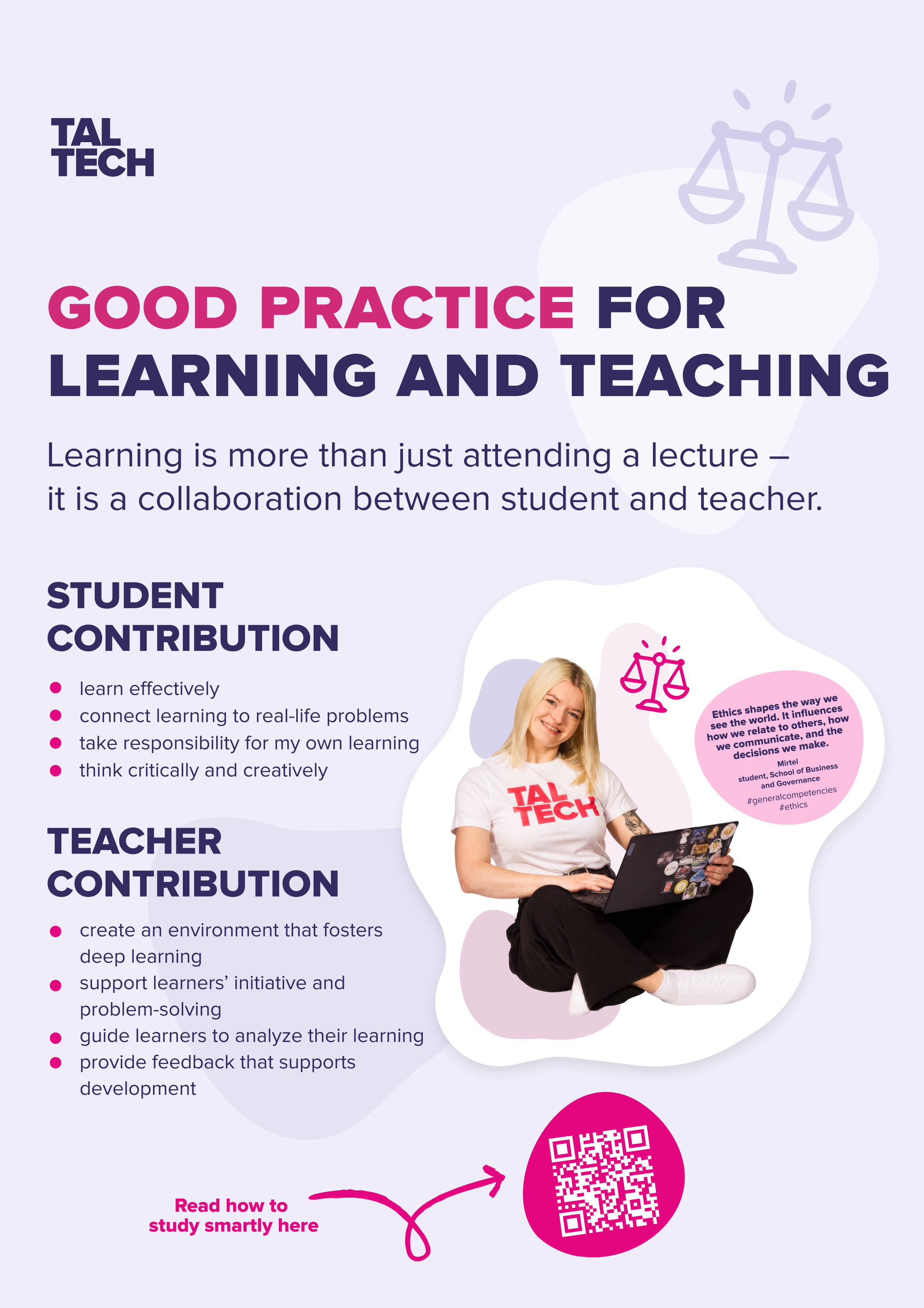
Mirtel Migur’s path to TalTech was far from straightforward: she began her studies in Building Design and Construction Management, but eventually found her way to the School of Business and Governance.
“I didn’t have a clear plan from the outset,” she admits. “In the end, I chose Business because it offers such a wide range of future opportunities. The programme doesn’t lead to one particular job; it gives you a broad foundation from which you can decide where to go next. I like the fact that I don’t have to commit to a single path – I can change my plans in the future.”
As a second-year Business student specialising in Accounting in the Digital Age, Mirtel particularly values this flexibility.
Learning as a natural part of life, teaching as mentoring

Asked to describe what learning means to her, Mirtel answers immediately: “Learning is part of life; you can’t do without it. It’s like breathing. Sometimes it can be difficult, but if you don’t breathe, you don’t live. If you don’t learn, you don’t move forward either.”
For her, learning extends far beyond the lecture hall. “You learn every day. Even when you take a different route in the car and notice something new. It’s a continuous process of personal development.”
Mirtel understands teaching through her own experience. “I’m a coach myself, so I look at teaching partly from that perspective,” she says.
To her, a teacher is less an authority who hands down knowledge from above and more a mentor along the way. “Everyone has their own path to walk. You can’t make choices for someone else or do things for them. You can’t really steer them anywhere if they aren’t moving themselves. A teacher’s role is to support and motivate – to provide tools and knowledge, but let people try things out for themselves.”
Mirtel believes that true teaching means empowering others. “It’s great that you know something. But what matters is passing on that knowledge and those skills so that the other person can manage independently. For me, teaching means walking alongside someone, rather than pulling them along from the front.”
“A teacher isn’t there to give orders and simply tell people what to do, but to help. It’s important to meet students on equal terms – to create an atmosphere where they feel confident enough to ask questions, make mistakes and discuss ideas. A supportive attitude builds trust. And when there is trust, real learning happens,” Mirtel notes.
Looking for the root cause
Mirtel isn’t satisfied with being told that something is “just the way it is”. “I like to learn more and go beyond what is said in a lecture. If something is complicated in a practical class, I don’t just want to know the answer. I want to know why it is that way. What is the root cause?”
In other words, understanding the process matters to her as much as the outcome. “If an explanation gives you a beginning and an end but leaves questions unanswered in between, it bothers me. I want to understand why things work the way they do.”
This approach reflects her analytical and thorough attitude to learning – she looks for logic and connections, rather than simply answers.
It is all an investment in yourself
When her motivation begins to fade, Mirtel reminds herself of a simple principle: “Ultimately, all of this is for me. I’m doing it for my future self. It’s like tidying my room in the evening so that my future self has a nice place to wake up in the morning. It’s an investment in myself.”
Alongside this focus on the future, Mirtel draws energy from the sheer joy of discovery. “When I learn a new Excel command, for example, I’m absolutely thrilled. It’s such a great feeling when you understand how something works.” Acquiring knowledge is motivating in itself. New tools, new software and new skills give her a sense of achievement and keep her interested.
There is also a deeper dimension to Mirtel’s motivation. She speaks openly about how she has always been driven by the wish to support her younger brother, who has a profound disability, in the future. “It has always been at the back of my mind. I want to get a good job with a good salary so that I can support him financially in the future. It gives me a very clear sense of responsibility – I can’t just give up or assume that things will somehow work out. I’m not studying only for myself. I’m also studying so that I can be there for someone else in the future.”
She identifies another important source of strength: community. Student organisations and friends help her keep going even when she is tired. “There are days when I might not feel up to it. But I come to university because of my friends. And once I’m here, I go to the lecture too. That sense of belonging makes a big difference.”
Competencies cannot always be taken for granted
Mirtel admits that many general competencies – self-management, collaboration and communication – have felt like a natural part of life to her from an early age.
“I grew up in a very varied environment. I was given these skills from childhood, so they seem self-evident to me,” she says. “But throughout life you meet people who haven’t had the same background. Then you realise that not everyone has these skills automatically.”
That is precisely why she believes universities should develop them deliberately. “They are essential for managing your own life and working with others. We may not think about them every day, but they influence everything.”
Mirtel clearly connects the need for general competencies with working life. “Sooner or later, you have to work in a team. You’re either a team member or a team leader, but either way, you need to communicate and give and receive feedback. It’s important to approach a situation as ‘us versus the problem’, rather than start blaming people.”
But it all starts with yourself, she says. “Before you can be a valuable team member, you need to have your own focus in place. Reflecting on yourself and analysing a situation – those things start on the inside before they extend outwards.”
“In our student organisation, we had a saying: ‘They’re a specialist.’ It meant that someone might be very knowledgeable in their field, but if they can’t communicate, give or receive feedback, reflect on themselves or arrive on time, something very important is missing,” Mirtel says, illustrating the importance of general competencies.
Practical classes as a real laboratory for development
Of TalTech’s general competencies, Mirtel feels that critical thinking is the one she uses most in her everyday studies. “I’m quite an analytical person. I like things to be organised and to have a plan. I tend to think situations through very thoroughly – perhaps sometimes even too thoroughly – before making a decision and moving forward.”
For her, critical thinking primarily means taking a rational approach: breaking a situation down, looking for causes and making informed decisions, rather than acting on emotion.
Another skill, perhaps even more important, is collaboration. “I work well independently, and sometimes it is quicker to do things on your own. You may go faster alone, but you go further together,” she says.
In Mirtel’s view, general competencies come to the fore most clearly in practical classes. “Lectures have a set format, but practical classes are where you really develop,” she says. “You do group work, learn how to divide tasks and work with people you may not know at all, with whom you have to find common ground.”
“These are the situations where you learn communication and collaboration most intensively. Different working styles, personalities and expectations force you to adapt, listen and explain. You can’t choose to work only with people you feel comfortable with. That’s real life,” Mirtel observes.
Feedback also plays an important role in development. Students are expected to analyse their work several times before presenting it – a process that already develops their ability to reflect on their own work. But they also have to assess other people’s work. “When you have to give feedback, the question immediately arises: how do you make it constructive and purposeful, rather than simply attacking the person?”
This teaches students to separate the problem from the person and give constructive feedback – honestly, but respectfully. Mirtel has noticed that several lecturers make a conscious effort to support this: they guide discussions, emphasise reasoned arguments and teach students how to communicate professionally in difficult situations.
Room to grow: ethics as a deeper compass
Although Mirtel feels she has developed considerably during her time at university, she sees room for further growth in every area. “I think you can develop every competency further,” she says. “One aspect of TalTech’s general competencies that caught my attention, and initially even raised questions for me, was ethics.”
It prompted her to consider the difference between morality and ethics. “Your moral compass may be in place – that comes largely from your upbringing and society. But for me, ethics means thinking through why something is right or wrong. What lies behind it?”
She sees ethics as one of the driving forces shaping a person’s worldview. “It affects how I see other people, how I communicate in a team and how I make decisions. If I understand ethics more deeply, it influences all the other competencies.”
That is precisely why she sees this as an area for personal development. “I feel I’m not yet as competent in this area. But the more I think it through, the stronger everything else becomes too.”
The dream: a university that works together and keeps pace with the times
When Mirtel thinks about the ideal learning experience, the first word that comes to mind is “unity”.
“I hope that students and lecturers form one coherent system. Collaboration requires effort and commitment from both sides – it can’t work if only one side contributes.”
Another important wish is for interactivity and keeping pace with the times. “Lecturers should make an effort, keep up with developments and create an environment that sparks the desire to learn. They should not only share knowledge, but also help students develop the desire to acquire it.”
In Mirtel’s vision, learning is more than collecting credits: it takes place in an environment that awakens curiosity and supports students’ development – consciously, collectively and with purpose.
TalTech’s Good Practice for Learning and Teaching is a shared agreement within the university aimed at supporting high-quality learning and teaching and developing a common academic culture. At its heart is the idea that learning is not merely about acquiring knowledge, but a collaborative process of development in which both students and lecturers play an important role.