
Elina Suut-Tuul defended her doctoral thesis, exploring how mechanochemistry can be used to synthesise complex molecules.
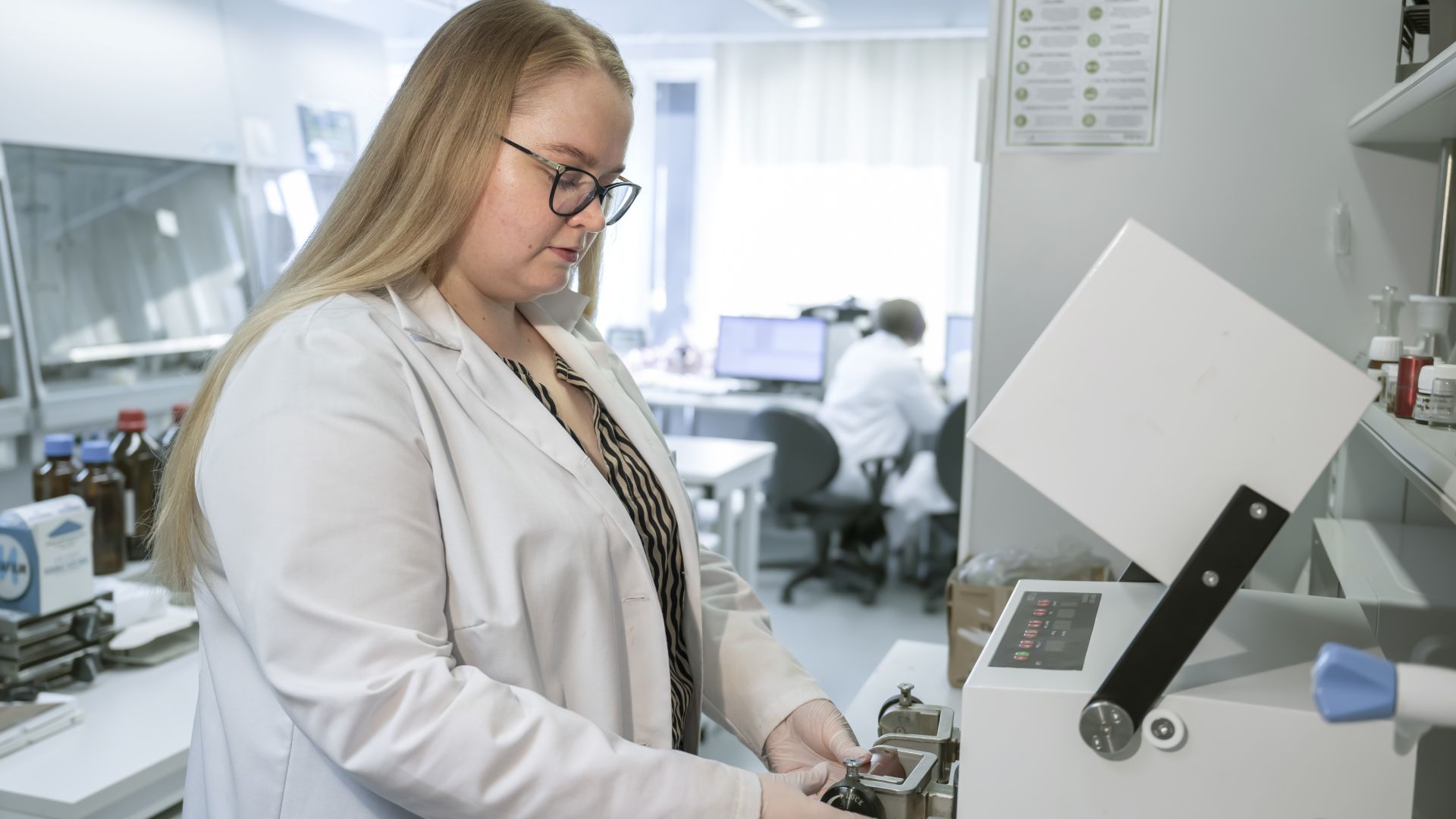
Elina's first encounter with mechanochemistry came during her bachelor's studies, when she joined Riina Aav's supramolecular chemistry research group. Around the same time, the laboratory acquired its first ball mill for grinding molecules. “I had the opportunity to start working with it from the very beginning and focus on mechanochemistry throughout both my master's and doctoral studies,” Elina recalls.
In a ball mill, chemical reactions are driven by mechanical energy. The starting materials are ground and mixed, while collisions between the milling balls help trigger the reactions. Mechanochemistry is considered one way of putting the principles of green chemistry into practice, as it can reduce the need for solvents and other materials, thereby also reducing waste.
Chemical processes typically require various solvents, which can result in substantial amounts of waste, high material consumption and an environmental impact. Mechanochemistry, by contrast, makes it possible to carry out reactions almost entirely in the solid state or with only a very small amount of liquid, using mechanical energy. This is one of the reasons Elina is interested in mechanochemistry. “It also makes it possible to create very interesting molecules by combining mechanochemistry with different chemical conditions, including some whose synthesis has previously been very difficult or even impossible.”
50,000 Possible Intermediates
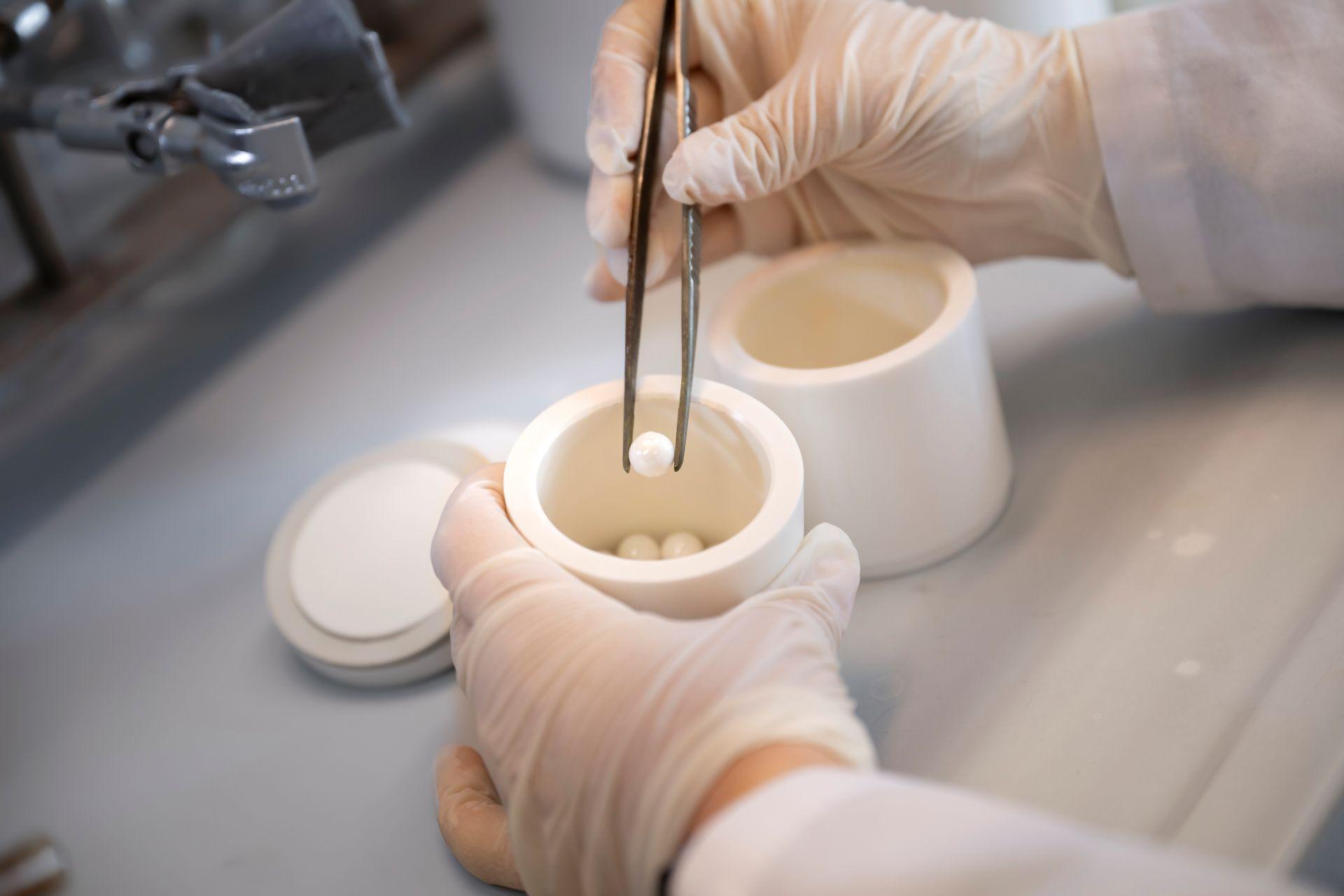
Elina's doctoral research focused on developing mechanochemical synthesis methods for functional hemicucurbituril derivatives containing biotin. Hemicucurbiturils are hollow macrocyclic molecules that can be thought of as tiny molecular containers. They are made up of monomers, which can be described as building blocks that join together to form a macrocyclic structure. Because of their cavity, hemicucurbiturils can act as host molecules, binding various anions and other smaller molecules inside.
“This makes them interesting, for example, as sensors or carriers for different substances. Hemicucurbiturils do not occur naturally; they are designed in the laboratory to have specific structures and functional properties,” Elina explains.
One of the central questions of the doctoral research was how to make the building blocks come together in exactly the desired way during a mechanochemical reaction. According to Elina, this is a major challenge because when two different monomers are used as starting materials, the synthesis of a mono-biotinylated macrocycle could theoretically produce around 50,000 different intermediates.
“By changing the reaction conditions, we were able to steer the system towards forming mainly two macrocycles, one of which was the desired mono-biotinylated hemicucurbituril. Adding biotin gave the macrocycle a new functionality, and we used this property to develop a new functional material for the selective removal of perchlorate anions,” Elina explains. Perchlorates are contaminants that can pose a risk to human health.
An 82-Fold Increase in Scale
Another important result of the doctoral research was the development of a new synthesis route for a macrocycle that had previously been synthesised: biotin[6]uril. Until then, it had been synthesised in solution, but the method had a relatively low yield, required a long reaction time and involved the use of large amounts of mineral acid. Elina developed a more efficient procedure that generated less waste and made it possible to produce the compound on a larger scale for the first time, while also reducing the reaction time and the amount of acid required. A single synthesis yielded almost 20 grams of pure product – an 82-fold increase in scale compared with the previous method.
Scalability is particularly important when considering potential industrial applications. As the chemical industry moves towards more sustainable alternatives, mechanochemistry offers one way of significantly reducing material and resource consumption as well as waste generation. Elina points out that analysing complex reactions is far from easy, particularly in the case of mechanochemical reactions. “While a reaction carried out in solution produces a homogeneous mixture, a mechanochemical reaction mixture can consist of different phases, and its composition can vary from one part of the mixture to another. We therefore had to develop and validate an analytical method that would allow us to reliably evaluate the outcome of the reaction.”
Scaling up the reactions presented another challenge. “Mechanochemical syntheses can be carried out using different types of instruments, and transferring a reaction protocol from one instrument to another is not necessarily straightforward. It was also not possible to simply apply the optimised conditions when working with larger quantities.”
Research Not Always Goes as Planned
Elina entered doctoral studies to delve deeper into interesting scientific problems and develop as an independent researcher. She quickly realised, however, that research rarely progresses in a straight line. “Plans can change quickly, experiments can fail, and sometimes unexpected results provide the most information,” she says.
For Elina, good collaboration, reliable data and a good supervisor are essential in science. For those considering doctoral studies, she recommends choosing a topic that genuinely interests them and carefully considering both the supervisor and the research group. “During a PhD, you need both scientific and day-to-day support to achieve your goals.”
Elina Suut-Tuul's doctoral thesis, "Mechanochemical Synthesis of Biotin-containing Hemicucurbiturils", is available in the TalTech digital repository.