
In November 2025, the first hydrogen-related continuing education course was delivered at TalTech Virumaa College, aiming to introduce participants to the fundamentals of hydrogen technologies, the hydrogen value chain, and applications in industry and energy. The course “Fundamentals of Hydrogen Technologies” (6 ECTS) was part of the international H2CoVE project, which focuses on developing hydrogen-related skills through cooperation between European vocational education and training institutions and higher education institutions.
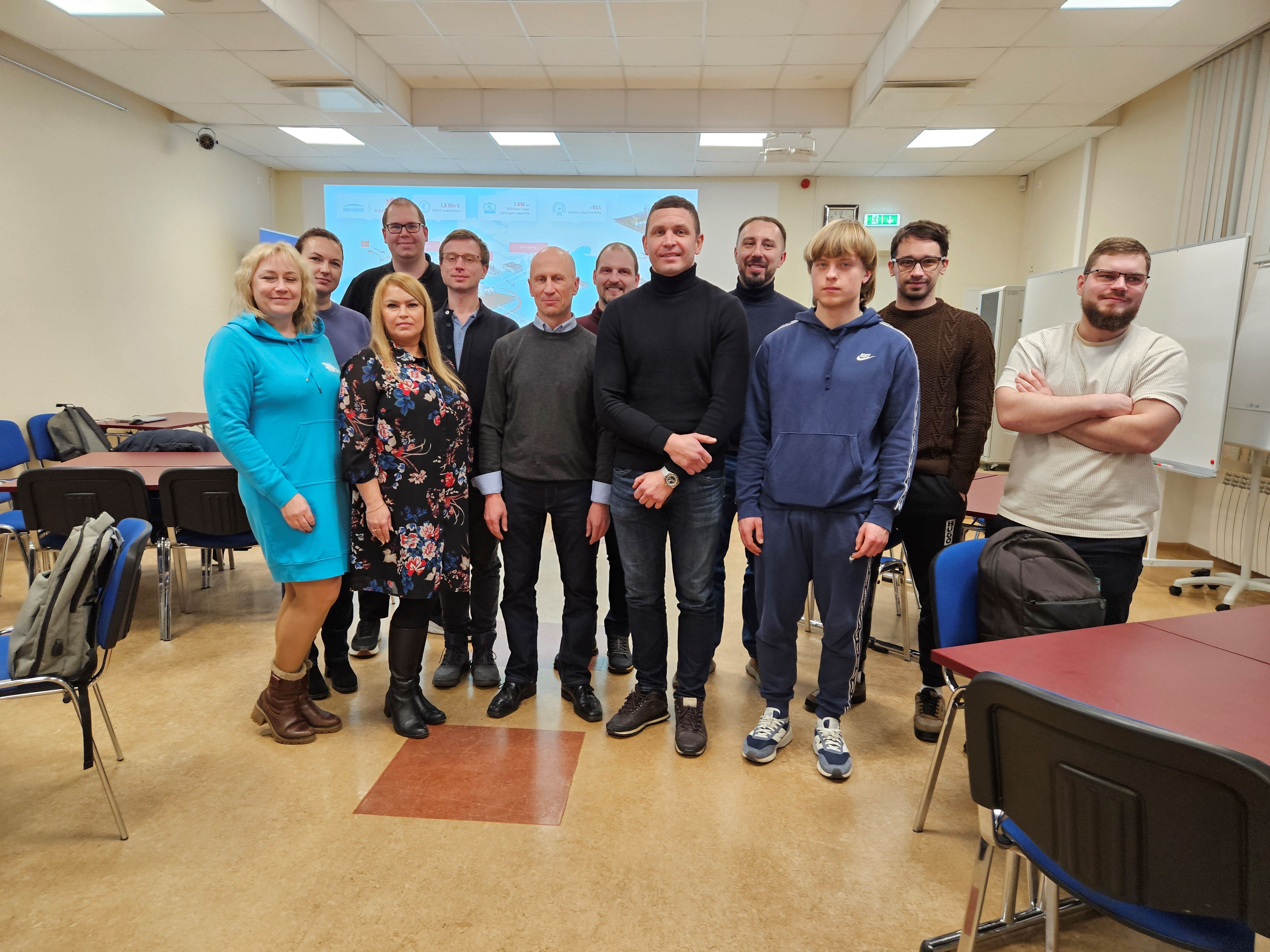
The training was targeted primarily at master’s level learners, but in terms of content it is also suitable for bachelor’s students and engineering professionals who wish to understand the role of hydrogen in the green transition. The course covered the physical and chemical properties of hydrogen, production technologies, safety, storage, transport, and applications across various sectors, ranging from transport to the chemical industry.
According to the course instructors, participant interest was high, and discussions based on practical examples and current technologies were substantive. As all learners were connected to technical or industrial fields, this strongly supported the integration of theoretical knowledge with real working-life contexts. “The development of learning materials is a continuous process, as the hydrogen sector is evolving very rapidly—future courses must also reflect new technological and regulatory developments,” confirms course instructor Ando Astor.
The course was delivered in a blended learning format, including both classroom lectures and a practical component. The first training course also served as input for the development of subsequent modules.
Within the framework of the H2CoVE project, the following hydrogen-related courses are planned to be developed in Estonia: “Fundamentals of Hydrogen,” “Hydrogen Technologies,” “Hydrogen Safety,” “Hydrogen Safety Management,” “Hydrogen Storage Systems,” and “Hydrogen in Mobility and Industrial Systems.” These courses cover the entire hydrogen value chain and are aimed at engineers, vocational learners, and specialists who wish to prepare for the development of the hydrogen economy.
Participants in the pilot course highlighted the practical relevance and topicality of the training in their feedback. At the same time, they emphasised the importance of continuing to update the materials and further train instructors in order to ensure high quality and alignment with the workforce needs of the hydrogen economy.
In Estonia, the development and piloting of the courses is coordinated by TalTech Virumaa College in cooperation with Tartu Vocational College (VOCO). Employers are involved both as contributors of input and as providers of practical training placements. The project partner countries are Norway, the Netherlands, Austria, Estonia, and Ukraine.
The objective of the project is to support Europe’s transition to sustainable energy by strengthening vocational and higher education in hydrogen technologies and by developing skills across the entire hydrogen value chain. The project is part of the European Union’s Erasmus+ programme and is funded through the Centres of Vocational Excellence (CoVE) initiative.