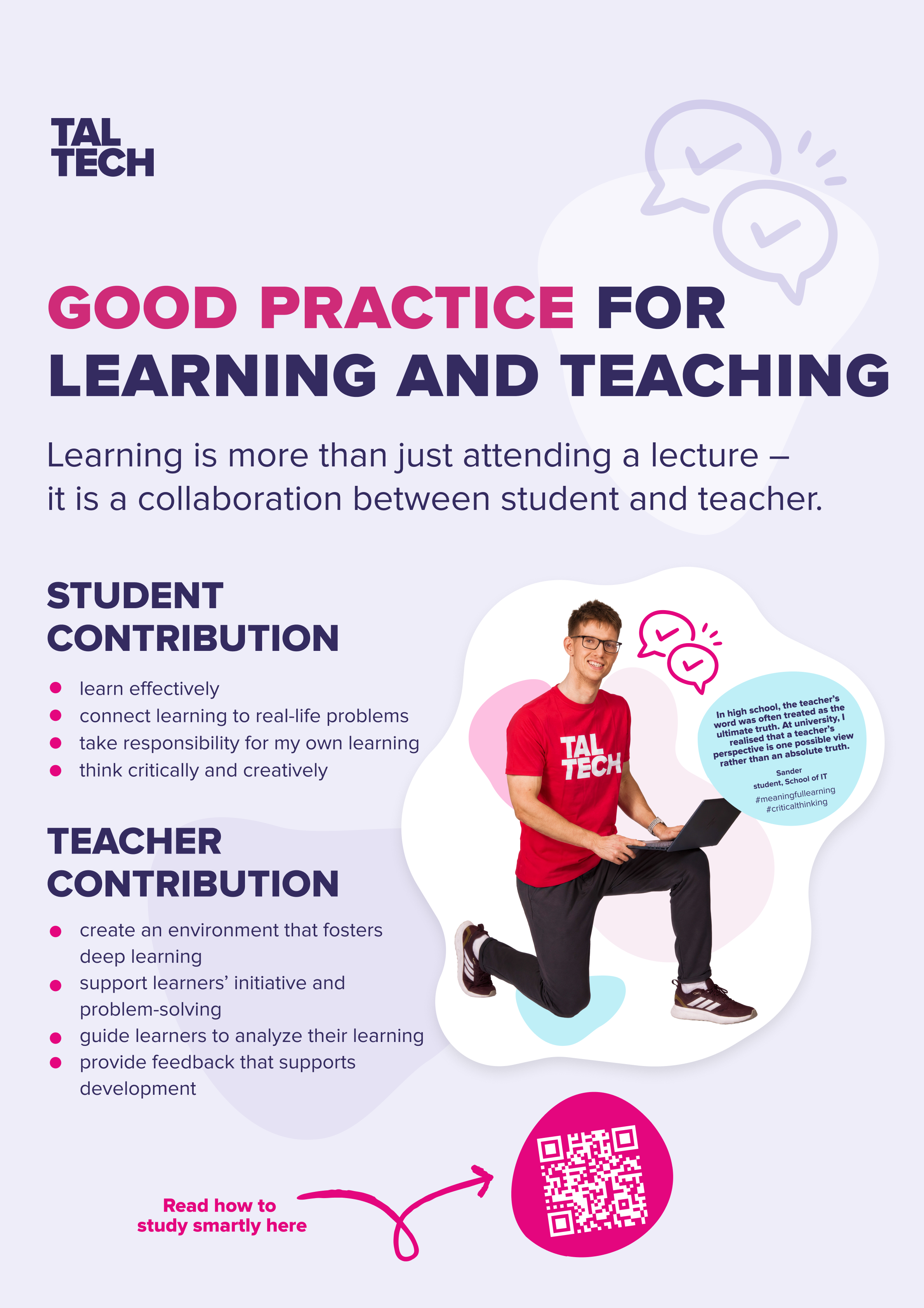
Sander Roosimäe, a second-year computer science student in the School of Information Technologies, did not come to university with a clear calling for a particular field. He chose a degree programme that seemed to offer the broadest range of opportunities.
“IT seemed like the field of the future. At the same time, I hadn’t had much exposure to it,” he recalls. “I looked at different curricula – software development, cybersecurity, and other specialised fields. Computer science seemed the broadest. I didn’t really understand what it involved, but it seemed to cover everything.” Today, he is confident that he made the right choice.
Learning and teaching: making connections and putting knowledge into practice
When asked what learning means to him, Sander does not begin with a definition, but with his own experience. “For me, learning is about creating connections in the brain. Recalling new or previously learned things and putting them to use again,” he explains. “But the most important thing is that it doesn’t remain purely theoretical.”
For him, knowledge truly takes hold only when it can be applied in practice. “When you’ve been stuck on something for a long time and finally understand what’s going on – that’s the best moment. Or when you see that a supposedly pointless mathematical theorem actually has a real-world application.”
Sander also speaks about teaching from firsthand experience – he teaches programming at an upper secondary school. “Teaching isn’t just about passing on knowledge through dry explanations,” he says. “It’s about seeing someone else have that eureka moment.”
He acknowledges that teaching has also changed the way he learns. “If you want to teach something to others, you have to understand it completely yourself. It’s not enough to know how to use something – you need to understand why it works.”
Teaching forces him to think in simpler, clearer terms. And that, in turn, deepens his own understanding.
Measure nine times, cut once
Sander describes himself primarily as a hands-on learner. “Even if a subject is purely theoretical, I like being able to do something practical with it straight away,” he says. “Take mathematics, for example – no matter how abstract the theory is, I prefer being able to solve exercises immediately. Or in programming, actually building something. Something tangible, or at least something where you can see the result.”
He considers himself a determined learner. “When I start something, I don’t like leaving it unfinished. I want to work through a problem piece by piece, focus on one part, finish it, and only then move on to the next. I like concentrating on one thing at a time.”
He also describes himself as analytical. “Before I start something, I usually spend quite a lot of time thinking. I consider the best way to solve the problem and which tools to use. Sometimes I spend an hour thinking and half an hour actually doing the work,” he says with a smile. “It’s a bit like the saying: measure nine times, cut once.” This approach gives him confidence that his work is carefully considered and of high quality.
Sander is strongly motivated by his vision of the future. “What motivates me is thinking about the opportunities that will open up after university,” he says. “Because I’m studying a practical field, it’s easy to imagine what I’ll be able to do in the future.”
Having a clear goal and understanding why he is learning something also makes more difficult subjects easier to tackle. “When you know something has real value, it’s easier to put in the effort,” he sums up.
Skills for the future: critical thinking, self-management and adaptability
Sander considers critical thinking the most important future-proof skill in today's world. He also connects the development of critical thinking with the transition from upper secondary school to university.
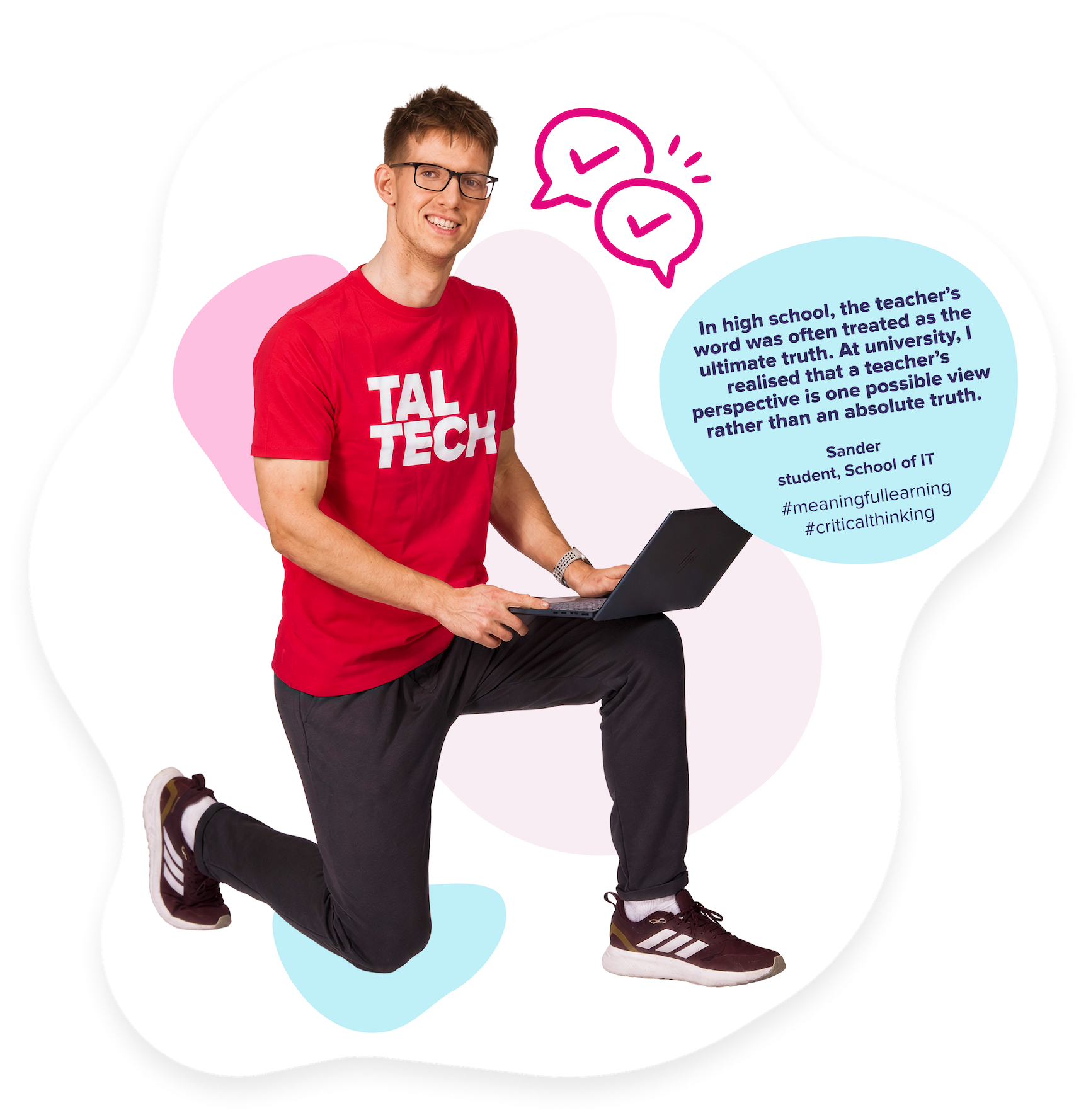
“In basic school and upper secondary school, it was usually the case that if a teacher said something, it was taken as the truth. You didn’t really question it,” he recalls. “When I got to university, I realised that lecturers can make mistakes too. And more importantly, they sometimes acknowledge themselves that their assessment may be just one possible perspective rather than an absolute truth.”
This changed Sander’s understanding of learning. “You start to realise that not everything people say or write is necessarily the final truth. You have to think for yourself.”
“Today, when there is an enormous amount of information everywhere, it’s important to be able to assess whether it’s accurate or not. Not just accept it, but analyse it.” For him, the ability to ask questions and evaluate claims lies at the heart of critical thinking.
Alongside critical thinking, Sander highlights the importance of adaptability and self-management. “Things are changing so quickly that you have to be prepared to adapt constantly,” he says. “Practically every year, you need to be ready to learn something new or do things differently. And that doesn’t just apply to your field of study, but also to how you think and how you work.”
He sees adaptability as important both socially and academically. “When you move from upper secondary school to university, you have to get used to a new environment and new people – you no longer have the same classmates around you all the time. And when you move from university into working life, you have to adapt again, for example to having a structured working day and different responsibilities. Every stage requires a new adjustment.”
He considers self-management essential for succeeding at university. “University is very independent. It’s no longer like upper secondary school, where someone is constantly checking up on you. You have to find your own motivation, plan your own time and complete all your assignments yourself. If you want to get somewhere, you need to know how to manage yourself.”
When asked how he has developed these skills, Sander says it has primarily been through his studies. “We have courses that are focused on the future, where we’re taught new ways of working and new tools. Lecturers emphasise that we need to learn how to use them because that’s where the future is heading. If you don’t develop these skills, you may find yourself without a competitive position in the job market.”
He also highlights the ability to express thoughts clearly and precisely, especially in the age of AI. “It’s important to be able to say exactly what you want. If you can’t clearly formulate your question or problem, you’ll get an incomplete or incorrect answer. Practising this is actually a very important part of adaptability and self-management.”
For Sander, adaptability means being willing to learn, rethink things and change direction when necessary – without panicking. It is a skill he believes will become increasingly important in the future.
The idea that students should focus solely on their chosen field and not on “some generic skills” strikes Sander as strange. “General competencies aren’t some optional extra. They’re an integral part of studying. You can’t simply separate them out.”
TalTech as a hands-on university of technology
When Sander compares TalTech with other universities, two qualities stand out to him: innovation and practicality. “Curricula are updated and courses are improved. It’s not a case of still using the same slides from 2014,” he says.
“Learning should be as close to real life as possible,” he says. “Not just theory, but real projects, real assignments and collaboration with companies.” His dream is for every student with the interest and skills to have the opportunity to work on real projects while still studying – projects connected to actual companies and real-world challenges. “For example, there could be courses where a company comes in with a specific problem and students work to solve it. That would add a whole new dimension.”
Sander believes this could even become one of TalTech’s strongest selling points: a university of technology that offers the most practical education and the closest connection to real life.
TalTech’s Good Practice in Learning and Teaching is a shared agreement within the university aimed at supporting high-quality learning and teaching and fostering a common academic culture. At its heart is the principle that learning is not merely about acquiring knowledge, but a collaborative process of development in which both students and lecturers play an important role.