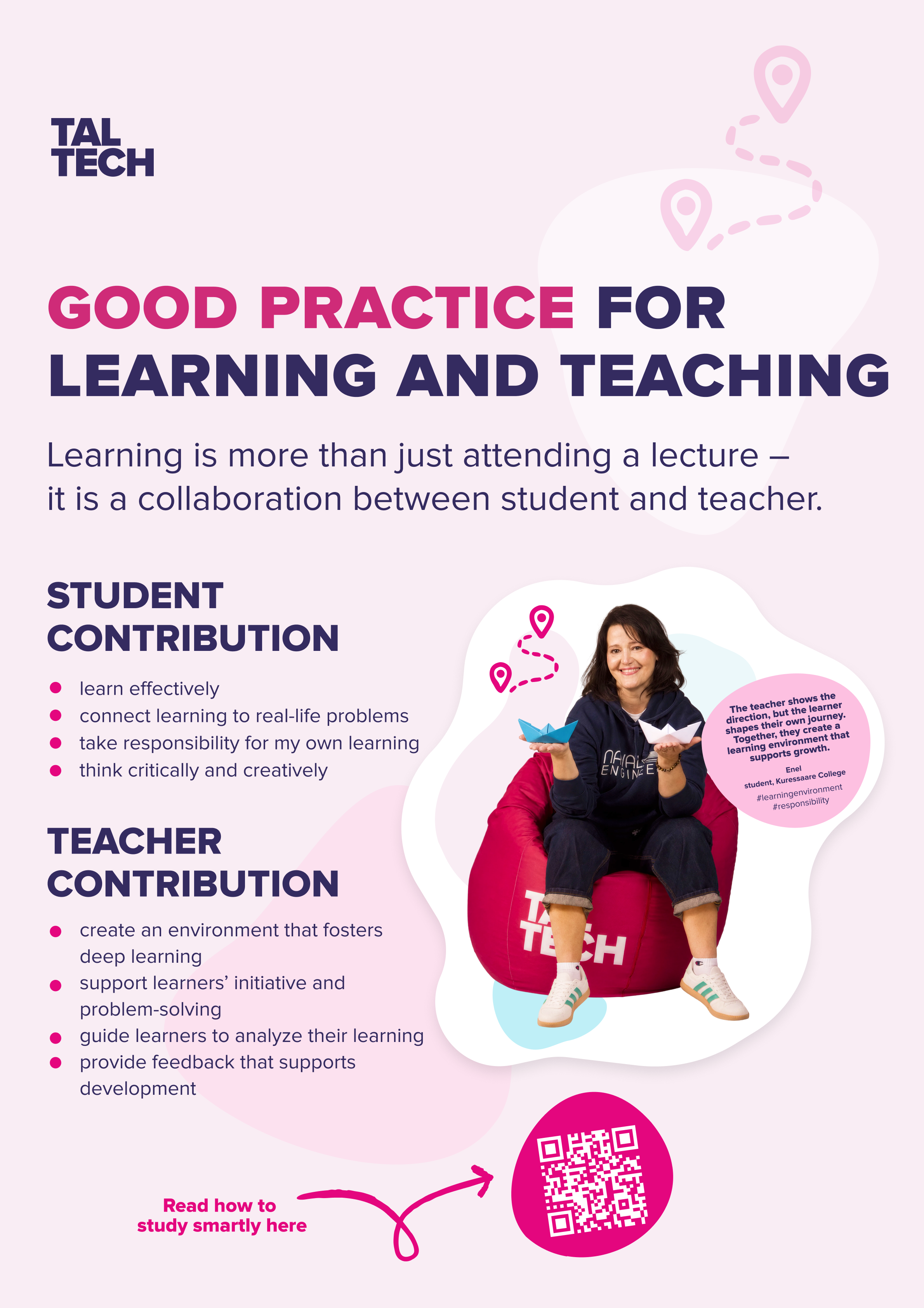
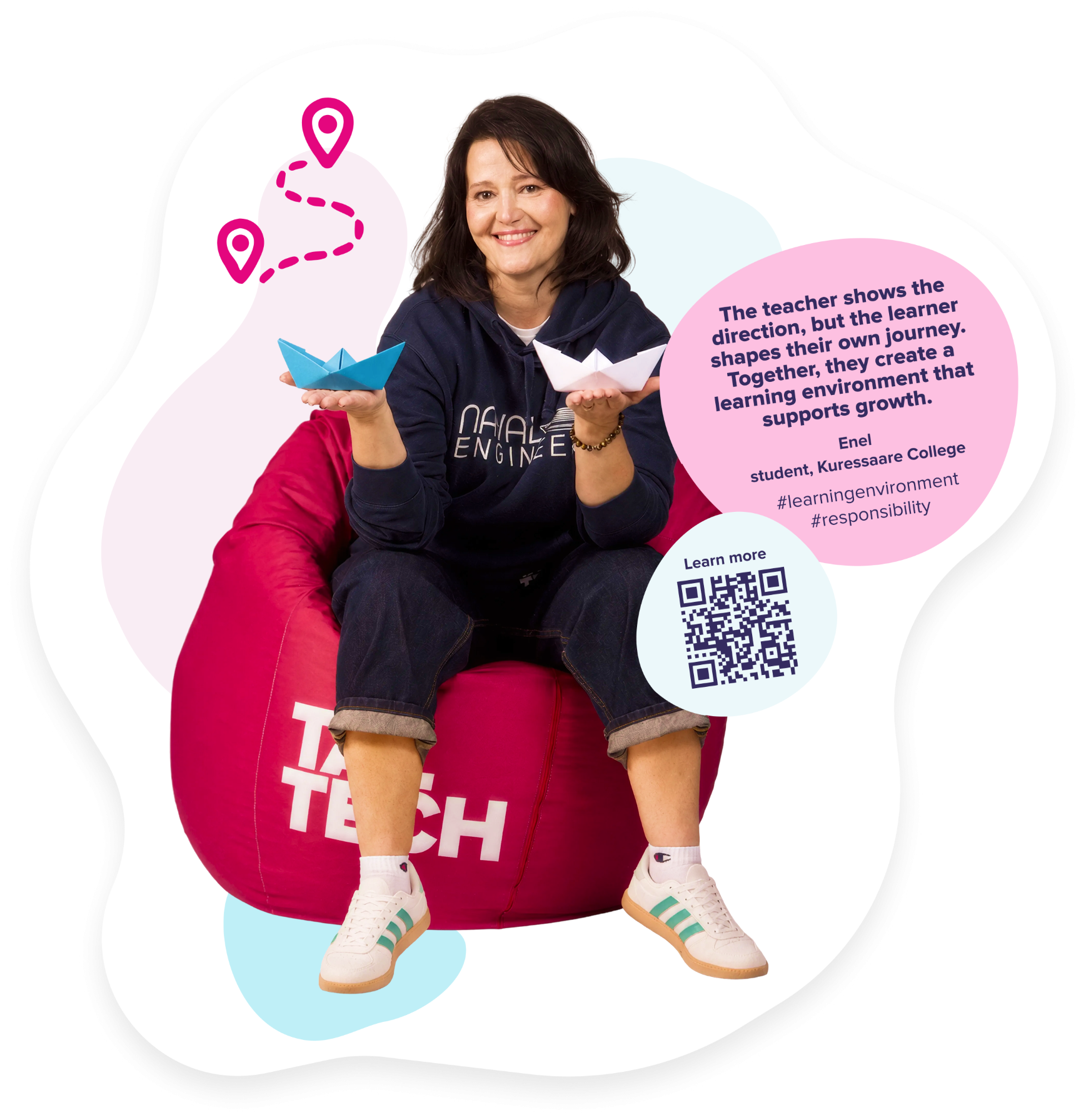
When Enel Kirch talks about learning, it sounds like a natural part of her everyday life. A fourth-year student of Marine Engineering and Small Craft Construction at Kuressaare College, she is a mother of four and an experienced designer who made a conscious decision to deepen her knowledge of engineering.
Her journey into shipbuilding began with designing commercial kitchens. At one point, she was asked whether she would also design a galley for a ship. “I thought, why not? And that’s where the journey began,” she recalls. After a while, she realised she wanted to understand the system as a whole rather than just its individual parts. That brought her to TalTech, where she could gain an in-depth understanding of structures, processes and engineering logic.
Learning as stepping outside your comfort zone
For Enel, learning is a conscious decision to set goals for herself and hold herself to high standards. “For me, learning is an enjoyable process that pushes me out of my comfort zone. You have to test your limits. Sometimes you think, ‘There’s no way I’ll ever be able to do this,’ and then you get the top grade and realise that you had it in you all along.”
For her, learning is not simply about acquiring knowledge; it is a way of staying alive. “I feel alive when I can absorb new information. That’s what lifelong learning means to me—not just a slogan, but genuinely a part of life.”
Her motto is simple and practical: done is better than perfect. “At first, you don’t chase perfection; you just move forward step by step. You write one sentence, then another, and at some point you look up and realise the work you set out to do is finished. You can worry about perfection later.”
She compares learning to the Tartu Ski Marathon: at first, the distance seems daunting, but if you break it down into smaller sections, you reach the finish line almost without noticing. “When you take it step by step, it becomes manageable for everyone.”
In Enel’s view, studying at TalTech is first and foremost a dialogue between the student and the lecturer, firmly grounded in research-based approaches. “Learning is a dialogue. Feedback matters, and most importantly, what you learn needs to connect with real life.”
In marine engineering, this means clear expectations, meaningful feedback and practical projects. Enel believes studies should include more industry-based assignments, international study weeks and teams that bring together students from different disciplines. “In real life, no discipline operates in isolation.”
For Enel, teaching is primarily about creating the right conditions for learning. “The lecturer doesn’t do the work for me. They create the environment, provide the tools and set the goals. From there, it’s my responsibility what I do with them.”
She values a balance between high expectations and support. “An inspiring lecturer believes in a student even when the student doesn’t yet believe in themselves.” She also appreciates lecturers explaining why a particular methodology has been chosen, as this helps students focus on the substance of what they are learning.
Stubborn persistence
If Enel had to describe herself as a student, she would say she is persistent, systematic and demanding of herself. “Without persistence, everything falls apart,” she says matter-of-factly. As a mother of four, she knows all too well that the perfect moment may never come. “I don’t have the luxury of waiting. I take it one step at a time and keep moving forward.”
She says TalTech provides a strong foundation, but in the world of work, you have to keep building on it yourself. Above all, she values courage - the courage to ask questions, to try and, when necessary, to make mistakes. “What matters is being able to admit when something has gone wrong. Making a mistake isn’t the end. That’s where learning and development really begin.”
She sometimes calls this persistence “stubborn determination”. If you need information, you have to go and find it. “Servers are like libraries. You don’t need to know everything by heart, but you do need to be willing to search for information and apply it.”
Enel’s motivation has many layers. She is driven by curiosity, a desire to grow and very practical considerations as well. “I’m motivated by knowing that these skills are needed in the workplace,” she says. Just as importantly, she wants to set an example for her children. “When they see me learning, working hard and developing, they see that learning is an inseparable part of life.”
General competencies: focus, critical thinking and ethics
Enel takes a highly practical view of general competencies. In her opinion, the most important skills in a rapidly changing world are self-management and critical thinking. “There’s an enormous amount of information out there. You have to be able to distinguish what matters from what doesn’t, stay focused and not allow yourself to become overwhelmed.”
She describes self-management as organising her work deliberately. She plans her activities in short, clearly defined steps and applies the principles of deep work. “I can do eight hours’ worth of work in four. You break a big task down into smaller parts and steadily work your way through them.”
Collaboration and communication are, she says, an unavoidable part of engineering. “A team can have fifty people in it, all with different backgrounds and personalities. What matters is how you express your ideas, how you ask questions and how you respond.”
She also emphasises professional responsibility. “An engineer’s decisions have real consequences, which is why acting thoughtfully and responsibly is just as important as technical skills.”
In her view, the essence of TalTech’s general competencies is simple: the student takes responsibility, while the lecturer creates the conditions that make learning possible. Together, they create an environment that supports development.
Learning by example
When asked about her most inspiring experience at TalTech, Enel doesn’t have to think for long. “I discovered that I’m good at maths and physics. Especially maths,” she says with genuine delight. For her, this realization was a symbolic moment—proof that stepping outside your comfort zone always pays off.
For Enel, learning is not only a personal goal; it is also a way of setting an example for her children and sending a message to anyone wondering whether it might be “too late” for them to study. “Anything is possible at any age. There’s someone in our group who turned 60. Age simply isn’t an issue,” she says.
She believes learning can also provide a new direction for people who have spent a longer period at home or are looking for a new rhythm in their lives. “With small steps, anything can be done and organised. There are so many opportunities.”
Enel’s outlook is summed up by a principle that has guided her both in her studies and in her career: “Learning is the ability to make connections and apply knowledge to solving real-world problems. A lecturer can point me in the right direction, but I’m the one who builds my own development.”
Enel’s journey at TalTech shows that learning is not merely about accumulating knowledge, but about being willing to grow, experiment and take responsibility for your own development. Her story demonstrates that confidence and new skills can be built at any age, even when progress comes in small but consistent steps. It is precisely this determined and thoughtful approach that has helped her find her place in engineering - and it sends a powerful message to anyone considering studying at TalTech: opportunities open up for those who are prepared to create them for themselves.
TalTech’s Good Practice for Learning and Teaching is a university-wide agreement designed to support high-quality learning and teaching and foster a shared academic culture. At its heart is the idea that learning is not merely about acquiring knowledge, but a collaborative process of development in which both students and lecturers have an important role to play.