
Tallinn University of Technology (TalTech) is strengthening its cooperation with Estonian vocational schools to connect vocational and higher education more closely, develop the IT competencies of students and teachers, and give young people more opportunities to pursue further studies and careers in technology. The partners are Pärnu Education Centre PARK, Raplamaa Applied College RAKO, Tartu Vocational College VOCO, Tallinn Technology College TechnoTLN, Haapsalu Vocational Education and Training Centre, Rakvere Vocational School and Kuressaare Vocational School.
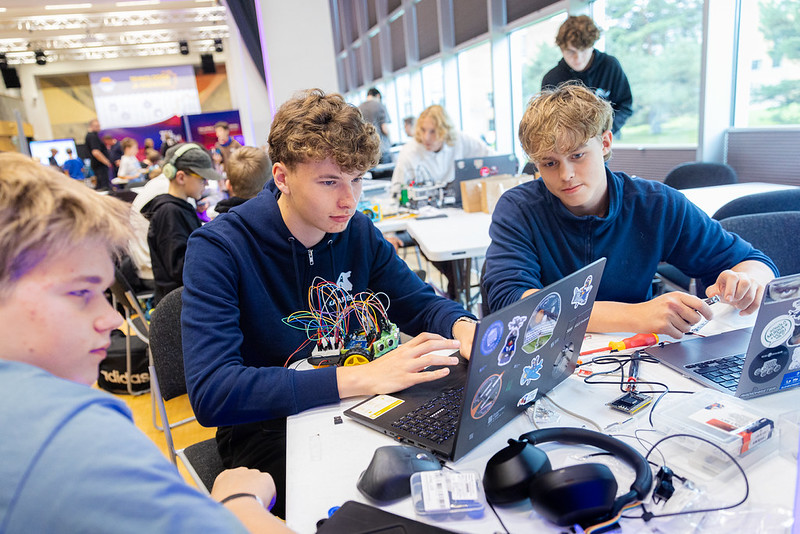
The aim is to make cooperation between vocational schools and the university more substantive and visible. Together, the partners seek to exchange expertise and best practices, compare curricula, develop students’ and teachers’ competencies, and involve more vocational students in TalTech’s degree programmes, training courses, competitions and other IT activities.
According to Gert Jervan, Dean of TalTech’s School of Information Technologies, a strong IT education system in Estonia requires vocational and higher education to be viewed as parts of a single whole. “A good IT specialist can begin their journey in many different places. Our goal is to ensure that vocational students understand their opportunities for further study and that the knowledge and practical skills they have already acquired support their next step into higher education. At the same time, teachers and lecturers on both sides benefit from this cooperation,” Jervan said.
Birgy Lorenz, Vice-Dean for Academic Affairs at TalTech’s School of Information Technologies, believes that vocational schools and universities should share a common educational space. “If a young person has already spent several years studying programming, systems administration, cybersecurity or other IT skills, their next stage of education should not begin with the question, ‘What do you actually know?’ We should understand what our partner schools teach, what skills students bring with them and how we can help them progress to the next level as smoothly as possible,” Lorenz said.
One practical area of cooperation is to connect vocational students’ final projects more closely with TalTech’s expertise. TalTech students and lecturers can contribute to vocational schools’ final projects as supervisors or members of assessment panels, for example. The partners can also review curricula and explore ways to support students’ progression to further education.
Teachers are another important focus of the cooperation. The partners can share learning materials and best practices, and involve teachers in training and joint activities. Students, in turn, will have opportunities to take part in TalTech competitions, training courses, visits and other activities that introduce them to the university and different fields of IT.
“We do not want a cooperation agreement that ends up gathering dust as a digitally signed file. The idea is for teachers to know one another, for students to move between institutions, for TalTech staff and students to visit vocational schools, and for vocational students to come to TalTech. If this leads to joint final projects, teams, training courses or new learning opportunities, the agreement will have served its purpose,” Lorenz added.
The cooperation agreements provide a framework for long-term collaboration. In addition to the activities specified in the agreements, the partners can launch new joint initiatives in response to the needs of their schools and students.
Tallinn University of Technology’s School of Information Technologies educates IT specialists at bachelor’s, master’s and doctoral levels. As a partner in the IT Academy cooperation programme, it works closely with businesses, educational institutions and the public sector. Cooperation with vocational schools helps connect the different levels of IT education in Estonia and supports students in progressing from vocational to higher education.
Tartu Vocational College VOCO: An increasing number of students wish to continue their studies in higher education. Providing different entry pathways and preparing students to succeed in their studies can help overcome apprehension about university education, while the strong practical professional skills acquired at the college help students better understand theory. This cooperation will also give current college students a closer look at the future of IT and opportunities to take part in various university events and workshops. Our graduates who are already studying at university are valuable ambassadors, helping our students understand what university studies involve, why learning skills matter and how to settle into student life.
Pärnu Education Centre PARK: Developments in information technology are affecting today’s labour market faster than ever before. Major technological breakthroughs, such as the emergence of artificial intelligence and machine learning, alongside the growing need for cybersecurity, are shaping the jobs of the future. Our four-year curriculum enables students to acquire the knowledge, skills, values and social readiness needed to continue their studies in higher education. Through this cooperation, we hope to further strengthen our students’ confidence and equip them with the knowledge they need to achieve their goals.
Raplamaa Applied College RAKO: Cooperation between vocational and higher education gives young people confidence that they can continue studying in their chosen field and achieve their career goals. Two talented young IT graduates from RAKO’s latest cohort were admitted to TalTech under special admission arrangements. Both were delighted to learn that they had secured a university place. These are precisely the success stories we want this cooperation to produce: a clear, smooth and supported pathway from vocational to higher education.
Tallinn Technology College TechnoTLN: It is important to us that vocational education should not mark the end of a student’s educational journey, but provide a natural pathway to acquiring academic knowledge that builds on the practical skills gained in vocational studies. A young person graduating from TechnoTLN is, in fact, better prepared and has a stronger starting point for higher education than someone coming from a general upper secondary school, for example. Strong IT education is built across educational levels and institutions. Close cooperation between vocational and higher education helps create a coherent learning pathway for students and better align education with the sector’s future needs. Cooperation between teachers and university lecturers is equally important, helping new knowledge and technologies reach vocational education more quickly.
Rakvere Vocational School: Several of Rakvere Vocational School’s IT students already go on to higher education. Through cooperation between our institutions, we want to increase that number. Opportunities to visit other schools and meet people during their studies help students develop a broader understanding of the field. We believe that networking among IT teachers and university lecturers helps the sector as a whole remain competitive with rapidly developing regions around the world.
Haapsalu Vocational Education and Training Centre: We do not have to think of vocational education as one path and higher education as another. At 16, a young person does not need to decide how far they will eventually go in education. They can start at a vocational school, gain real skills and experience, and then progress quite naturally to university. Our task is to ensure that there is no high fence between these two worlds that young people have to climb over on their own. Cooperation with TalTech helps us create more and more gates in that fence—and ideally, one day, there will be no need for the fence at all.
Kuressaare Vocational School: Here on Saaremaa, it is particularly important to us that local young people have access to high-quality, modern education and opportunities to continue their learning journey. For Kuressaare Vocational School’s IT students and teachers, cooperation with TalTech opens up new opportunities, broadens horizons and makes the pathway from vocational to higher education more natural and seamless. A strong network of partners in the field is invaluable to the quality and future of IT education.