
The 2026 Günther Laukien Prize, "to recognize recent cutting-edge experimental research in nuclear magnetic resonance (NMR) with a high probability of enabling beneficial new applications”, has been awarded together with Professor Guido Pintacuda of CNRS, Lyon, France, to Ago Samoson, Leading Research Fellow at Tallinn University of Technology, Estonia, for their pioneering work in advancing ultra-fast magic angle spinning (MAS) nuclear magnetic resonance (NMR) spectroscopy.
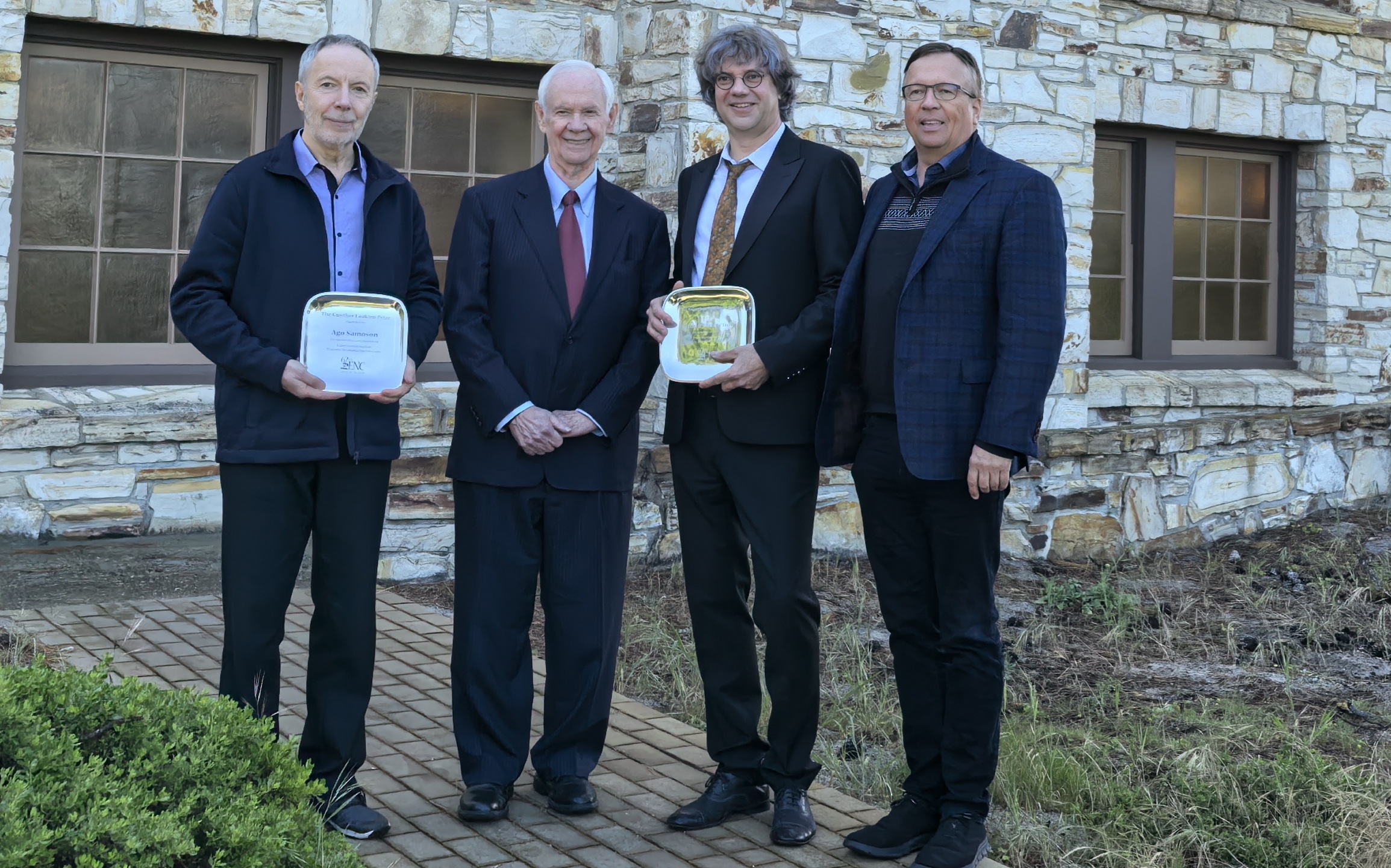
Vice Rector for Research at Tallinn University of Technology, Jarek Kurnitski, emphasizes that Ago Samoson’s work represents a real high-tech product that has been developed and manufactured within the university. “The award recognizes Ago Samoson as a scientist among the top 1% in the world, but also more broadly Estonia’s engineers and researchers, as these inventions have found widespread use globally,” Kurnitski said.
The award recognizes Samoson’s role in pioneering and developing technologies that enable extremely high rotor spinning speeds in solid-state NMR experiments, dramatically improving the resolution of proton (1H) signals in solid materials. This has long been one of the key challenges in the field, as strong anisotropic interactions in solids typically broaden signals and limit the level of detail that can be observed.
By designing and refining ever-smaller, more robust rotors—particularly using metastable zirconia materials—Samoson made it possible to reach spinning frequencies of 100 kHz, with later developments pushing over 200 kHz. These ultra-fast spinning conditions allow scientists to resolve fine structural details in a wide range of systems, including complex materials, polymers, and biological samples. His earlier work also includes the invention of the double rotation (DOR) experiment, which addressed signal broadening in quadrupolar nuclei by simultaneously spinning samples around two axes. Together, these innovations have significantly expanded the capabilities of solid-state NMR and opened up new experimental approaches, in particular based on ubiquitous hydrogen and oxygen.
Samoson’s contributions have had a lasting impact on the field, helping to establish ultra-fast MAS as a standard tool in modern NMR spectroscopy. The technologies developed under his leadership are now widely used internationally, including in commercially available instrumentation, enabling high-resolution analysis with smaller sample sizes and improved efficiency. Other prizewinner, G. Pintacuda, was recognized for application of the technology principally developed by the team of A. Samoson, including study of membrane processes where there are no other suitable methods.
The Günther Laukien Prize, established in 1999 in memory of Bruker co-founder Professor Günther Laukien, recognizes cutting-edge experimental NMR research with strong potential for impactful applications. The prize includes a monetary award of 20,000 US dollars, and the recipients are invited to deliver the opening plenary lecture at the Experimental NMR Conference (ENC).
Sources of information
enc-conference.org/Gunther-Laukien-Prize