
As part of presenting good practices in teaching and learning at Tallinn University of Technology (TalTech), we highlight 12 inspiring educators whose teaching has been highly rated by students. One of them is from the School of Engineering: Tiia Plamus.
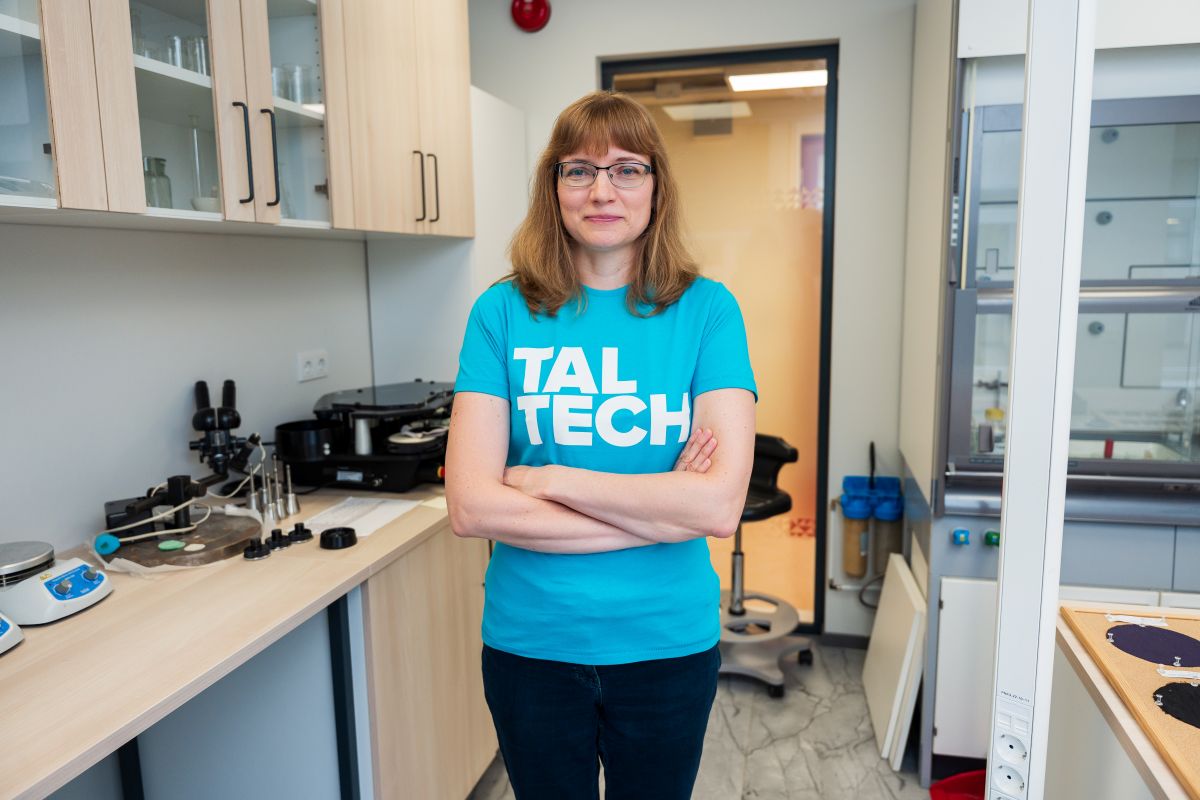
Tiia Plamus, Associate Professor at TalTech’s Institute of Materials and Environmental Technology, began teaching at the university in 2010. Her fields include textile technology, circular economy, materials technology, and material testing. Today she is responsible for several Bachelor’s and Master’s courses, teaches in both Estonian and English, supervises theses, and coordinates large courses — including “Introduction to Circular Economy.”
Teaching as Stepping onto the Stage
As a lecturer, Plamus is inspired by the variety and constant renewal that her work brings — every new cohort of students brings fresh energy. Supervising theses is also rewarding for her: “It is a two-way process, where through the joint effort of student and supervisor something new and valuable emerges.”
She admits that each time she walks into the lecture hall, she feels a bit like a performer stepping onto the stage. “I never walk into the auditorium as if just to wave a hand. Whether there is one student or two hundred — it always requires preparation and presence,” she says.
For her, it is always important that theory does not remain hanging in the air. She constantly brings real-world examples into her lectures — from research, consulting for companies and trade fairs. “For example, at the Frankfurt textile fair I was given samples of volcanic rock from Mount Fuji, whose powder is added to synthetic fibres — I was able to bring to students a fresh and exciting example of how innovations in materials technology take place in reality,” she explains.
Expectations for Students: Commitment and Presence
“My first expectation is that a student would be committed to learning,” says Plamus. Although she understands that students tend to optimise studying — attending only exams and labs — she believes that attending lectures creates deeper understanding. “If you are present in the lecture, you always get more than just the grade,” she says.
Plamus finds that beyond professional knowledge, students also need the ability to manage themselves, plan time and show initiative. She emphasises responsibility, communication skills and a willingness to “get hands-on.”
Among TalTech’s generic competencies, she especially highlights critical thinking and teamwork. “Our graduate should be able to distinguish between serious and nonsensical claims and be able to find solutions as a team,” she emphasises. She also deems communication and ethics important, although they often remain in the background during discussions.
Learning as Constant Improvement
Plamus considers it essential that also educators continuously improve themselves — both in their field and pedagogically. “A good course needs a thoughtful structure and constant updating. Also cooperation with colleagues so that courses align with each other,” she says. In her opinion, pedagogical continuing education for teachers could be more regular and more extensive than the current minimum requirement.
To describe herself, she uses three words: patient, calm and systematic. Patience is expressed particularly in supervising theses — it is a long process in which the student must develop step by step. “If a teacher becomes nervous, it only makes things worse,” she notes. Calmness and clarity help to create a trusting atmosphere; systematic working gives a solid frame to the teaching process.
When imagining ideal learning and teaching at TalTech, Plamus considers it important that in every course attitudes — courage to solve problems, initiative and a “hands-on” approach — are valued alongside knowledge. “Life is not ideal; obstacles always occur. That is not a problem, but a challenge to learn from,” she says.
To learn more about good practices in teaching and learning, see: https://taltech.ee/en/learning