
Tallinn University of Technology highlights 12 inspiring lecturers — those whose teaching has been highly valued by students. One of them is Veronika Shirokova from Virumaa College.
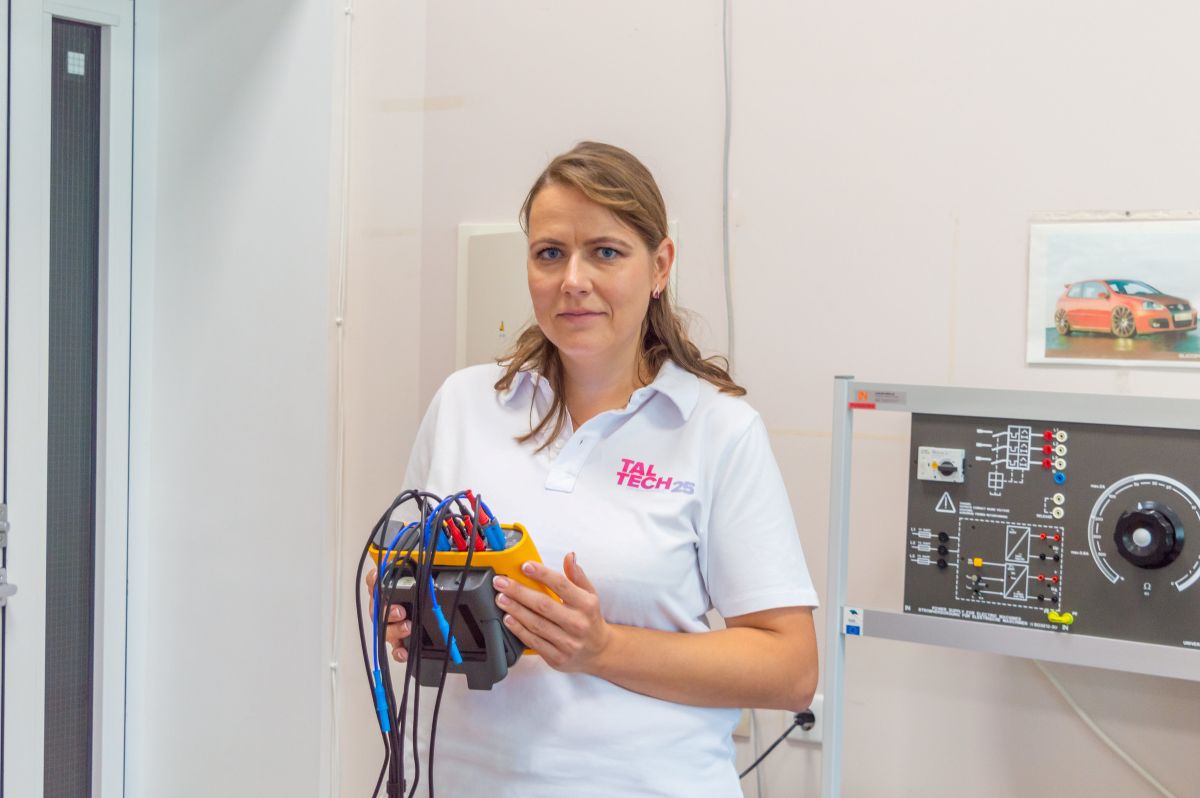
Veronika Shirokova — Senior Lecturer at TalTech Virumaa College and Programme Director of the Degree Programme in Process Control of Mechanical Engineering and Energy Technology — has taught at the university for almost two decades. She has a background in physics (her doctoral work focused on materials technology), and in her daily work she instructs both bachelor’s and master’s students, in fields ranging from technical physics and steel design to electrical engineering and materials modelling.
Learning as a lifelong process
Shirokova believes that learning never ends — it is a continuous self-development and quest for new knowledge. “Just as doctors must keep up with new treatment methods, lecturers must constantly update themselves. My aim is to pass on to students what is not yet in textbooks — new technologies and research results,” she says. For her, learning is simultaneously personal development and bringing new knowledge and methods to students.
The core of teaching for Shirokova is to inspire young people to value engineering and to see how theory connects with real life. “Teaching is not only about transferring facts. It must spark in the student the interest as to why this knowledge is needed and how it can be used in real life,” she explains. In her courses, students carry out project work and create models that link what they learn with laboratories, research projects and business.
Lecturer in three words: commitment, evidence-based, and collaboration
As a lecturer, Shirokova describes herself with three keywords: committed — because for her teaching is more than work — it is about igniting and supporting students’ interest; evidence-based — because every course must be based on the latest science and link learning to research; and collaborative — because learning is a dialogue between student and lecturer.
She draws inspiration from students’ bright eyes. “The moment when a difficult theory becomes understandable and the student is able to apply it in practice — that is the greatest joy,” she says. She also mentions that her aunt, who works at a college as a lecturer too, deeply influenced her. “Her dedication and perseverance were a role model for me already in my youth — from that moment I wanted to become a teacher too,” she recalls.
General competences — critical thinking, cooperation and self-management
Shirokova considers critical thinking — the ability to react quickly and analyse situations — the most important in students’ development. Equally important are co-operation, including the ability to take different roles in a team and bear responsibility — and self-management: the ability to learn independently, plan tasks and present results.
In her subjects, project-based and problem-based learning methods are applied, allowing students to practice these competences in real situations. For example, students have worked in small groups to design components or solve tasks given by companies. “When students see that the final result is truly needed, motivation and understanding of the importance of competences emerges,” she says.
TalTech’s good teaching practice is best embodied in Shirokova by her evidence-based approach and collaboration. Her courses are structured so that theory is linked with research projects and laboratory work. She also values collaboration among lecturers — for example between mathematics and specialised subject lecturers — so that students receive support where they need it the most.
Shirokova believes that TalTech’s future-oriented education must be competitive, practical and relevant to real life. In her view, graduates should have a clear idea where and how to apply their skills. “It is important that a student does not study just for an exam, but is able to use their knowledge immediately in working life. This way they can be confident that their field of study has value and future,” she says.
Learn more aboutsmart learning and teaching: https://taltech.ee/en/learning