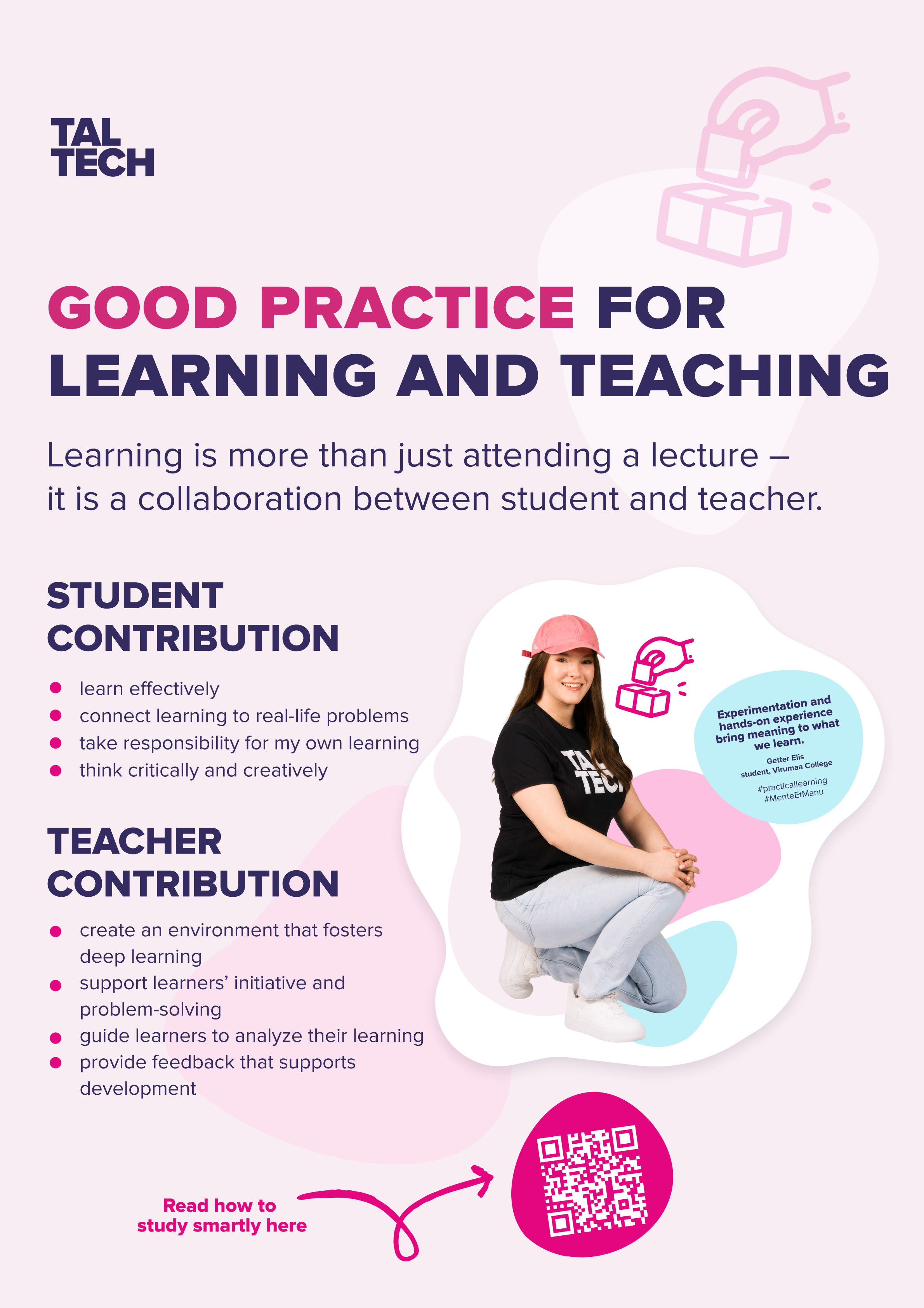
Getter Jalak knew from quite an early age that her path would lead her into engineering. Exactly which field was not clear at first, but the direction was certain. Today, she is in her third year at TalTech’s Virumaa College, studying the management of mechanical engineering and energy technology processes.
Her interest in technology did not come about by chance. From childhood, it was a natural part of her everyday life. “My father is an engineer, and I was always very interested in what he did. I used to go with him to construction sites and hardware stores. I was always fascinated by how things actually work and how they are put together,” she recalls. At home, this often meant tinkering—taking toy cars apart and building new creations out of Lego. It was precisely this curiosity and desire to understand how systems work that eventually led her towards engineering.
Learning as a path to a real career
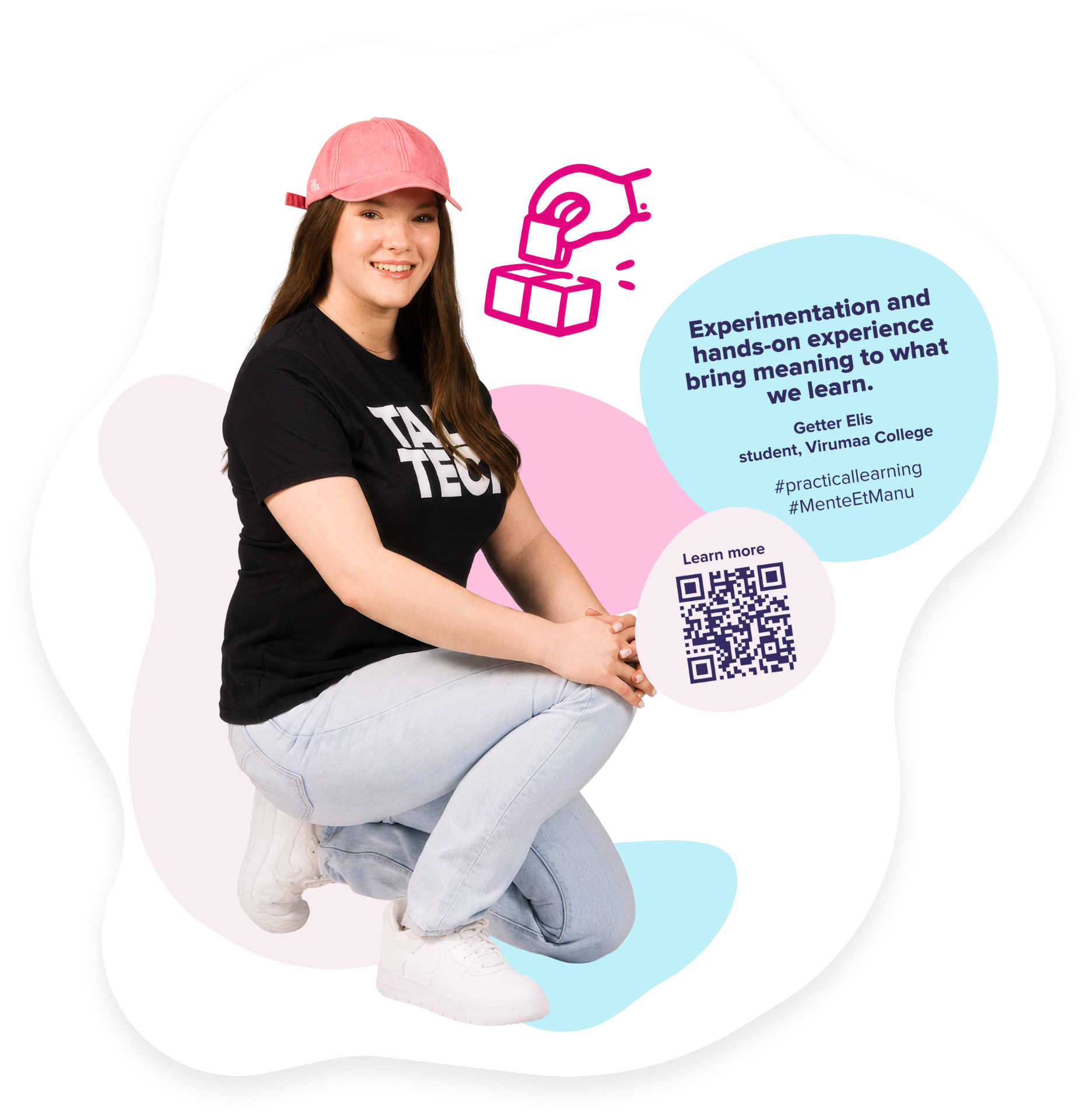
For Getter, studying is part of a bigger journey. It is not just about acquiring knowledge, but a necessary step towards eventually doing work that genuinely interests her. “I see studying as part of the process—I can’t really start doing the work I want to do until I have completed my education,” she explains.
At the same time, learning for her is not limited to sitting in lectures. She actively looks for opportunities to broaden her university experience and connect it with the real world. For example, she attends fairs and various events that help expand her horizons and give her new experiences. “I try to remember all the things that might be useful at work someday.”
Getter readily admits that she learns best when a subject genuinely interests her. “If something interests me, I remember it. If it doesn’t, it goes in one ear and out the other,” she says. She has never been someone who needs to spend long hours memorising material for exams. If she attends a lecture and listens, the knowledge often sticks naturally.
For her, the way something is taught also matters. Teaching is not simply about speaking in front of a classroom. “Teaching means passing your knowledge on to someone in a way that they understand it and can use it themselves,” Getter says. If the learner does not truly understand something, simply attending a lecture is not enough.
Getter works full-time alongside her studies, which often means spending her weekends studying. It is not always easy. “It’s hard and it’s tiring, but it has to be done,” she says. “Keeping up this kind of pace requires good self-management, but at the same time it gives me confidence that my experience and knowledge are developing in parallel.”
Practice gives knowledge meaning
For Getter, one of TalTech’s strengths is that learning is not confined to lectures. Theory and practice go hand in hand, and classes often move directly from the lecture room to the laboratory. “We often start in the classroom, where we listen to a lecture or solve calculation problems, and then we go to the lab and conduct experiments,” she explains. This structure—understanding something first and then trying it yourself—is what makes learning engaging and easy to grasp for her.
Getter says this was also one of the reasons she chose TalTech and a professional higher education programme. In her view, a diploma alone is not enough in today’s labour market. “In addition to an education, employers want to see that you have practical experience, that you have actually tried things and know how to do something. Knowledge that exists only on paper isn’t enough.”
According to her, practical learning also means that students get to use various programs and tools needed in engineering. This gives them a sense, already during their studies, of how problems are solved in the real working world. It is undoubtedly useful in the labour market and also broadens their horizons.
Getter also knows exactly what kind of learning suits her best. “If someone just talks, it doesn’t give me very much. I have to do it myself,” she says. When someone demonstrates and provides guidance, but she has to carry out the work herself, understanding comes much faster.
Laboratory work, experimenting and actually putting something together are what truly bring learning to life for her. “If I can build something, experiment and try things out, that’s when it’s most interesting,” she says.
The courage to seize opportunities
When asked what kind of student she is, Getter describes herself in three words: courageous, open-minded and proactive. She is always ready to try new opportunities and gain new experiences.
“If I’m offered something, I tend to say yes. I’ve been to different fairs, workshops and presentations at schools—wherever I’ve been invited,” she says. Routine does not particularly appeal to her. Instead, she is drawn to new experiences and different challenges.
This attitude also helps her get through more difficult courses. Sometimes you simply have to accept that not everything needs to be interesting straight away and that some things just have to be done. At the same time, Getter often manages to find something useful even in those subjects, whether it is knowledge related to her field or experience of working with other people.
General competencies as real-life skills
In Getter’s view, general competencies are much more than principles written into a university curriculum. They are skills needed in every area of life—in studies, at work and in everyday situations. For her, perseverance and open-mindedness are particularly important. “If something goes badly, you can’t just give up. You try again and keep moving forward,” she says. According to her, this attitude is particularly valuable in engineering studies, where many students drop out during the first few years because of the challenges they encounter.
Equally important is a willingness to try and learn new things. If you become stuck in a single system or way of thinking, it is difficult to develop. Getter believes that a university should encourage students to experiment, think and explore different solutions.
She says that general competencies are not limited to academic work. Self-management, time management, critical thinking and collaboration are skills needed in every situation—from studying and working to friendships and everyday decisions. “These are competencies that everyone should ideally have even before they come to university,” she says. “They simply help you manage in life.”
One aspect of her studies that Getter particularly values is collaboration. For her, group work and joint projects are not just about dividing up tasks, but also about getting to know people and finding solutions together. “If you sit alone in a corner, everything is much harder. If you communicate, ask for help and discuss things with others, learning becomes much easier,” she explains.
Getter admits that she still has room to develop as well, particularly when it comes to self-management. When there is a lot going on and the pace is fast, you have to learn to plan your time better. At the same time, she can see that combining university studies with working life has helped her develop these skills. “At first, it was easy to forget things, but now everything goes into my calendar and I’m gradually learning to manage my time better,” she says.
In her view, general competencies are what give university studies a broader meaning: in addition to specialist knowledge, students learn how to think independently, make decisions and collaborate with others—in other words, skills they will need throughout their lives.
Learning is research-based and learner-centred
According to Getter, TalTech’s good practice for learning and teaching is reflected most clearly in two principles: learner-centredness and research-based learning.
She believes it is important that everything students are taught is genuinely grounded in science and verifiable knowledge. “It isn’t simply a case of someone saying that this is how it is,” she says. “You can experiment yourself, test different theories and formulas, and see that they really do work.”
It is precisely this experimentation and hands-on experience that gives knowledge meaning. When theory can be tested in a laboratory or applied in practice, learning becomes much clearer and more memorable.
Independent work also plays an important role. Getter explains that at the college, students often spend part of their time working independently in the laboratory: they are given a task, but finding the solution is up to them. “If you have a question, the lecturer will help and guide you, but they won’t do anything for you. You have to try things yourself and figure it out,” she says.
Getter finds this approach highly motivating. The learner’s role is not to listen passively, but to take an active part.
At the same time, she has noticed that teaching methods at the university are changing. Although some lecturers still prefer the traditional lecture format and teaching materials that have remained unchanged for years, more and more encourage students to search for information themselves and use different tools.
“More and more often, we’re told: I’ll give you part of what you need, and then you go and find out more yourself,” Getter explains. This means that students are expected to think actively, take a critical approach and be willing to seek out new sources independently.
In her experience, this way of learning genuinely supports the acquisition of knowledge. “You have to make the effort yourself and try things out. The lecturer is there to support you on that journey, rather than doing everything for you,” she says.
What would the TalTech of her dreams look like?
When Getter thinks about what learning could look like in the future, the first thing she sees is an opportunity for greater specialisation. In her view, mechanical engineering is a very broad field, and as students progress through their studies, they could have more opportunities to choose a narrower area of focus.
“By the third or fourth year, many students already have a fairly clear idea of what they want to do in the future,” she says. “At that point, there could be more opportunities to choose specialised courses that would prepare students better for a particular field.”
She gives the metal industry as an example: if a student knows they want to work in that sector, the final stages of their studies could include more courses covering the use and processing of materials and industrial processes. “That would be very helpful, because employers really value it when you already have experience and know how things actually work,” Getter says.
Another development she would like to see in the future is more flexible study arrangements. Although laboratories and practical classes require students to be physically present, she does not believe every lecture necessarily needs to take place in a physical classroom. “Sometimes there could be more opportunities to attend lectures from home,” she says. “Travelling from one place to another and sitting in a classroom often takes a lot of time, and some topics could be covered more quickly by students working independently.”
Getter believes it is important for learning to give students more freedom to choose their own pace—for example, listening to lectures, reviewing materials and completing assignments at the times that suit them best.
University gives you more than just knowledge
Although studying can be intensive, Getter sees the value of university as extending far beyond specialist knowledge. One of its greatest benefits is the people you meet.
She was fortunate to already have friends at the university when she started, but over time she has made many more. “You make lots of new connections and meet new people,” she says. “Those relationships often continue after graduation, as your coursemates go on to work in similar fields.”
That is why Getter has a simple piece of advice for anyone wondering whether or not to go to university: it is worth giving it a try. “It won’t do you any harm,” she says. “You’ll gain new experiences, meet new people and find out whether it’s the right path for you. But at least you’ll have tried.”
TalTech’s Good Practice for Learning and Teaching is a university-wide agreement aimed at supporting high-quality learning and teaching and fostering a shared academic culture. At its heart is the idea that learning is not merely about acquiring knowledge, but a collaborative process of development in which both the learner and the lecturer have an important role.