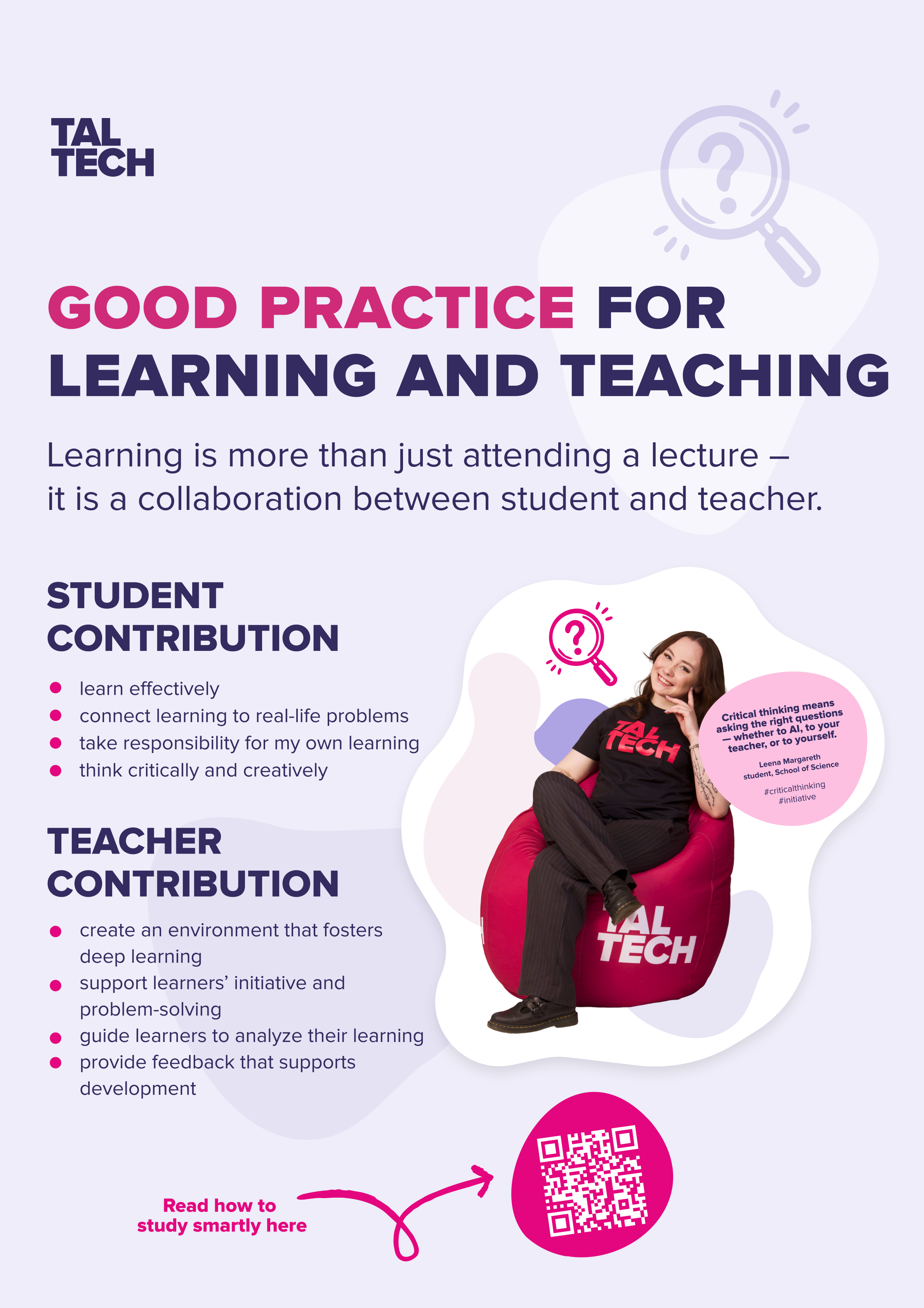
Leena Margareth Viilup, a third-year student in the School of Science’s Food and Biotechnology programme, is approaching the final stretch of her bachelor’s studies. Looking back, she says her chosen field has offered exactly what she was looking for: creativity, hands-on experience, and a solid foundation in science.
“I initially wanted to study either chemistry or even something related to public administration,” Leena Margareth recalls. “But when I started looking at the programme descriptions and courses, food technology seemed somehow broader and more creative – connected to biology, but also offering excellent future prospects.”
It was precisely this combination of science and real life that led her to TalTech’s School of Science.
Learning as a Skill No One Can Take Away
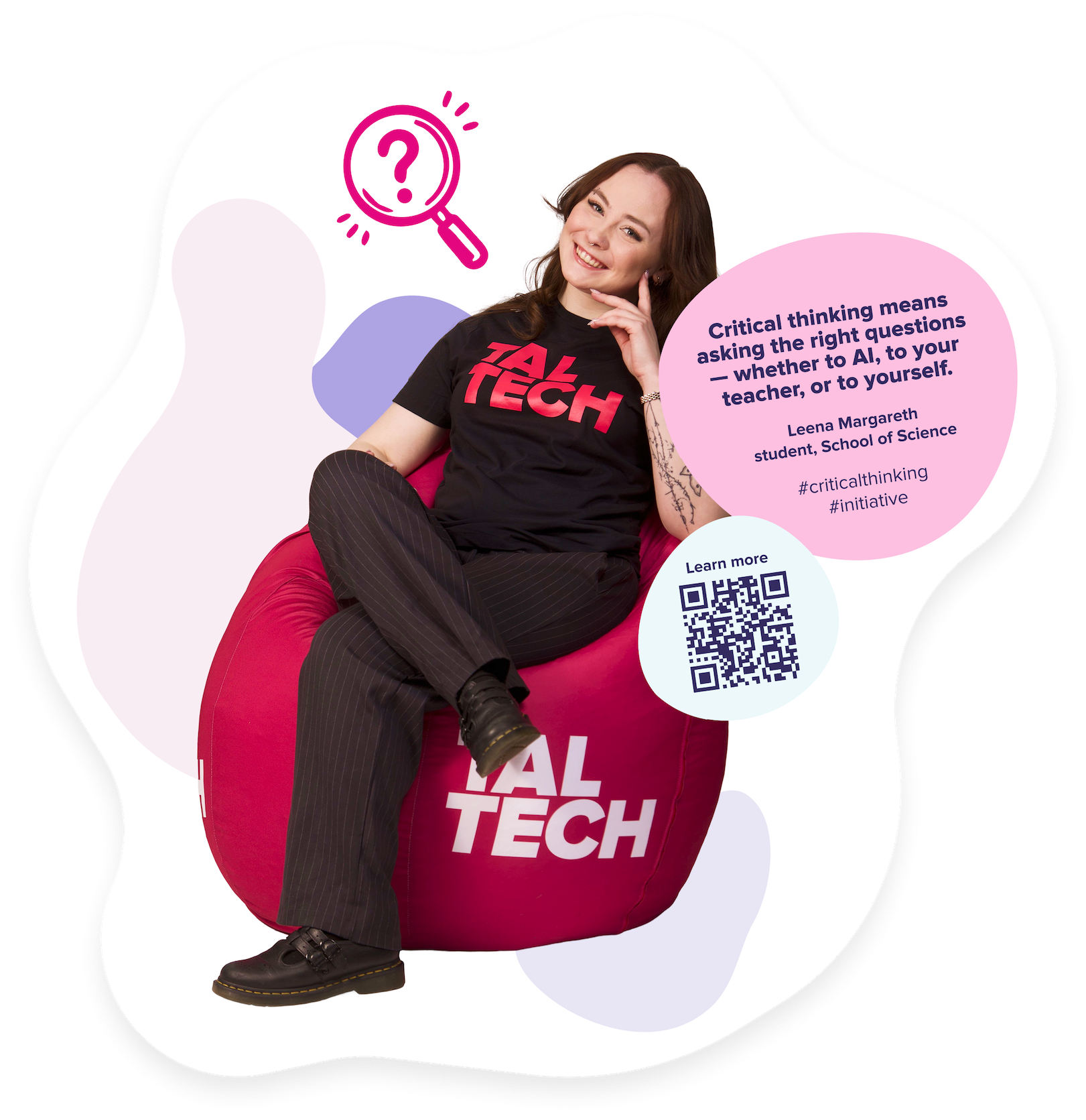
For Leena Margareth, learning is first and foremost about acquiring something new that stays with you for life. “To me, learning means gaining a new skill – something that no one can ever take away from me,” she says. “One of my teachers in upper secondary school often reminded us of that, and I completely agree.”
She uses a metaphor to describe learning as a process much like everyday life: “Learning is a bit like a wonderfully chaotic house – lots of things happening all at once. But if you're determined, you can manage it, and eventually everything falls into place.”
Leena Margareth describes her own approach to studying as fairly traditional and thorough. “I write everything out on paper. A lot of people take notes on their computers, but I prefer writing by hand,” she explains. She also creates summary sheets and tests herself to see what she actually remembers. It's a study technique she recommends to other students as well.
If learning is the internal work students do, teaching is the spark that ignites their curiosity. “Teaching is primarily about inspiring interest. A lecturer should make students excited about learning and eager to explore things further on their own,” she says.
According to Leena Margareth, this is particularly important in the natural sciences, where the world of research is constantly evolving. “It's really important to want to find out for yourself what's happening in the world – what's being researched, what scientific papers are being published, and what's being discussed even at the Nobel Prize level.”
Leena Margareth also highlights a particular lecturer who had a significant influence on her learning experience. “In my first year, we had a biochemistry course taught by Ly Villo, who was incredibly supportive and motivating. She was genuinely passionate about what she did,” Leena recalls. “She encouraged us to use new tools, such as artificial intelligence, but also taught us to approach them critically. She pushed us to question whether AI could be trusted and whether its sources were accurate. That really developed our critical thinking skills.”
Studying for Her Own Future
Leena Margareth says the most important thought that has guided her throughout her studies is simple: “I'm studying for my own future. Knowledge is never wasted.” This mindset helps her stay focused even when a particular subject doesn't seem inspiring at first. “That's when you have to remind yourself why you're doing it and what truly motivates you.”
She also emphasises that students are never really alone when things get difficult. “One thing is maintaining your own motivation, but another really important factor is having coursemates who support one another,” she says.
She recalls her first year and a higher mathematics course, when group study sessions literally stretched late into the night. “One day, we were studying at university until one in the morning, when a security guard finally kicked us out of the room. But we got everything done.”
She also has her own system for staying motivated. “If I study for 20–30 minutes, I reward myself with the same amount of time on my phone. Or when studying with a coursemate, food was our motivation – we'd finish the exercises and then order something to eat.”
University as a Place Where You Grow into Your Own Person
According to Leena Margareth, one of the biggest changes university brings is a greater sense of responsibility. While at school there was often someone to guide you and remind you what needed to be done, at university students have to decide for themselves how and when to get things done.
“At university, the only person you can blame is yourself,” she says frankly. “It's where you realise that you need to start things earlier and take responsibility for managing your own learning.”
She particularly appreciates courses and lecturers that encourage consistent learning rather than making everything depend on one major exam. “I prefer having several tests instead of just one final exam. That way, you stay engaged throughout the course,” Leena Margareth explains.
At the same time, she recognises that responsibility extends beyond oneself, especially when it comes to group work. “If you leave everything until the last minute, you're not just letting yourself down, you're letting others down too,” she says. In her view, universities could do more to support effective teamwork and the fair distribution of responsibilities.
More broadly, Leena sees university as a place for personal growth and becoming an independent adult. “University is where you really grow as a person,” she says. “You learn to understand for yourself why you're doing something, because you get to experience things in practice.”
Transveral Skills: Self-Management, Collaboration and Critical Thinking
Of the transveral skills promoted at TalTech, Leena Margareth considers the ability to manage your own life and time the most important. “I'd highlight self-management and time management. When you know how to plan your time, it also helps develop critical thinking and better communication skills.”
University is often the first place where students have to structure their entire lives independently. “In your first year, you realise that you really have to plan your own time – lab sessions, tutorials, work, and even where and when you're going to eat.”
She also stresses the importance of collaboration. “In most courses, you have to work together, and the instructions are deliberately designed to make you think for yourself. That helps develop teamwork skills.”
For Leena Margareth, critical thinking increasingly means being able to navigate today's overwhelming amount of knowledge and information, especially as digital tools and artificial intelligence become more widely used in education.
“To me, critical thinking means knowing how to ask the right questions – both of AI and of your lecturers. Should you ask AI to explain topics to you or use it as a study partner? But even more importantly, what should you ask it, and especially how should you phrase your questions?” she reflects.
The same applies to studying more generally: students need to be able to clearly express what they need. “Asking lecturers questions is a skill in itself. How do I phrase my question so that I get the answer I actually need? That's part of both communication skills and critical thinking,” Leena Margareth explains.
She also emphasises the importance of assessing the reliability of information. Can the information we're given actually be verified? “Are the links and sources provided by AI, for example, real? Is the information trustworthy, especially when you're looking for scientific articles?” she asks.
A recent course project reinforced just how important this is. Students had to complete a substantial project and find scientific papers on which to base their work. “That's when the question became: what can I actually trust? There are so many scientific articles out there, and it's not always easy to tell which ones are genuinely high-quality and which aren't,” she admits.
Situations like these demonstrate that critical thinking isn't an abstract concept but a practical tool students need every day.
When imagining her ideal TalTech, Leena Margareth says she would like to see an even greater emphasis on making connections between different areas of knowledge. “It's not just about memorising facts, but about being able to connect things. That's more important.”
A University That Values Student Culture
If Leena Margareth had to describe herself as a student, three words wouldn't be enough. She's actively involved in several roles at once. “I'd say I'm someone who likes to keep busy. I do a lot of different things – besides studying for my degree, I'm a student tutor, a member of the School of Science's student council marketing team, and I work as a student counsellor at the counselling centre,” she lists.
She sums it up with a smile: “The more you do, the further you go.”
According to Leena Margareth, student life at TalTech is vibrant. She believes the university places great value on students being active outside the classroom. Student organisations and the student council offer opportunities to connect with others, grow personally, and find a sense of community.
She particularly encourages new students not to worry that joining an organisation means immediately taking on major responsibilities. “First-year students might get the impression that if they join, they'll have to start organising events straight away. But in reality, it can simply be a place to hang out, chill, play games, and meet new people,” Leena Margareth explains.
She believes it's important to step outside your comfort zone every now and then and try something new.
TalTech's Good Practice for Learning and Teaching is a shared agreement within the university aimed at supporting high-quality learning and teaching and fostering a common academic culture. At its heart is the principle that learning is not merely about acquiring knowledge, but is a collaborative process of development in which both students and lecturers play an essential role.