
Honours and awards
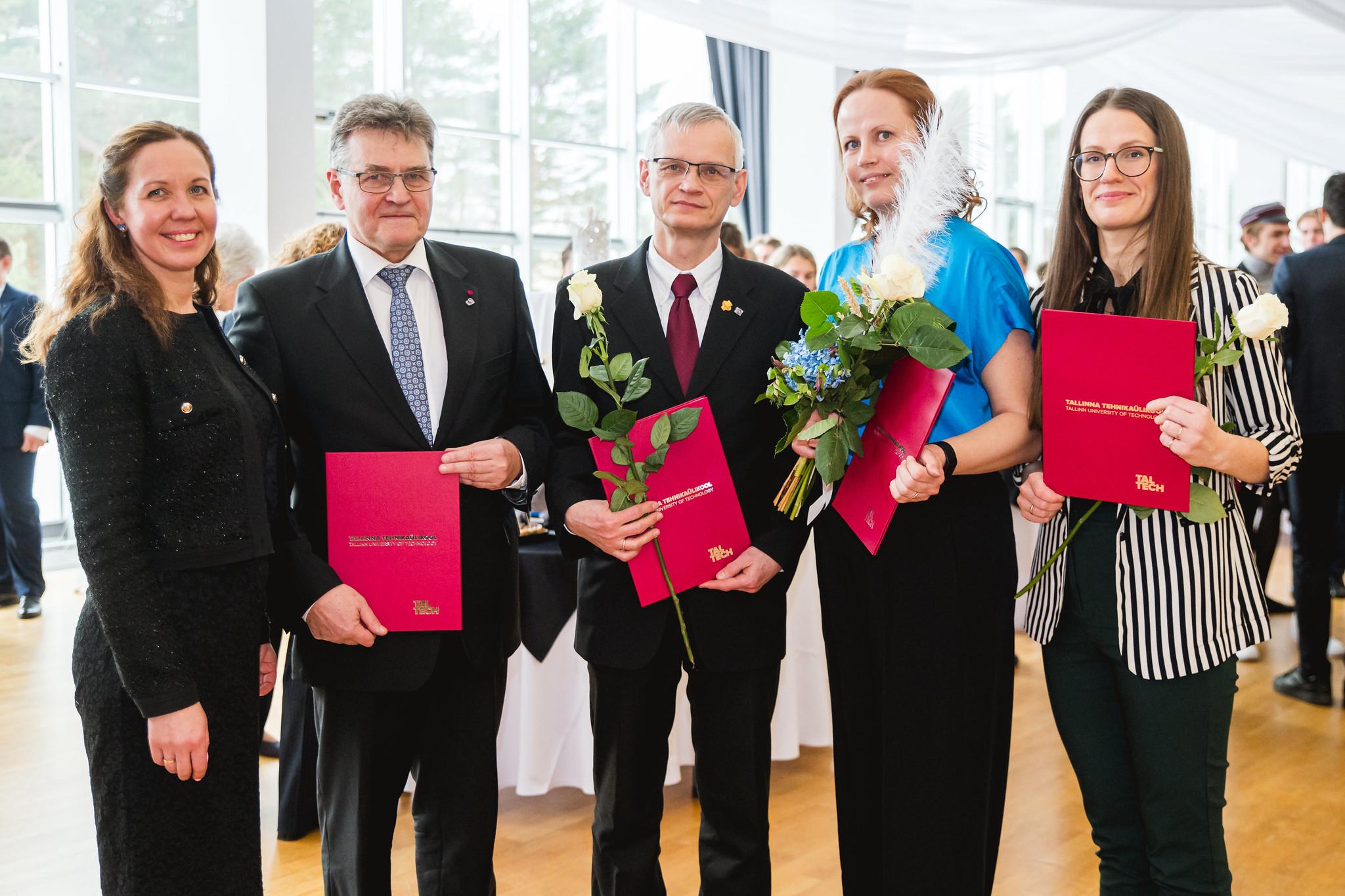
Estonian National Science Awards are granted to researchers and research teams for outstanding achievements in scientific research and development.
2024 Peep Palumaa, for the cycle of research entitled “Copper metabolism and possibilities for its regulation”
2020 Tõnis Timmusk, for the cycle of research entitled “Mechanisms of neural activity–regulated gene expression”
2016 Tõnis Kanger, for the research work “Asymmetric organocatalytic and cascade reactions”
2015 Toomas Paalme, for the cycle of research entitled “Food quality, sensory and health properties, and their stability”
2011 Ülo Lille, for long-term outstanding research and development activities
2011 Peep Palumaa, for the cycle of research entitled “Cellular functions of zinc and copper and their role in the pathology of Alzheimer’s disease”
2009 Erkki Truve, for the cycle of research entitled “Studies on plant viruses and plant defence mechanisms” (head of the research team, together with Merike Sõmera and Cecilia Sarmiento Guérin)
2008 Tõnis Timmusk, for the cycle of research entitled “On the molecular mechanisms of nervous system diseases”
2007 Mihkel Kaljurand, for the cycle of research entitled “Electromigration methods in the analysis of bioprocesses”
(head of the research team, together with Mihkel Koel and Merike Vaher)
2004 Margus Lopp, for the cycle of research entitled “New asymmetric reactions and their catalysts”(head of the research team, together with Tõnis Kanger and Anne Paju)
2002 – Nigulas Samel, for the cycle of research entitled “Biosynthesis of prostaglandins in invertebrates” (head of the research team, together with Ivar Järving, Reet Koljak, Karin Valmsen and Külliki Varvas)
1991 – Endel Küllik, for the cycle of research entitled “Computer chromatography” (head of the research team, together with Mihkel Koel and Mihkel Kaljurand)
The Order of Merit of the White Star (Valgetähe teenetemärk) is bestowed on individuals in the service of the government or of local authorities, or to give recognition for services or achievements of nation-wide importance in economy, education, science, culture, sports or other areas.
2026 – Vello Tõugu, The Order of the White Star, Fourth Class
2025 – Petri-Jaan Lahtvee, The Order of the White Star, Fourth Class
2024 – Riina Aav, The Order of the White Star, Fourth Class
2017 – Raivo Vilu, The Order of the White Star, Fourth Class
2016 – Nigulas Samel, The Order of the White Star, Fourth Class
2015 – Toomas Rang, The Order of the White Star, Fourth Class
2015 – Tõnis Kanger, The Order of the White Star, Fourth Class
2014 – Peep Palumaa, The Order of the White Star, Fourth Class
2010 – Tõnis Timmusk, The Order of the White Star, Fourth Class
2009 – Mihkel Kaljurand, The Order of the White Star, Fourth Class
2008 – Margus Lopp, The Order of the White Star, Fourth Class
2006 – Mihkel Koel, The Order of the White Star, Fourth Class
2006 – Mati Karelson, The Order of the White Star, Third Class
2001 – Ülo Lille, The Order of the White Star, Fifth Class
2024 – Tõnis Kanger
2023 – Riina Aav
2018 – Tõnis Timmusk
2012 – Peep Palumaa
2011 – Mihkel Kaljurand
The TalTech Young Scientist of the Year title recognises the scientific achievements and related societal engagement of early-career researchers at TalTech. To be eligible, the young scientist must have obtained their doctoral degree less than ten years ago.
2024 – Agne Velthut-Meikas
2022 – Birgit Mets
2017 – Pirjo Spuul
2012 – Kaarel Adamberg
Best articles in the field of Life, Physical, Mathematical and Health Sciences.
2024 – Agne Velthut-Meikas, Ilmatar Rooda. In-depth analysis of transcriptomes in ovarian cortical follicles from children and adults reveals interfollicular heterogeneity. Nat Commun. 2024 Aug 21;15(1):6989. doi: 10.1038/s41467-024-51185-0.
2023 – Jagadeesh Varma Nallaparaju, Tatsiana Nikonovich, Tatsiana Jarg, Danylo Merzhyievskyi, Riina Aav, Dzmitry G. Kananovich.Mechanochemistry-Amended Barbier Reaction as an Expedient Alternative to Grignard Synthesis. Angew Chem Int Ed Engl. 2023 Sep 25;62(39):e202305775. doi: 10.1002/anie.202305775.
2022 – Sameera Vipat, Hele Anderspuk, Tatiana N. Moiseeva „The non-catalytic role of DNA polymerase epsilon in replication initiation in human cells. Nat Commun. 2022 Nov 19;13(1):7099. doi: 10.1038/s41467-022-34911-4.
2020 – Tatsiana Dalidovich, Kamini A. Mishra, Tatsiana Shalima, Marina Kudrjašova, Dzmitry G. Kananovich, Riina Aav. Mechanochemical Synthesis of Amides with Uronium-Based Coupling Reagents: A Method for Hexa-amidation of Biotin[6]uril. ACS Sustainable Chem. Eng. 2020, 8, 41, 15703–15715. doi: 10.1021/acssuschemeng.0c05558
2019 – Sandra Kaabel, Robin S. Stein, Maria Fomitšenko, Ivar Järving, Tomislav Friscic, Riina Aav .Size-Control by Anion Templating in Mechanochemical Synthesis of Hemicucurbiturils in the Solid State. Angew Chem Int Ed Engl. 2019 May 6;58(19):6230-6234. doi: 10.1002/anie.201813431.
2017 – Mari Sepp, Hanna Vihma, Kaja Nurm, Kaisa Roots, Priit Pruunsild, Tõnis Timmusk. The intellectual disability and schizophrenia associated transcription factor TCF4 is regulated by neuronal activity and protein kinase. J Neurosci. 2017 Oct 25;37(43):10516-10527. doi: 10.1523/JNEUROSCI.1151-17.2017.
2016 – Sandra Kaabel, Mario Öeren, Mart Reimund, Elena Prigorchenko, Aivar Lõokene, Riina Aav. Chiral hemicucurbit[8]uril as an anion receptor: selectivity to size, shape and charge distribution. Chem Sci. 2017 Mar 1;8(3):2184-2190. doi: 10.1039/c6sc05058a.
2013 – Kerti Ausmees, Kadri Kriis, Franz Werner, Ivar Järving, Margus Lopp, Tõnis Kanger. Hum Mol Genet. 2012 Jul 1;21(13):2873-88. doi: 10.1093/hmg/dds112.
2012 – Mari Sepp, Priit Pruunsild, Tõnis Timmusk. Pitt–Hopkins syndrome-associated mutations in TCF4 lead to variable impairment of the transcription factor function ranging from hypomorphic to dominant-negative effects. Hum Mol Genet. 2012 Jul 1;21(13):2873-88. doi: 10.1093/hmg/dds112.
2011 – Artur Noole, Maria Borissova (Kuhtinskaja), Margus Lopp, Tõnis Kanger. Enantioselective Organocatalytic Aza-Ene-Type Domino Reaction Leading to 1,4-Dihydropyridines J Org Chem. 2011 Mar 18;76(6):1538-45. doi: 10.1021/jo200095e.
2010 – Kairit Zovo, Peep Palumaa. Affinity gradients drive copper to cellular destinations. Nature. 2010 Jun 3;465(7298):645-8. doi: 10.1038/nature09018.
2009 – Jelena Gorbatšova, Martin Jaanus, Mihkel Kaljurand.Digital Microfluidic Sampler for a Portable Capillary Electropherograph. Anal Chem. 2009 Oct 15;81(20):8590-5. doi: 10.1021/ac9015825.
2007 – Tõnis Timmusk. Novel neurotrophic factor CDNF protects and rescues midbrain dopamine neurons in vivo. Nature. 2007 Jul 5;448(7149):73-7. doi: 10.1038/nature05957.
2006 – Marju Laars, Kadri Kriis, Tõnis Kanger. 3,3’-Bimorpholine Derivatives as a New Class of Organocatalysts for Asymmetric Michael Addition. Org Lett. 2006 Jun 8;8(12):2559-62. doi: 10.1021/ol0607490.
2025 – II prize: „SmartAGRO – Portable Laboratory-Grade Soil Nutrient Analysis Platform for Precision Agriculture“, Jekaterina Mazina-Šinkar, Jelena Gorbatšova, Martin Jaanus, Mari-Liis Leinus, Evelin Halling, Mihkel Kaljurand, Merike Vaher.
2024 – Toomas Tamm
2022 – Riina Aav
2021 – Pirjo Spuul
2020 – Maria Kuhtinskaja
2018 – Tõnis Timmusk
2017 – Margus Lopp
2016 – Ly Villo
2015 – Toomas Tamm
2023 – Katrin Laos
2019 – Vello Tõugu
Members of the Estonian Academy of Sciences are selected from among Estonian citizens who are distinguished researchers with outstanding achievements in scientific research and development and who have made significant contributions to the advancement of their field, as well as prominent Estonian creative individuals who have made an important contribution to the cultural and intellectual life of Estonia.
1983-2023 Ülo Lille
2007 Mati Karelson
2011 Margus Lopp (2014–2017 Secretary-General of the Estonian Academy of Sciences)
Members of the Estonian Young Academy of Sciences are outstanding and active researchers under the age of 41 who hold a doctoral degree, have been nominated for membership by Estonian research institutions on the invitation of the Estonian Academy of Sciences, and have subsequently applied for and been admitted to membership.
2017- Gert Preegel
2026 - Kärt Mätlik
2026 - Maksim Ošeka
The Honor Universitatis Medal recognises employees who have completed 50 years of service at Tallinn University of Technology (starting in 2025)
2025 - Mihkel Kaljurand
2025 - Margus Lopp
2025 - Mihkel Koel
The Mente et Manu Service Medal recognises a TalTech employee who has made an outstanding contribution to the development of the university and higher education.
2024 – Tõnis Kanger
2022 – Andres Siirde
2022 – Toomas Tamm
2018 – Mihkel Koel
2017 – Toomas Rang
2016 – Raivo Vilu
2015 – Mihkel Kaljurand
2009 – Margus Lopp
The Honorary Doctor of Tallinn University of Technology is a researcher who has made significant contributions to alma mater TalTech and has extraordinarily contributed to the advancement and internationalization of TalTech research activities.
Honorary Doctors appointed by the Field of Chemistry, Biotechnology and Food Science:
2025 – Tapio Salmi
2018 – Kari Rissanen
2016 – Sir Martyn Poliakoff
2009 – Victor Algirdas Snieckus
2007 – Ilmar Koppel
2005 – Martin Schröder
2025 – Tõnis Timmusk was elected a member of EMBO (the European Molecular Biology Organization), one of the world’s leading representative organisations in the life sciences.
2025 – Tõnis Timmusk was elected a member of Academia Europeae.
2011 – Peep Palumaa was elected a member of EMBO, becoming the first scientist elected from Estonia.