
Antidotes against nerve agents can save lives, but their effect in the brain is limited because they do not readily cross the blood-brain barrier. Researchers from the Department of Chemistry and Biotechnology have identified a potential solution by using nanodiamonds as drug carriers.
Working together with colleagues from the Czech Republic and the United States, TalTech researchers developed a nanodiamond-based drug delivery system that was able to cross a surrogate blood-brain barrier model in laboratory experiments. Although the approach is still at an early stage of development, the same principle could eventually be used to deliver other drugs that currently struggle to reach the central nervous system.
Why is it so difficult to deliver drugs to the brain?
The human brain is protected by the blood-brain barrier, whose role is to maintain the brain's delicate environment. It allows essential substances to enter the brain while preventing many other molecules, including medicines, from passing through.
This is also a challenge in the treatment of poisoning caused by several nerve agents, such as sarin, Novichok and VX, as well as certain pesticides. Nerve agents can paralyse the nervous system within minutes by blocking an enzyme called acetylcholinesterase (AChE). This enzyme is essential for transmitting signals between nerve cells. Once it is blocked, severe symptoms such as convulsions and respiratory failure develop rapidly and can be fatal.
Oximes, which are used as antidotes, can successfully restore AChE activity in the peripheral nervous system, but their effect in the central nervous system has remained limited. Because these drug molecules carry a positive charge, they have difficulty crossing the blood-brain barrier. As a result, although the antidote may save a patient's life, it may not prevent brain damage. Oximes have been used for more than 50 years, yet an effective way of delivering them into the brain has remained elusive.
Led by Senior Researcher Yevgen Karpichev, head of TalTech's Sustainable Chemistry and Engineering Research Group, the researchers investigated whether nanodiamonds could be used to transport antidotes into the brain. They found that oximes attached to nanodiamonds were able to cross a surrogate blood-brain barrier model in vitro and restore the activity of AChE that had been inhibited by nerve agents.
Nanodiamonds as drug carriers
Nanodiamonds are produced using controlled detonations and are only about 5 nanometres in diameter. By comparison, a human hair is approximately 60,000–80,000 nanometres wide.
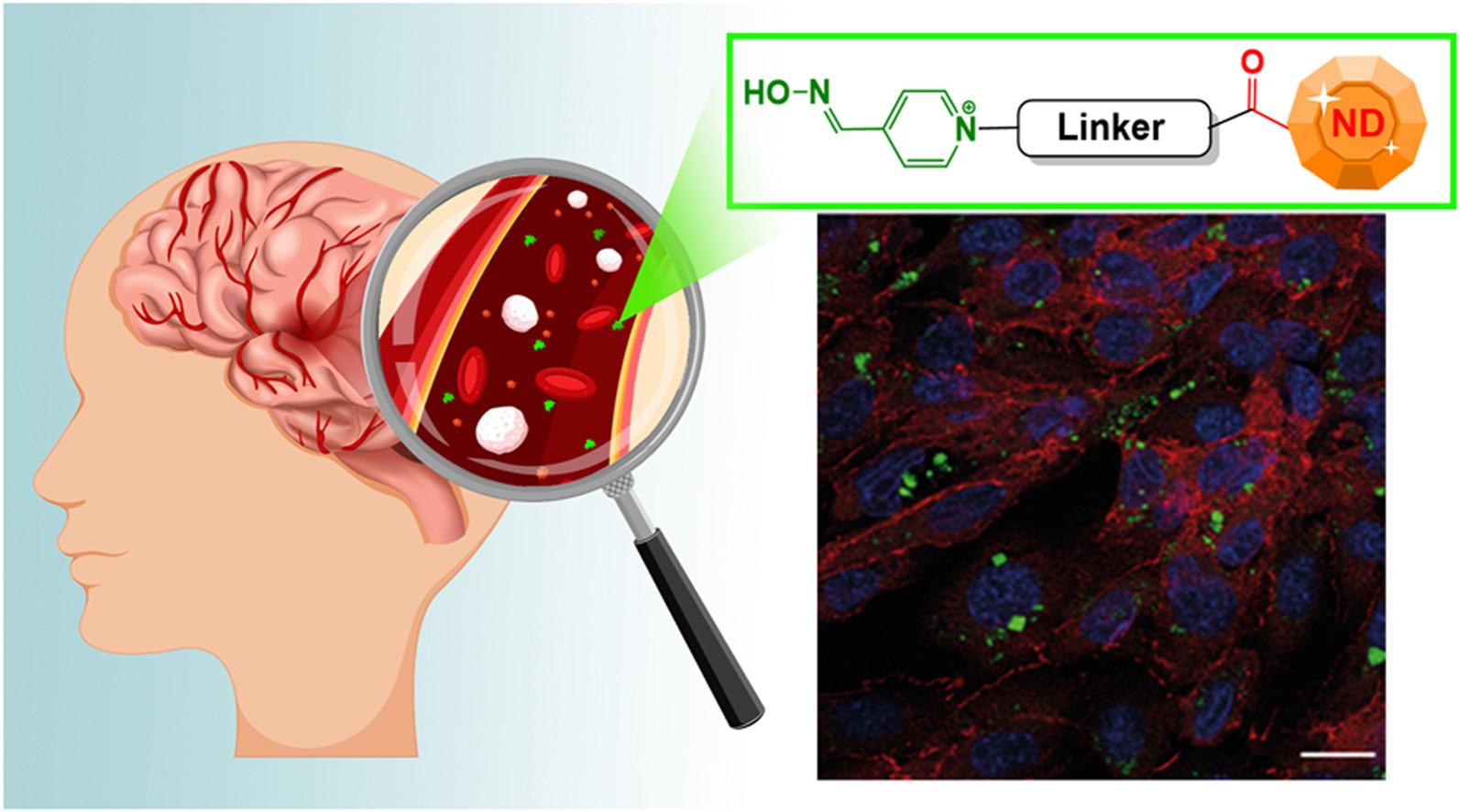
Their value as drug carriers lies not only in their extremely small size but also in their unique properties. Nanodiamonds have a highly stable and chemically robust crystal structure, meaning they do not readily degrade or react with other molecules. At the same time, their surface can be chemically modified to attach a wide range of molecules, including drugs.
A US patent application has also been filed for the technology. "Our study is the first to demonstrate that nanodiamonds can serve as carriers that help antidotes against nerve agents cross the blood-brain barrier. „This is the first stage of our research, and we will continue to develop the nanocarrier platform to improve its performance and expand its potential applications in biomedicine,” said Karpichev. “In the future, the same technology could also be used to deliver other drugs whose passage into the brain is currently limited, for example in the treatment of neurodegenerative diseases or brain tumours.”
The study was published in the prestigious journal Chemico-Biological Interactions