
‘We have four seasons,’ they say. ‘There’s no bad weather, only bad clothing,’ they scold. ‘If you're cold, dress warmer,’ they advise. But what exactly is ‘warm clothing’? During the cold winter months, the Sustainability Months focus on warmth and light, and to find an answer to the question of what to wear when it’s chilly indoors or outside, we measured the heat retention of different clothing materials. And we’ve got some answers!”
Researcher Paul Klõšeiko from the Nearly Zero Energy Buildings research group welcomes us to the Building Physics and Indoor Climate Laboratory at the Ehituse Mäemaja with a thermal camera, temperature sensors, and heat flux sensors. There’s also a room cooled to 20°C in the lab, where we can simulate sitting office work. Together with associate professor and head of the Textile Technology Lab, Tiia Plamus, we’ve brought clothing made from different materials. Senior researcher Andres Udal from the Proactive Technologies Lab at the Institute of Software Science, who recently conducted a related study for the defense industry with Plamus, is also on hand to assist.
I’m here as a hiker and the test subject, and both my and Professor Plamus’s hypothesis is that clothing made from different materials retains—or more accurately, transmits—body heat differently. Klõšeiko’s hypothesis is that what matters most is how thick the material is and how much of the body it covers; in office conditions, the specific materials are of secondary importance.
First, the theory
Paul Klõšeiko explains that heat transfers through materials in three main ways: conduction, or heat flow through fibers and the air between them; convection, or heat movement due to air circulation; and radiation. We measure the combined effect of these for different garments.
Tiia Plamus defines thermal insulation as the garment's ability to retain the wearer's body heat. This depends both on the type of textile fiber and the construction of the fabric. Also crucial is the fact that both the fibers and the air between them contribute to heat flow. “Different fibers have different thermal conductivities—for example, cotton is a very good heat conductor, which is why it’s well-suited for summer clothing. But if cotton is brushed on the inside, it can also retain heat well in winter,” says Plamus, describing one of the most common fibers.
This is because brushed fabrics trap a lot of still air between fibers, and still air has the lowest thermal conductivity. “If we use fine, crimped, and elastic fibers in textile structures, we create closed pores filled with immobile air, which improves the fabric’s thermal insulation,” the professor explains. She adds that fabric thickness and density also influence insulation.
Andres Udal explains that the base principle of thermal insulation—both in clothing and buildings—is to trap air, which has a thermal conductivity of 0.026 W/m*K. That means 52 W/m² for a 1 cm thick layer and a 20°C temperature difference. “All other materials and structures around that air serve to trap it. When it comes to clothing, the air-trapping structure must not add significant thermal conductivity itself, nor should it collapse when damp. That’s what makes natural fibers like sheep’s wool and alpaca superior to most cheap synthetics and even cotton—primarily because cotton lacks sufficient loft.”
With the theory clear, we move to practice.
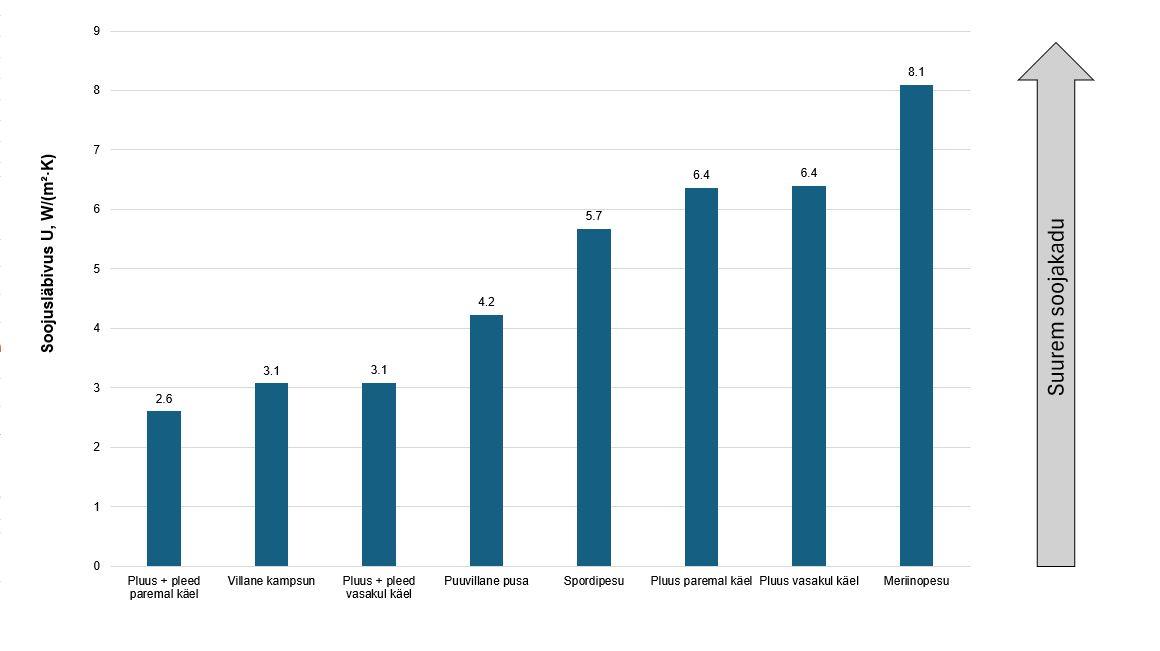
To ensure our test is fair across different materials, we tape temperature and heat flux sensors to both of the test subject’s arms, then simultaneously cover the forearms with garments made of different materials. Klõšeiko converts the results to thermal transmittance, which shows how much heat moves through a one-square-meter surface at a 1°C temperature difference. “Thermal transmittance is also a key metric in evaluating building envelopes, and with some allowances, these test results can be compared to those. For example, a wool sweater in office conditions has similar thermal transmittance to a 100-year-old window or a 25 cm thick wall made of silicate bricks. Modern windows are about 4x and walls 20–30x more effective,” Klõšeiko says after analyzing the data.
Indoors, denser fabric and wool fibers win
In the “cool office” test conditions, I’m the subject, first sitting and shivering in a thin “office blouse”—it really is chilly for office work.
Then, one arm goes into a cotton TalTech sweatshirt, the other into a 100% wool sweater. The comfort level improves, and the sensors show that skin temperature rises by a few degrees on both arms. However, the heat flux from the arm in the cotton sleeve is about one-third higher than from the one in the wool sweater. We can assume that over a longer period, the person wearing the sweatshirt would feel cold and start looking for a warm drink or snack, but our test isn’t that long. The first hypothesis is confirmed: a wool sweater retains heat better than a cotton sweatshirt.
Next, we test the same arms with thinner garments: the left wears a breathable polyester sports shirt, and the right a similarly thin 100% wool hiking shirt. Although the left arm feels cooler, the sensors now show that the sports shirt retains heat better. Klõšeiko points out that the proportion of the thermal transfer components depends on how the garment is constructed—a loosely woven fabric becomes much less insulating when in motion or exposed to wind, due to convection.
Finally, we let the test subject cool down in just the blouse again, then cover each arm with a blanket made of different materials. Here, sensation and sensors agree: if the blanket is just draped over shoulders or arms, cold air seeps in and no warmth is felt. But if wrapped tightly, a dense-fabric blanket warms up quickly, even if it’s not wool. The heat flux sensor shows that a tightly wrapped blanket retains body heat as well as a wool sweater. According to Tiia Plamus, garments that sit close to the body usually provide better thermal comfort than very loose and baggy ones.
Klõšeiko sums up: “In this test, we simulated an office where a person isn’t moving much and there’s hopefully no wind. In different conditions, blankets and sweaters might perform worse than a tightly woven sweatshirt. Luckily, we can combine different clothes, and when going outdoors, it’s wise to add a windproof layer over the sweater.”
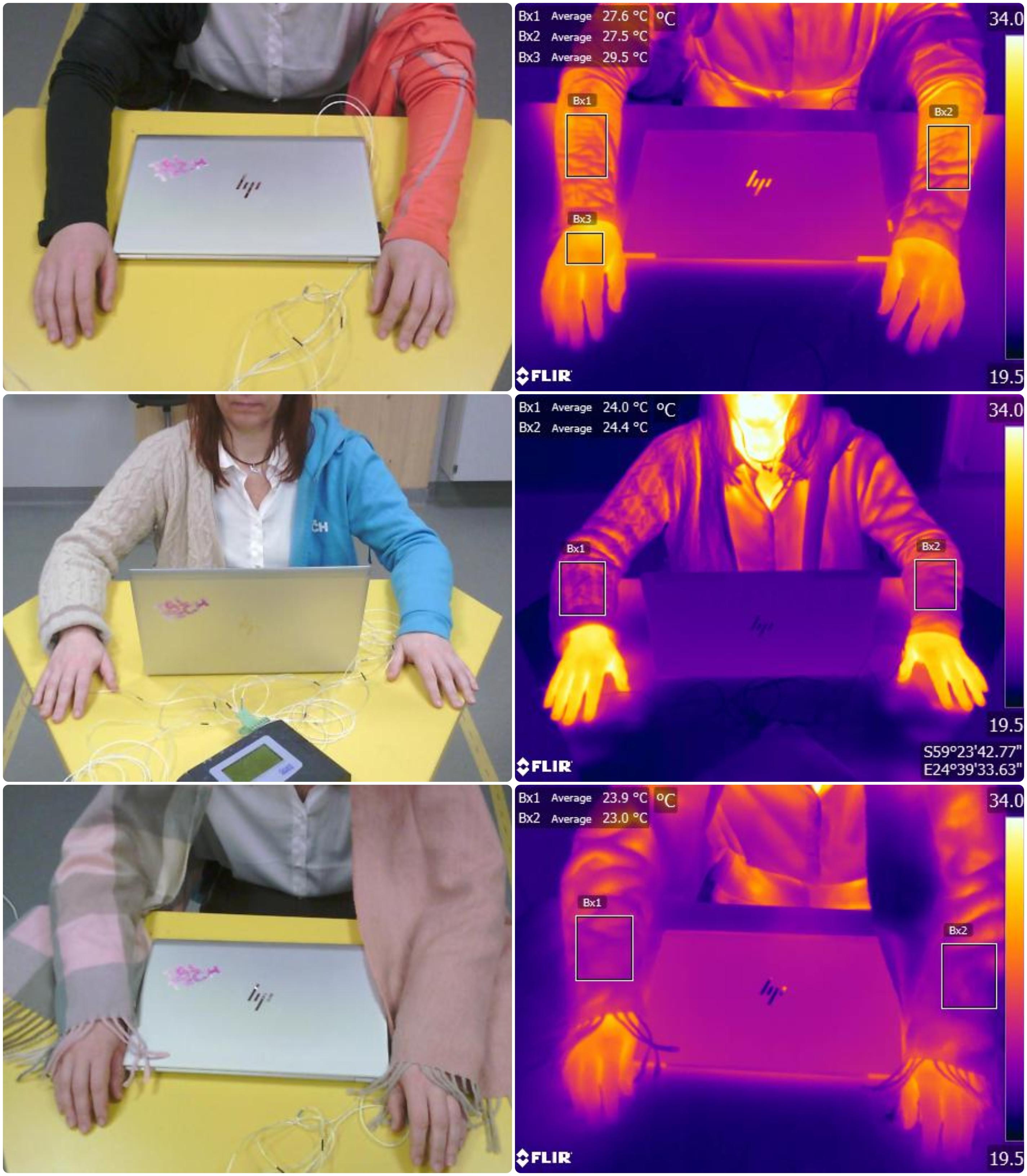
Thermal images confirm the thermal transmittance measurements: the clothing combinations with the lowest thermal transmittance (middle and bottom rows: sweater, sweatshirt, or blanket added over a shirt) show the lowest temperatures. The thicker the air-trapping layer, the less heat is lost. The biggest temperature differences appear when comparing a cotton sweatshirt and a wool sweater (middle row).
“The results don’t represent absolute truth, of course—we measured heat flux on a stationary person in a very localized area (1x1cm), and results are affected by whether a fold of fabric with an air pocket happened to be over the sensor,” Klõšeiko adds an important caveat.
Winter mantra: warmer fibers and still air
Meanwhile, a second test is taking place in -7°C cold, using outerwear. The thermal camera clearly shows that thin gloves hand-knitted by a mother from a wool and alpaca blend keep warmth close to the hand, while cheap acrylic store-bought gloves leak body heat straight into the frost, leaving hands cold.
We’ve all likely heard since childhood in the north that the head is where the most heat escapes. That’s why we also measure the thermal retention of hats. The wool superiority hypothesis is confirmed again: a double-layer cotton hat lets heat escape, while a similarly thick double-layer merino wool hat keeps the warmth close to the head.
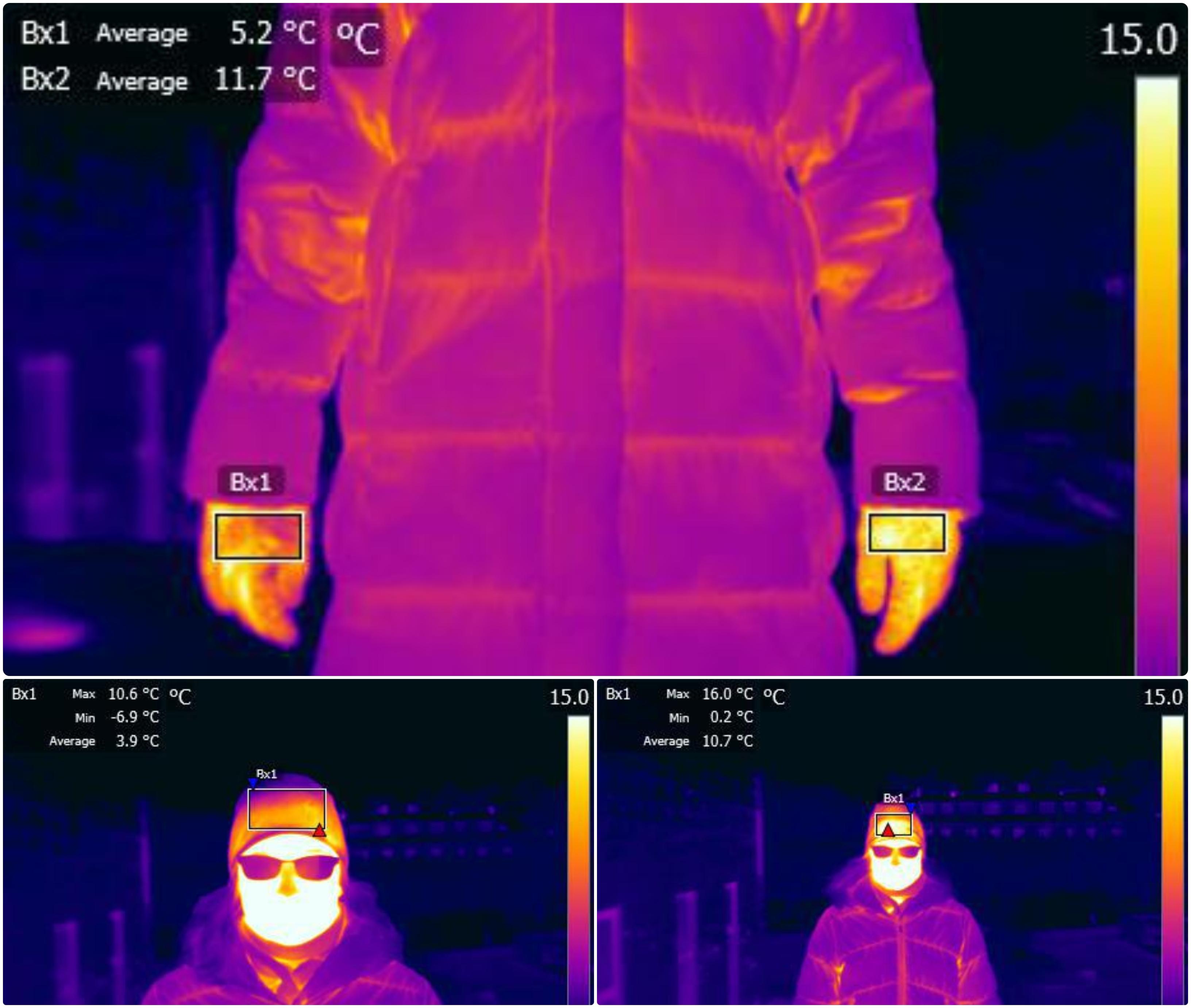
Plamus draws attention to the structure of the materials in both hats. “For garments to retain warmth even in the wind, the air within them must remain still. That’s why a loosely knit merino wool hat might retain less heat than a tightly knit, brushed-on-the-inside cotton hat,” she explains.
Professor Plamus also tests a down coat she bought for this winter’s frost, comparing it to a polyester wadding coat. As a textile technologist, she knows that jackets and coats with down filling are highly insulating primarily because a large amount of still air gathers between the feathers, especially the fine down feathers we’ve mentioned several times already. This is crucial for winter clothing.
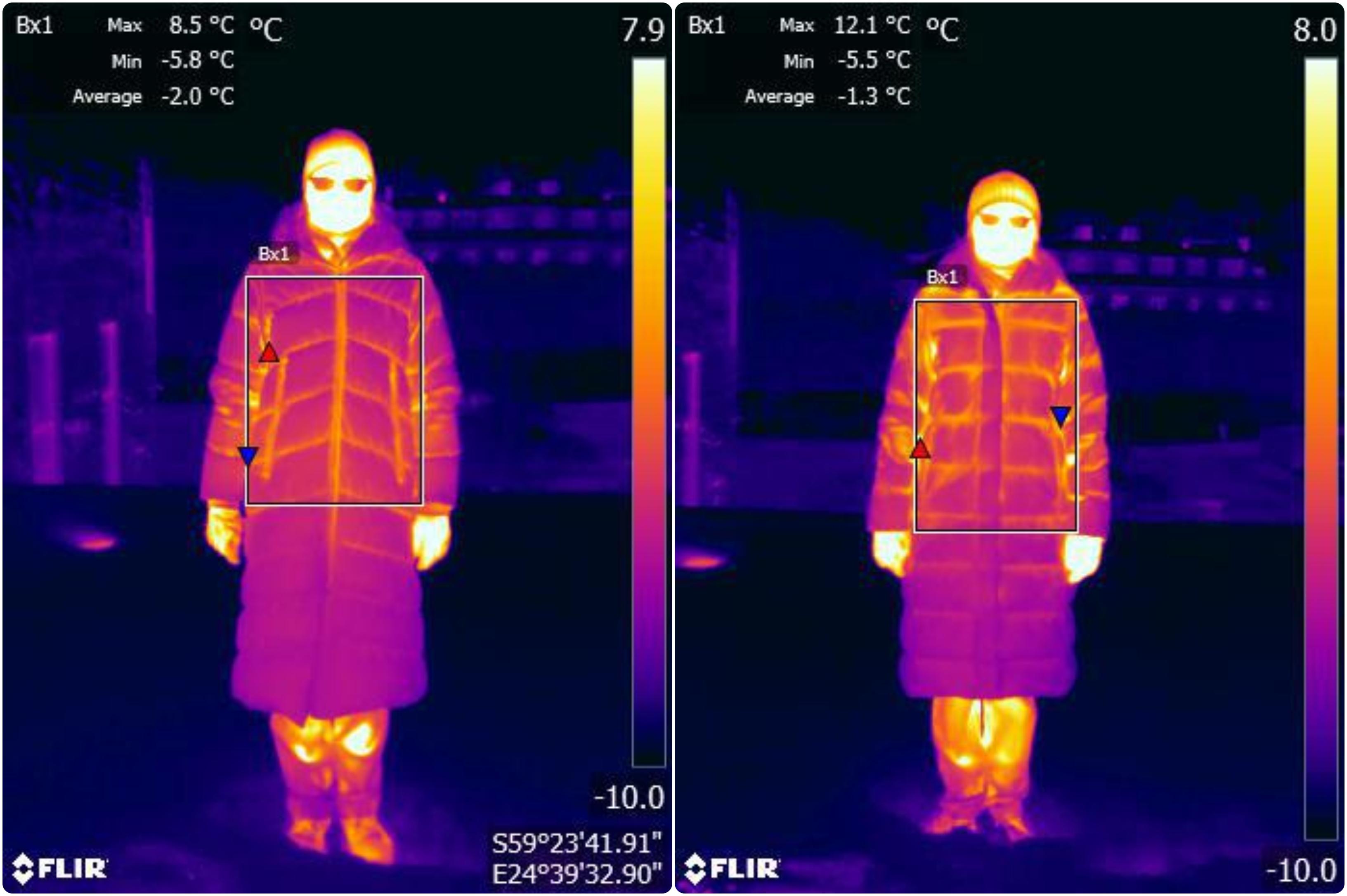
Speaking about outerwear, Andres Udal notes that in construction—especially in sauna insulation—thermal retention can be improved with metallic additives or film layers that block the radiation component of heat transfer. “In construction, we see this in the form of gray-colored silver-foam polystyrene boards. While such foil-like layers are generally absent in regular clothing, they can be very helpful in specialized gear for hikers, workers, or rescue personnel,” Udal explains.
For the final test, I did a few squats and more vigorous movements in the cool lab. While the sensors didn’t register a change in skin temperature, the rise in heart rate quickly brought warmth, improved mood, and sharpened the mind. So, instead of sitting in a cold room, it’s definitely worth considering walk-and-talk or plank meetings, which boost not just warmth but also mood, health, and job satisfaction.
Long story short - what we can recommend:
- Sitting in a cold office wearing just a thin shirt is, indeed, cold. We have four seasons—wear something extra in winter!
- The TalTech cotton sweatshirt is almost as good as a wool sweater of the same thickness, but wool still retains warmth better.
- A blanket keeps you nearly as warm while sitting as a sweatshirt or sweater—but only if you wrap yourself up properly.
- Acrylic and cotton won’t keep you warm outdoors in winter—during cold spells, pay attention to the materials of your gloves, scarves, and hats!
- The more still air between clothing layers, the better the insulation. The warmest thing of all is a down coat.
- Movement warms you up—and also makes life better!
In the Building Physics and Indoor Climate Laboratory at the Ehituse Mäemaja:
We measure and model the thermal and moisture performance and durability of building materials and envelope structures. We also assess the performance of heating, ventilation, and cooling systems, as well as their impact on indoor climate and human thermal comfort.
In the Textile Technology Laboratory:
We develop various textile materials and test their properties. Our main focus is on creating materials from recycled textile fibers, but we also examine the properties of different commercially available materials.
In our laboratories, it is possible to develop various garments and textile products. First, we select the most suitable materials, then prepare technical drawings, construct the patterns, and finally produce prototypes of the garments and textile items.